 Join Our WhatsApp Channel for Updates!
Expanding Social Horizons: Socioemotional Development in Middle Childhood
| Institution | Keiser University |
| Course | Pschology |
| Year | 4th Year |
| Semester | Unknown |
| Posted By | Faith Kagwi |
| File Type | |
| Pages | 34 Pages |
| File Size | 174.87 KB |
| Views | 2590 |
| Downloads | 0 |
| Price: |
Buy Now
 Buy via
whatsapp Buy via
whatsapp
|


Description
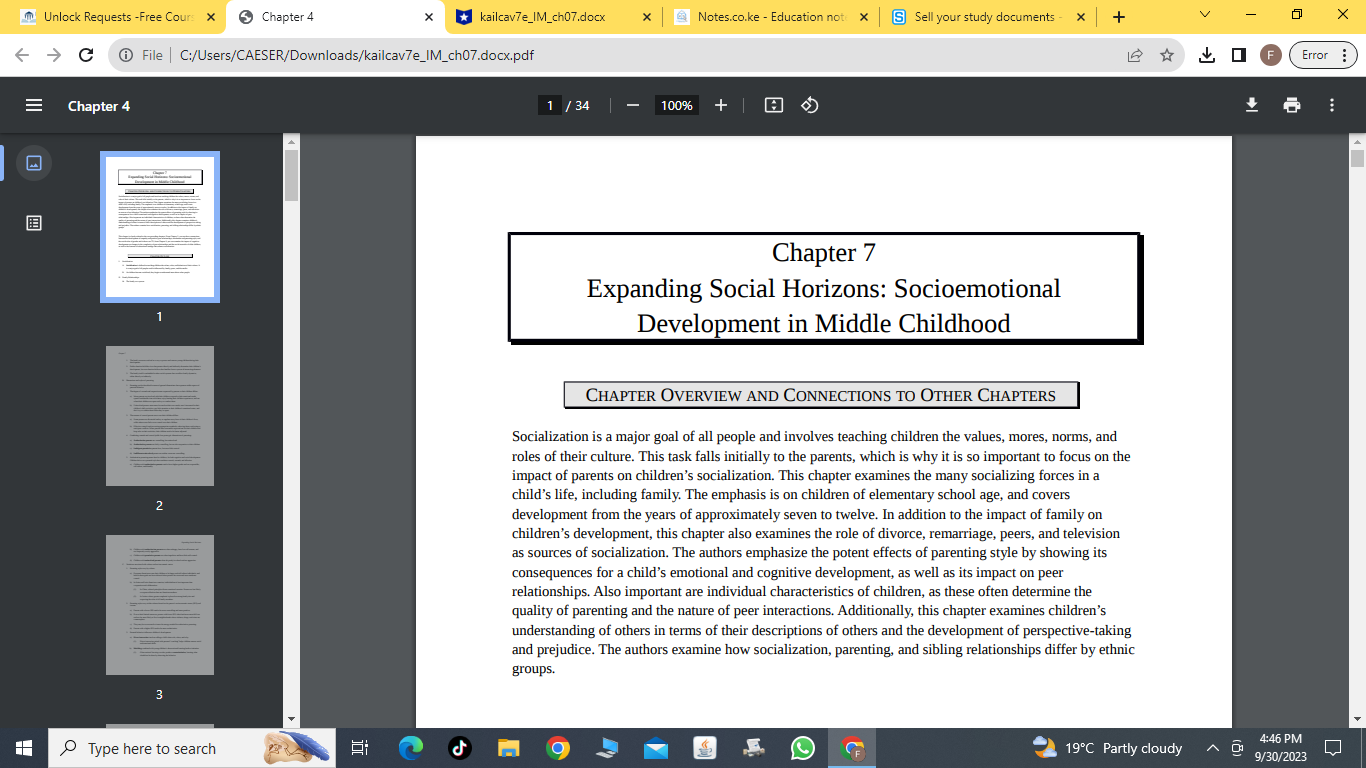
CHAPTER OVERVIEW AND CONNECTIONS TO OTHER CHAPTERS
Socialization is a major goal of all people and involves teaching children the values, mores, norms, and
roles of their culture. This task falls initially to the parents, which is why it is so important to focus on the
impact of parents on children’s socialization. This chapter examines the many socializing forces in a
child’s life, including family. The emphasis is on children of elementary school age, and covers
development from the years of approximately seven to twelve. In addition to the impact of family on
children’s development, this chapter also examines the role of divorce, remarriage, peers, and television
as sources of socialization. The authors emphasize the potent effects of parenting style by showing its
consequences for a child’s emotional and cognitive development, as well as its impact on peer
relationships. Also important are individual characteristics of children, as these often determine the
quality of parenting and the nature of peer interactions. Additionally, this chapter examines children’s
understanding of others in terms of their descriptions of others and the development of perspective-taking
and prejudice. The authors examine how socialization, parenting, and sibling relationships differ by ethnic
groups.
This chapter is closely related to the two preceding chapters. From Chapter 5, you can draw connections
between the development of empathy and positive peer relationships, attachment and parenting style, and
the social roles of gender and violence on TV; from Chapter 6, you can examine the impact of cognitive
development on changes in the complexity of peer relationships and the social networks of older children,
as well as the features of educational settings that enhance socialization.
Below is the document preview.

SMA 2104: Mathematics for Sciences - Lesson 4 Factorisable polynomials
Trending!
Upon completing this topic, you should be able to factorise and solve polynomials of degree higher than 2
No pages found
5020 Views
0 Downloads
277.4 KB
SMA 2104: Mathematics for Sciences - Lesson 5 Permutations and Combination
Trending!
Permutations and Combination
Permutations - This is defined as the number of different ways of arranging different objects in order.
No pages found
4356 Views
0 Downloads
273.38 KB
SMA 2104: Mathematics for Sciences - Lesson 6 Binomial expansion
Trending!
Upon completing this topic you should be able to understand the binomial theorem and it’s application in the expansion of expressions and in approximations.
No pages found
4533 Views
0 Downloads
282.79 KB
SMA 2104: Mathematics for Sciences - Lesson 7 Probability
Trending!
Upon completing this topic,you should be able to;- Apply the principles of probability to solve problems in real-world contexts. Understand and use the language of probability and to compute the probabilities of composite events using the basic rules of probability.
No pages found
4919 Views
0 Downloads
395.57 KB
SBC100: STRUCTURE OF BIOMOLECULES
Trending!
They are well descritive
30 Pages
6093 Views
0 Downloads
2.65 MB
SMA 2104: Mathematics for Sciences - Lesson 8 Statistics
Trending!
Upon completing this topic,you should be able to Collect, organize, and represent data, and be able to recognize and describe relationships. Apply the principles of statistics to solve problems in real world contexts. Demonstrate knowledge of statistical terms. Differentiate between the two branches of statistics. Identify types of data. Understand and use the basic measure of central tendency
No pages found
4395 Views
0 Downloads
282.84 KB
SMA 2104: Mathematics for Sciences - Lesson 9 TRIGONOMETRY
Trending!
Upon completing this topic, you should be able to Define, manipulate and apply trigonometric functions. Define the basic trigonometric ratios, sine, cosine and tangent of an angle and derive the other trigonometric ratios; cosecant, secant and cotangent using the basic trigonometric ratios. Derive identities involving the trigonometric ratios
11 Pages
6212 Views
0 Downloads
635.34 KB
SMA 2104: Quadratic Equations Practice Problems
Trending!
Quadratic Equations Practice Problems, Solving Quadratic Equations When the Product of Two Numbers is Zero
12 Pages
5300 Views
0 Downloads
602.99 KB
SMA 2104: Factorisation Practice Questions
Get a copy Factorisation Practice Questions, this is suitable for your revision
2 Pages
440 Views
0 Downloads
38.59 KB
SMA 2104: Factorisation Practice Questions Answers
Trending!
Factorisation Practice Questions Answers
2 Pages
5450 Views
0 Downloads
38.59 KB