 Join Our WhatsApp Channel for Updates!
Expanding Social Horizons: Socioemotional Development in Middle Childhood
| Institution | Keiser University |
| Course | Pschology |
| Year | 4th Year |
| Semester | Unknown |
| Posted By | Faith Kagwi |
| File Type | |
| Pages | 34 Pages |
| File Size | 174.87 KB |
| Views | 2593 |
| Downloads | 0 |
| Price: |
Buy Now
 Buy via
whatsapp Buy via
whatsapp
|


Description
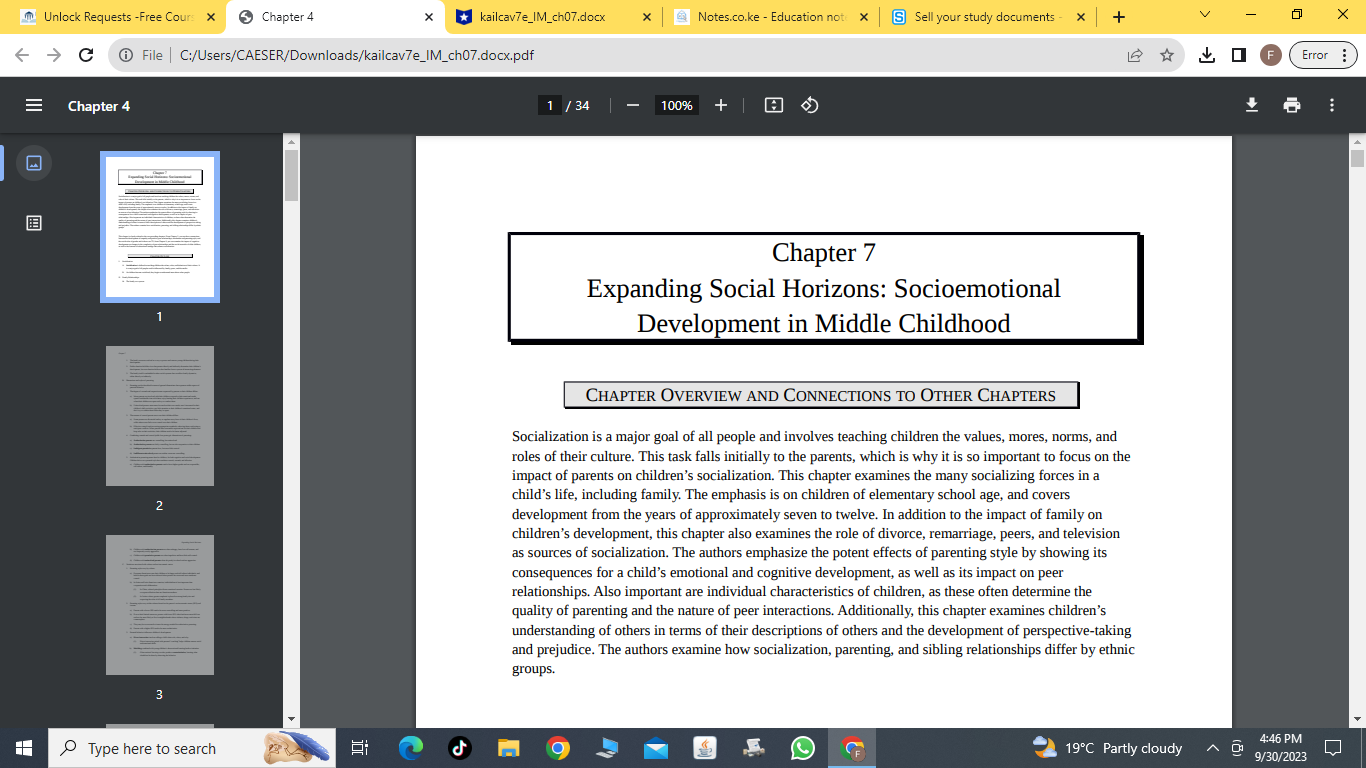
CHAPTER OVERVIEW AND CONNECTIONS TO OTHER CHAPTERS
Socialization is a major goal of all people and involves teaching children the values, mores, norms, and
roles of their culture. This task falls initially to the parents, which is why it is so important to focus on the
impact of parents on children’s socialization. This chapter examines the many socializing forces in a
child’s life, including family. The emphasis is on children of elementary school age, and covers
development from the years of approximately seven to twelve. In addition to the impact of family on
children’s development, this chapter also examines the role of divorce, remarriage, peers, and television
as sources of socialization. The authors emphasize the potent effects of parenting style by showing its
consequences for a child’s emotional and cognitive development, as well as its impact on peer
relationships. Also important are individual characteristics of children, as these often determine the
quality of parenting and the nature of peer interactions. Additionally, this chapter examines children’s
understanding of others in terms of their descriptions of others and the development of perspective-taking
and prejudice. The authors examine how socialization, parenting, and sibling relationships differ by ethnic
groups.
This chapter is closely related to the two preceding chapters. From Chapter 5, you can draw connections
between the development of empathy and positive peer relationships, attachment and parenting style, and
the social roles of gender and violence on TV; from Chapter 6, you can examine the impact of cognitive
development on changes in the complexity of peer relationships and the social networks of older children,
as well as the features of educational settings that enhance socialization.
Below is the document preview.

SZL 2111: HIV/AIDs - Lesson 6
Trending!
General introduction: Public health and hygiene, human reproductive system, sex and sexuality. History of sexually transmitted diseases (STDs); History of Human Immunodeficiency virus/Acquired Immune de
ciency Syndrome (HIV/AIDS), Compara-
tive information on trends, global and local distribution, Justification of importance of course. Biology of HIV/AIDS; Overview of immune system, natural immunity to HIV/AIDS. The AIDS virus and its life cycle, disease progression, transmission and
diagnosis.
48 Pages
5120 Views
0 Downloads
401.01 KB
SZL 2111: HIV/AIDs - Lesson 7
Trending!
General introduction: Public health and hygiene, human reproductive system, sex and sexuality. History of sexually transmitted diseases (STDs); History of Human Immunodeficiency virus/Acquired Immune deficiency Syndrome (HIV/AIDS), Comparative information on trends, global and local distribution, Justification of importance of course. Biology of HIV/AIDS; Overview of immune system, natural immunity to HIV/AIDS. The AIDS virus and its life cycle, disease progression, transmission and diagnosis.
42 Pages
5014 Views
0 Downloads
2.19 MB
SZL 2111: HIV/AIDs - Lesson 8
Trending!
General introduction: Public health and hygiene, human reproductive system, sex and sexuality. History of sexually transmitted diseases (STDs); History of Human Immunodeficiency virus/Acquired Immune deficiency Syndrome (HIV/AIDS), Comparative information on trends, global and local distribution, Justification of importance of course. Biology of HIV/AIDS; Overview of immune system, natural immunity to HIV/AIDS. The AIDS virus and its life cycle, disease progression, transmission and diagnosis. Discordant couples.
20 Pages
4190 Views
0 Downloads
286.61 KB
SZL 2111: HIV/AIDs -Lesson 9
Trending!
General introduction: Public health and hygiene, human reproductive system, sex and sexuality. History of sexually transmitted diseases (STDs); History of Human Immunodeficiency virus/Acquired Immune deficiency Syndrome (HIV/AIDS), Comparative information on trends, global and local distribution, Justification of importance of course. Biology of HIV/AIDS; Overview
of immune system, natural immunity to HIV/AIDS. The AIDS
virus and its life cycle, disease progression, transmission and
diagnosis.
44 Pages
4205 Views
0 Downloads
369.34 KB
SZL 2111: HIV/AIDs - Lesson 10
Trending!
General introduction: Public health and hygiene, human reproductive system, sex and sexuality. History of sexually transmitted diseases (STDs); History of Human Immunodeficiency virus/Acquired Immune deficiency Syndrome (HIV/AIDS), Compara-
tive information on trends, global and local distribution, Justification of importance of course.
38 Pages
4864 Views
0 Downloads
339.57 KB
SMA 2104: Mathematics for Sciences - Course Outline
Trending!
This unit aims at providing a good foundation in mathematics for students who plans to do more specialized work in the university, especially in the Computing, Medicine, Engineering, etc.
3 Pages
4668 Views
0 Downloads
266.54 KB
SMA 2104: Mathematics for Sciences - Lesson 1 Quadratic equations
Trending!
Upon completing this topic, you should be able to: Solve quadratic equations by factoring Learning outcomes Solve quadratic equations using the method of extraction of roots Determine the nature of the solutions to a quadratic equation Understand the logic underlying the method of completing Solve a quadratic equation using the method of completing
No pages found
5946 Views
0 Downloads
367.62 KB
SMA 2104 - MATHEMATICS FOR SCIENCE - Lesson 1B
Trending!
By the end of this topic you should be able to; Understand the laws of indices and their application in Learning outcomes simplifying algebraic expressions. Define index, Establish the laws of indices, Solve simple problems using the laws of indices, Understand the theory of logarithms and surds and their applications in manipulating expressions.
No pages found
4888 Views
0 Downloads
344.76 KB
SMA 2104: Mathematics for Sciences - Lesson 2 Algebra
Trending!
By the end of this topic you should be able to; Understand the laws of indices and their application in simplifying algebraic expressions. Define index, Establish the laws of indices, Solve simple problems using the laws of indices. Understand the theory of logarithms and surds and their applications in manipulating expressions. Define logarithm
No pages found
5549 Views
0 Downloads
344.76 KB
SMA 2104: Mathematics for Sciences - Lesson 3 Sequences and series
Trending!
Upon completing this topic, you should be able to:
Differentiate between a series and a sequence, Use Sigma notation in representing a series, Understand the properties of arithmetic and geometric progressions, Define an Arithmetic progression (A.P.), Obtain the formula for nth term and the first n terms of an A.P, Define a geometric progression (G.P.)
No pages found
4953 Views
0 Downloads
325.42 KB