 Join Our WhatsApp Channel for Updates!
Expanding Social Horizons: Socioemotional Development in Middle Childhood
| Institution | Keiser University |
| Course | Pschology |
| Year | 4th Year |
| Semester | Unknown |
| Posted By | Faith Kagwi |
| File Type | |
| Pages | 34 Pages |
| File Size | 174.87 KB |
| Views | 2555 |
| Downloads | 0 |
| Price: |
Buy Now
 Buy via
whatsapp Buy via
whatsapp
|


Description
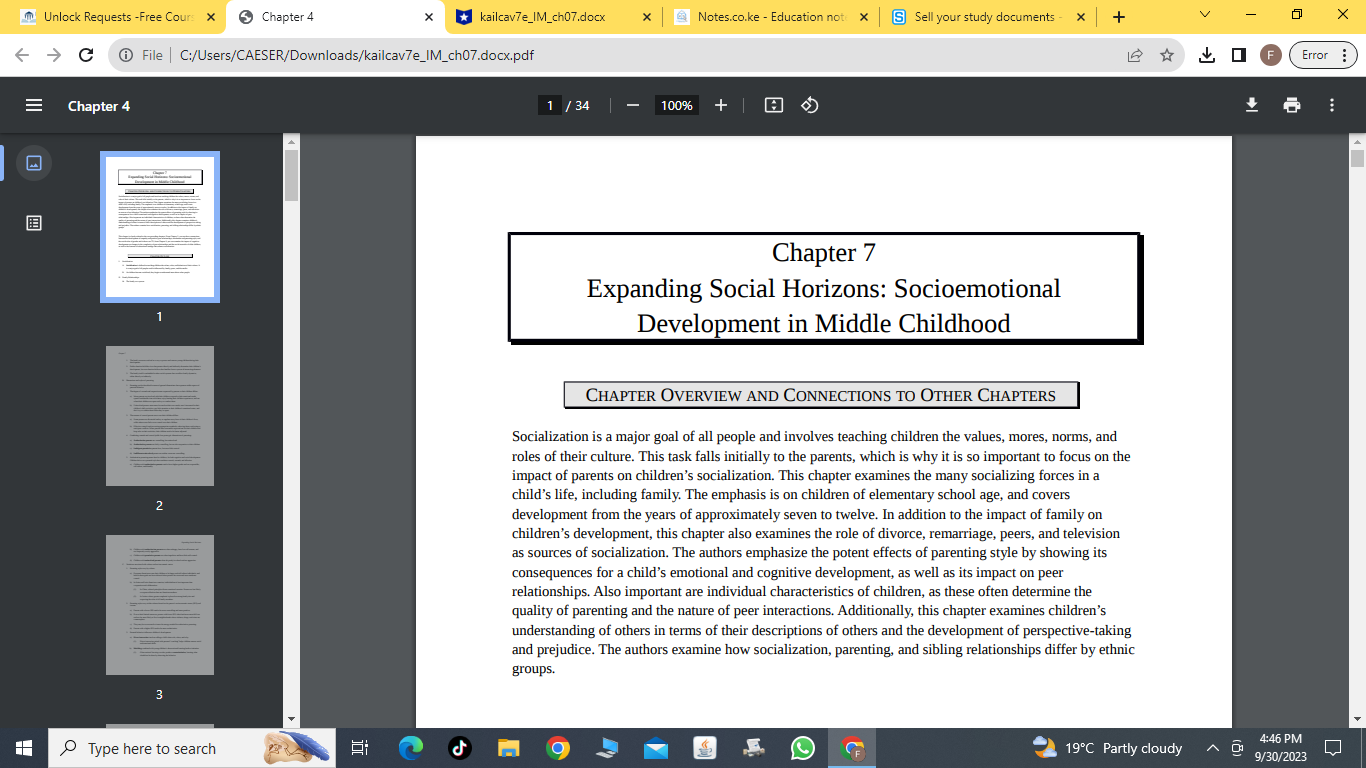
CHAPTER OVERVIEW AND CONNECTIONS TO OTHER CHAPTERS
Socialization is a major goal of all people and involves teaching children the values, mores, norms, and
roles of their culture. This task falls initially to the parents, which is why it is so important to focus on the
impact of parents on children’s socialization. This chapter examines the many socializing forces in a
child’s life, including family. The emphasis is on children of elementary school age, and covers
development from the years of approximately seven to twelve. In addition to the impact of family on
children’s development, this chapter also examines the role of divorce, remarriage, peers, and television
as sources of socialization. The authors emphasize the potent effects of parenting style by showing its
consequences for a child’s emotional and cognitive development, as well as its impact on peer
relationships. Also important are individual characteristics of children, as these often determine the
quality of parenting and the nature of peer interactions. Additionally, this chapter examines children’s
understanding of others in terms of their descriptions of others and the development of perspective-taking
and prejudice. The authors examine how socialization, parenting, and sibling relationships differ by ethnic
groups.
This chapter is closely related to the two preceding chapters. From Chapter 5, you can draw connections
between the development of empathy and positive peer relationships, attachment and parenting style, and
the social roles of gender and violence on TV; from Chapter 6, you can examine the impact of cognitive
development on changes in the complexity of peer relationships and the social networks of older children,
as well as the features of educational settings that enhance socialization.
Below is the document preview.

EEE 2202: ANALOGUE ELECTRONICS I
Trending!
Electronics is the study of conduction current in solids, gases, vacuum and liquids.
It is a branch of engineering that comes from the 2 words Electrons - negatively charged particle in an atom, Mechanics - Study of motion of an electron. Electronics is also study of electrons and how they can be used to perform different functions.
The ability to control movement of electrons or electron flow is the basic of electronics it specializes in digital computers, audio systems, communication systems, and automatic control.
99 Pages
4879 Views
0 Downloads
1.43 MB
HBC 2101: Introduction to Accounting I - Course Outline
Trending!
Introduce students to financial accounting for processing and communicating of financial information to support economic decision making. This particularly focuses on procedures of book keeping and preparation of the financial statements for a simple business.
1 Pages
4620 Views
0 Downloads
51.57 KB
HBC 2101: Introduction to Accounting I - ERRORS ON ACCOUNTS
Trending!
The trial balance produced from the accounts appears to be correct, i.e the debits
are the same as the credits. However, on taking a close check on the balances and
transactions posted, errors may have been made and therefore the balances shown on
the trial balance may be incorrect i.e. under or over stated.
16 Pages
4260 Views
0 Downloads
331.19 KB
HBC 2101: Introduction to Accounting I
Accounting is defined as a process of Recording Classifying Summarizing Interpreting the financial transactions and Communicating the result thereof to the persons interested in such information for decision making purposes
48 Pages
421 Views
0 Downloads
1.25 MB
HBC 2101: Nature, purpose and scope of accounting
Trending!
Accounting may be defined as the process of collecting, recording, summarizing and
communicating financial information. Accounting is nothing but a means of
communicating the results of business operations to varies parties interested in or
connected with the business, viz., the owner, creditors, investors, government, financial institutions and other agencies. Accounting is, therefore, rightly called as the language of business. The basis purpose of a language is to serve as a means of communication. Accounting also serve this purpose. Accounting is not only associated with business but also with every body who is interested in keeping an account for the money received and money spent.
10 Pages
4108 Views
0 Downloads
110.52 KB
HBC 2101: Purchases Ledger Control Account.
Trending!
Purchases Ledger Control Account is a summary account which checks the arithmetical accuracy of the Purchases Ledger. It enables us to see at a glance whether the general ledger balance for the purchase’s ledger agrees with the total of all the individual trade payable accounts held within the purchase’s ledger.
3 Pages
4097 Views
0 Downloads
84.66 KB
HBC 2101: CONTROL ACCOUNTS
Trending!
Control accounts are so called because they control a section of the ledgers. By control
we mean that the total on the control accounts should be the same as the totals on the
ledger accounts. There are two main types of control accounts:
11 Pages
4491 Views
0 Downloads
253.08 KB
HBC 2101: ACCOUNTING FOR TRANSACTIONS
Trending!
HBC 2101 Introduction to Accounting I - ACCOUNTING FOR TRANSACTIONS
50 Pages
4404 Views
0 Downloads
2.11 MB
HBC 2101: BANK RECONCILIATION STATMENTS
Trending!
The cashbook for cash at bank records all the transactions taking place at the bank i.e. the movements of the account held with the bank. The bank will send information
relating to this account using a bank statement for the firm to compare. Ideally, the records as per the bank and the cashbook should be the same and therefore the balance carried down in the cashbook should be the same as the balance carried down by the bank in the bank statement.
11 Pages
4712 Views
0 Downloads
134.71 KB
HBC 2101: Accounting principles and concepts
Trending!
Qualities of Useful Financial Information. The four principal qualities of useful financial information are understandability, relevance, reliability and comparability.
45 Pages
4329 Views
0 Downloads
1.04 MB