HISTORICAL BACKGROUND OF KENYA'S LEGAL SYSTEM
| Institution | UNIVERSITY |
| Course | BACHELOR OF SOCIAL W... |
| Year | 1st Year |
| Semester | Unknown |
| Posted By | stephen oyake rabilo |
| File Type | |
| Pages | 45 Pages |
| File Size | 252.76 KB |
| Views | 8093 |
| Downloads | 0 |
| Price: |
Buy Now
 Buy via
whatsapp Buy via
whatsapp
|


Description
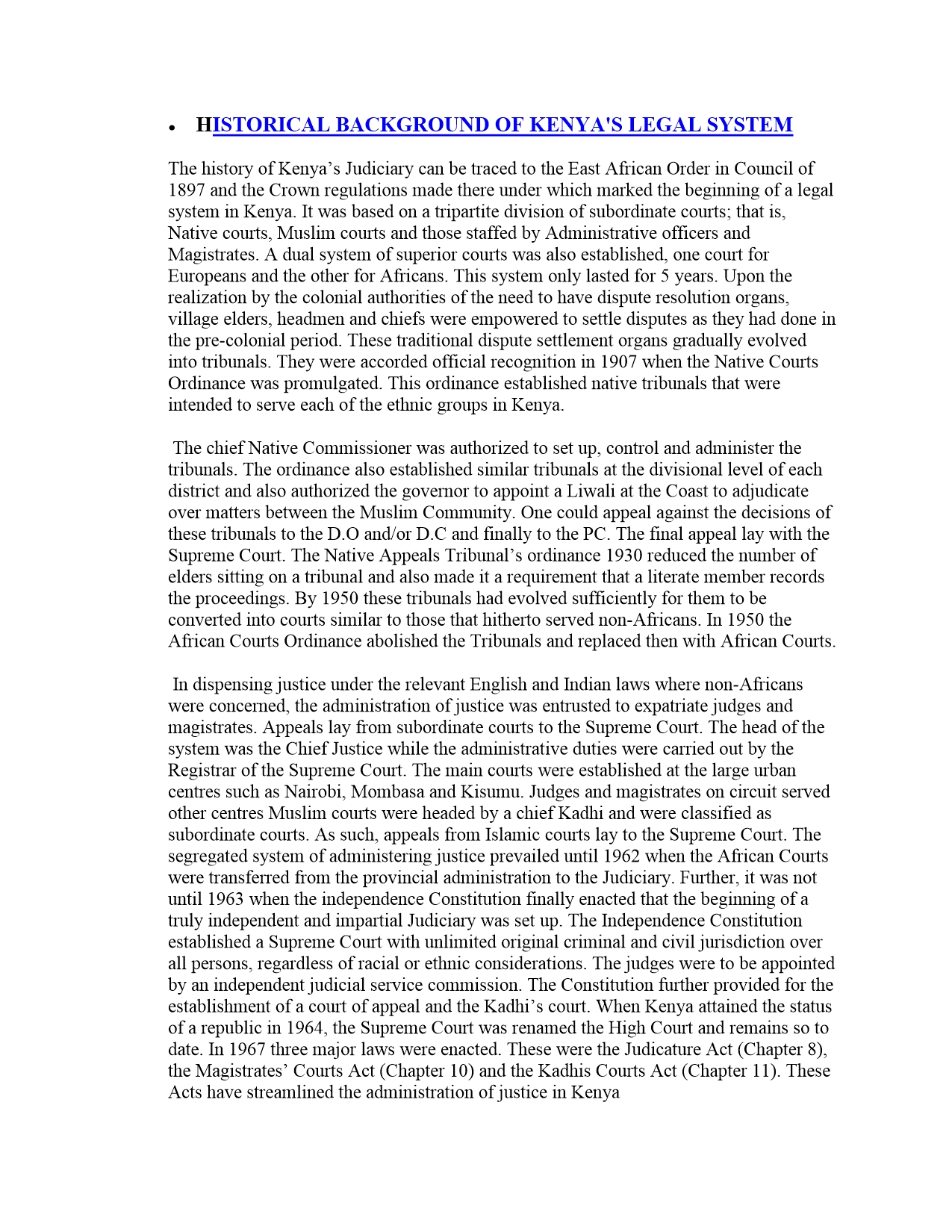
The history of Kenya’s Judiciary can be traced to the East African Order in Council of 1897 and the Crown regulations made there under which marked the beginning of a legal system in Kenya. It was based on a tripartite division of subordinate courts; that is,
Native courts, Muslim courts and those staffed by Administrative officers and Magistrates. A dual system of superior courts was also established, one court for Europeans and the other for Africans. This system only lasted for 5 years. Upon the realization by the colonial authorities of the need to have dispute resolution organs, village elders, headmen and chiefs were empowered to settle disputes as they had done in the pre-colonial period.
Below is the document preview.

Elegant business card template
Trending!
Photoshop psd elegant business card template free
13373 Views
0 Downloads
2.62 MB
Awesome insiring web design template
Trending!
Free awesome responsive bootstrap web design template
8462 Views
0 Downloads
2.8 MB
BIOCHEMISTRY
Polyurethanes are prepared from diisocyanates
and diols. Urethane (also called a carbamate) is a
functional group that contains both an ester and an
amide at a single carbonyl group.
Nucleophilic Addition Reaction: Example 1:
Sevin is a highly effective, biodegradable insecticide. It
affects the nervous systems of insects by blocking
access to the neurotransmitter acetylcholine.
57 Pages
1466 Views
0 Downloads
1.68 MB
BIOCHEMISTRY
PETROLEUM CHEMISTRY
Carbon is so Important in the Life Cycle. It has
numerous ways of bonding with many other
elements, particularly oxygen and hydrogen.
It can form both “organic” and “inorganic”
compounds. Organic compounds are considered
unstable in the biosphere because they are in the
reduced state.
Whereas Inorganic compounds, principally
calcite (CaCO3
) and dolomite (CaMg(CO3
)2
), are
stable because they are in the oxidized state.
Carbon is present in most substances that are
vital for the development of life (called
“biomolecules”): Proteins, lipids, sacharides, etc
76 Pages
1450 Views
0 Downloads
1.86 MB
BIOCHEMISTRY
Alkyl halides are organic molecules containing a halogen
atom bonded to an sp3 hybridized carbon atom.
• Alkyl halides are classified as primary (1°), secondary (2°),
or tertiary (3°), depending on the number of carbons bonded
to the carbon with the halogen atom.
• The halogen atom in halides is often denoted by the symbol
“X”.
53 Pages
1539 Views
0 Downloads
2.07 MB
BIOCHEMISTRY
Natural Gas
Natural gas is a gaseous fossil fuel consisting
primarily of methane but including significant
quantities of ethane, butane, propane, carbon
dioxide, nitrogen, helium and hydrogen sulfide.
Obtained from oil fields and natural gas fields,
and in coal beds.
Methane-rich gases are produced by the
anaerobic decay of non-fossil organic material, ie
biogas.
Total world production of natural gas in 1986
was 100 trillion m3
.
It is used as feed stock as well as fuel. It is
preferred due to its high Calorific Value
52 Pages
1435 Views
0 Downloads
1.17 MB
Calculus 1 First Year
Trending!
Excelling in Calculus is the key
81 Pages
9858 Views
3 Downloads
841.91 KB
EPSC122: DEVELOPMENTAL PSYCHOLOGY
Trending!
Development refers to qualitative changes in behavioural characteristics of the individual leading towards maturity. Development can be inferred from the differentiation and emerging capabilities (functioning) of the individual e.g. cognitive, social, and moral, personality and motor abilities.
10431 Views
0 Downloads
331.5 KB
PHYS 121: GEOMETRICAL OPTICS
Trending!
The course will introduce you to
electromagnetic radiation, as light, mainly visible, which undergoes the
phenomena of reflection and refraction, which are applied to optical elements,
namely mirrors and lenses.
95 Pages
8790 Views
1 Downloads
977.28 KB