The SN2 reaction
| Institution | UNIVERSITY |
| Course | BACHELOR OF SCIENCE... |
| Year | 4th Year |
| Semester | Unknown |
| Posted By | stephen oyake rabilo |
| File Type | |
| Pages | 13 Pages |
| File Size | 190.14 KB |
| Views | 5366 |
| Downloads | 0 |
| Price: |
Buy Now
 Buy via
whatsapp Buy via
whatsapp
|


Description
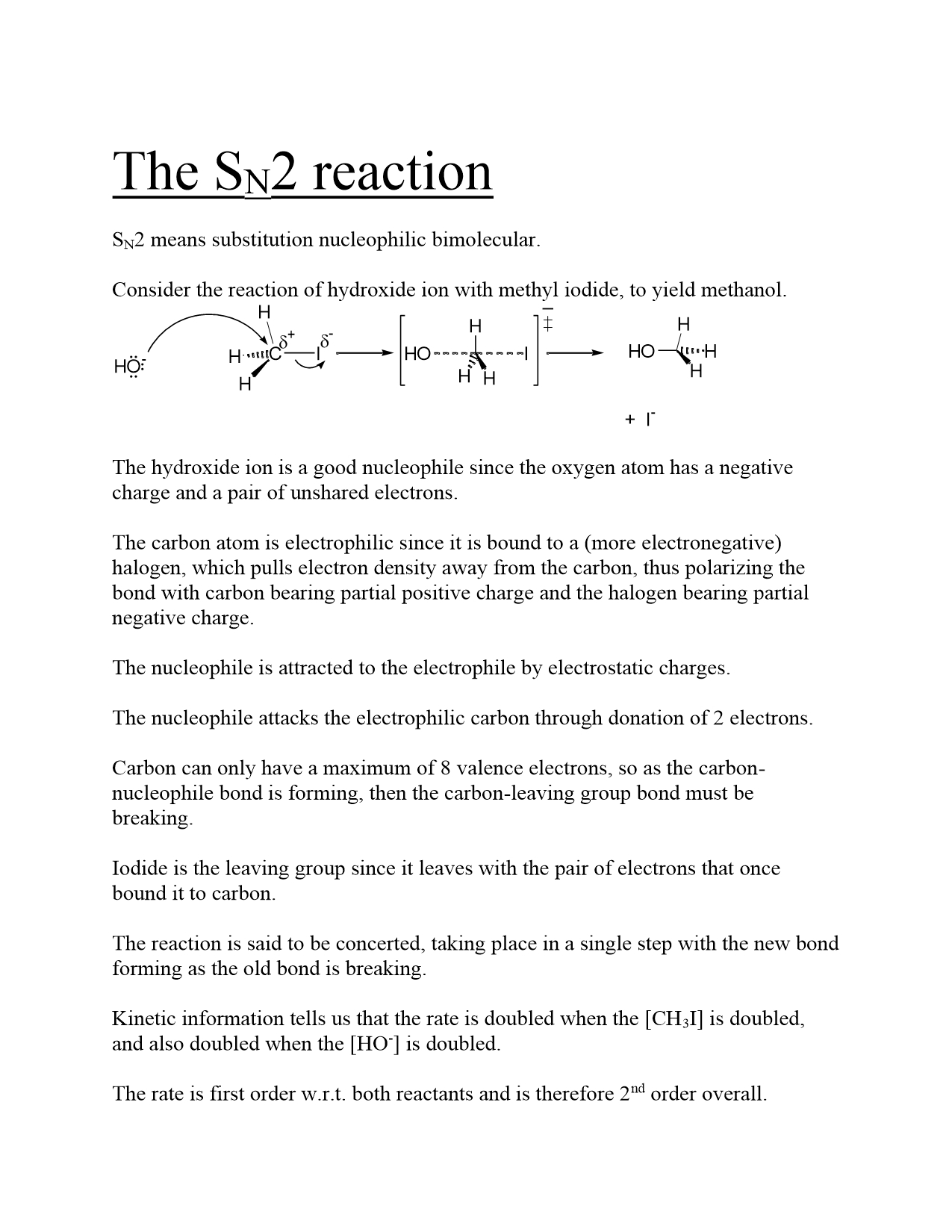
The hydroxide ion is a good nucleophile since the oxygen atom has a negative charge and a pair of unshared electrons.
The carbon atom is electrophilic since it is bound to a (more electronegative)
halogen, which pulls electron density away from the carbon, thus polarizing the
bond with carbon bearing partial positive charge and the halogen bearing partial negative charge.
The nucleophile is attracted to the electrophile by electrostatic charges.
The nucleophile attacks the electrophilic carbon through donation of 2 electrons. Carbon can only have a maximum of 8 valence electrons, so as the carbon nucleophile bond is forming, then the carbon-leaving group bond must be breaking. Iodide is the leaving group since it leaves with the pair of electrons that once bound it to carbon.
Below is the document preview.

EPSC122: DEVELOPMENTAL PSYCHOLOGY
Trending!
Development refers to qualitative changes in behavioural characteristics of the individual leading towards maturity. Development can be inferred from the differentiation and emerging capabilities (functioning) of the individual e.g. cognitive, social, and moral, personality and motor abilities.
9406 Views
0 Downloads
331.5 KB
PHYS 121: GEOMETRICAL OPTICS
Trending!
The course will introduce you to
electromagnetic radiation, as light, mainly visible, which undergoes the
phenomena of reflection and refraction, which are applied to optical elements,
namely mirrors and lenses.
95 Pages
7344 Views
1 Downloads
977.28 KB
BIOCHEMISTRY
Human physiology
Definition
physiology explains physical and
chemical factors that are
responsible for the origin,
development, and progression of
( .life ,(each type of life
18 Pages
1333 Views
0 Downloads
1.07 MB
BIOCHEMISTRY
SBT1102 – BIOCHEMISTRY
UNIT 1 CARBOHYDRATES
Introduction. Classification, Properties and Biological importance. Isomers, epimers,
enantiomers,mutarotation, open chain and closed chain structures of glucose.
UNIT 2 AMINOACIDS AND PROTEINS
Aminoacids: classification- essential and non-essential amino acids, protein and nonprotein amino acids, Zwitter ions. Proteins: Classification- based on i) shape and
solubility and ii) increasing complexity of structure. Structure of proteins: primary,
secondary, tertiary and quaternary, biological significance. Concept of isoelectric
point and its significance.
UNIT 3 LIPIDS
Introduction, Classification, Properties and Biological importance. Fatty acid
nomenclature and structure, Lipids in cell membrane Cholesterol and Steroids,
Hormones - structure and function
UNIT 4 NUCLEIC ACIDS
Introduction- Nitrogeneous bases - Purines and Pyrimidines - Nucleosides and
Nucleotides -- Structure of nucleic acids - DNA, RNA: m-RNA, t-RNA, r-RNA -
Biological importance of nucleic acids. 16s rRNA and its significance.
UNIT 5 VITAMINS AND MINERALS
Vitamins: fat soluble and water soluble vitamins. Minerals: Micro and Macro
minerals. Biological importance of vitamin and minerals, deficiency symptoms
22 Pages
1308 Views
1 Downloads
821.13 KB
BIOCHEMISTRY
ENDOCRINE SYSTEM
The endocrine system is a network of glands in your body
that make the hormones that help cells talk to each other. They’re responsible for almost every cell, organ, and
function in your body. If your endocrine system isn't healthy, you might have
problems developing during puberty, getting pregnant,
or managing stress. You also might gain weight easily,
have weak bones, or lack energy because too
much sugar stays in your blood instead of moving into
your cells where it's needed for energy
14 Pages
1251 Views
0 Downloads
376.4 KB
HPE 131: NETBALL
Trending!
In 1891 in Springfield, Massachusetts a 30-year-old Canadian immigrant to the USA, James
Naismith, was ordered to invent an indoor game for high-spirited young men at the School for
Christian Workers (later the YMCA).
Most games tried ended with injury rates of staggering proportions! So Naismith conjured up a game whereby a ball had to be lobbed into a high peach basket (his reasoning being that if a ball had to dropped into the "goal", it couldn't be thrown at breakneck speed).
21 Pages
5665 Views
0 Downloads
303.3 KB
ENGLISH WRITING
Trending!
A document is readable if the reader can understand it on a single reading. the more often the reader must read what you have written the more likely that the read might misunderstand or abandon your reading all together
20 Pages
8240 Views
1 Downloads
353.12 KB
UCU110: FUNDAMENTALS OF COMMUNICATION AND COLLABORATION
Trending!
The major goal of any communicative action is to promote understanding. In the academic setting and in the professions, deeper understanding and insight are necessary. Collaboratingwith others in learning and at work ensures that quality ideas are shared for more effective task completion and problem solving. Therefore, the importance of communication and collaboration for learning and for assisting students prepare for their future careers cannot be overemphasized. These two competencies form part of the 4Cs (communication, collaboration, critical and creative thinking) that have been singled out as the core attributes for success in the 21st century.
67 Pages
7110 Views
0 Downloads
648.22 KB
EPS110: PSYCHOLOGY.
Trending!
Psychological research uses scientific methods to provide enlightening and reliable information about behavior. Science is derived from the Latin word “scire” i.e. to know. Science avoids mere opinions, intuitions and guesses and strives to know by using objective evidence. Science uses logic to reason about the possible causes of a phenomenon and then tests the resulting ideas psychology relies on empirical evidence i.e. information gained from direct observation.The information is collected systematically through carefully designed experiments; various assumptions can be validated or refuted
91 Pages
7762 Views
0 Downloads
3.04 MB
BIOMOLECULES
Carbohydrates ,proteins and lipids are important sources of energy and are acquired from diets or meals. Carbohydrates are stored as glycogen in the liver and muscle cells whereas lipids are stored as triacylglycerols in the adipose tissue.
1899 Views
0 Downloads
271.68 KB