 Join Our WhatsApp Channel for Updates!
CPA-2-Public Finance and Taxation
| Institution | KASNEB |
| Course | CPA |
| Year | 2nd Year |
| Semester | Unknown |
| Posted By | stephen |
| File Type | |
| Pages | 340 Pages |
| File Size | 2.13 MB |
| Views | 3746 |
| Downloads | 0 |
| Price: |
Buy Now
 Buy via
whatsapp Buy via
whatsapp
|


Description
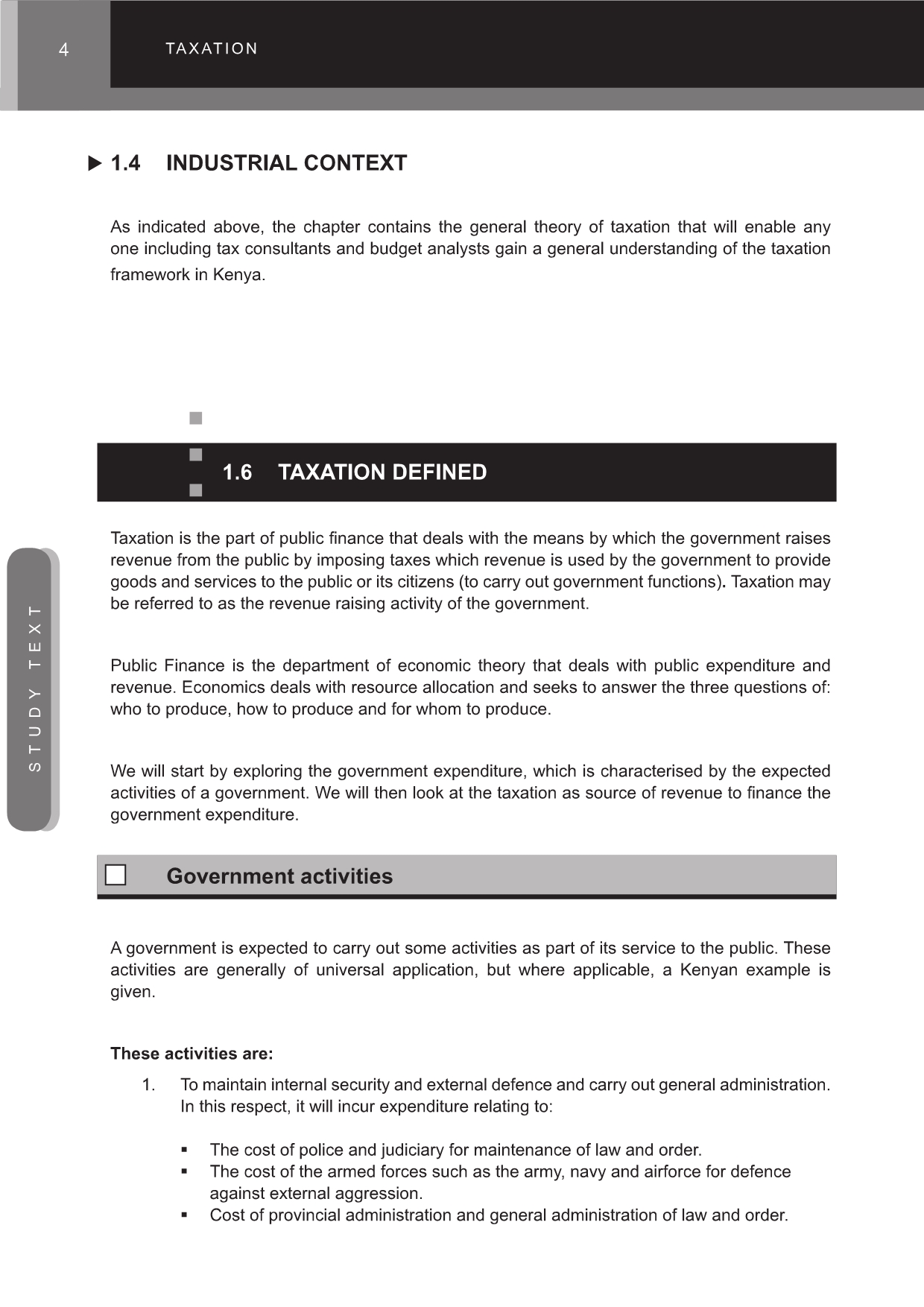
Taxation is the part of public finance that deals with the means by which the government raises revenue from the public by imposing taxes which revenue is used by the government to provide goods and services to the public or its citizens (to carry out government functions). Taxation may be referred to as the revenue raising activity of the government. Public Finance is the department of economic theory that deals with public expenditure and revenue. Economics deals with resource allocation and seeks to answer the three questions of: who to produce, how to produce and for whom to produce. We will start by exploring the government expenditure, which is characterized by the expected activities of a government. We will then look at the taxation as source of revenue to finance the government expenditure
Below is the document preview.

History form 2 exams paper 1 and 2 (with marking schemes)
Trending!
This entails form 2 exams for term two.Besides,it has both paper 1 and 2.Therefore it is very useful for your students
6820 Views
10 Downloads
40.47 KB
Elegant business card template
Trending!
Photoshop psd elegant business card template free
7313 Views
0 Downloads
2.62 MB
Awesome insiring web design template
Trending!
Free awesome responsive bootstrap web design template
3838 Views
0 Downloads
2.8 MB
BIOCHEMISTRY
Polyurethanes are prepared from diisocyanates
and diols. Urethane (also called a carbamate) is a
functional group that contains both an ester and an
amide at a single carbonyl group.
Nucleophilic Addition Reaction: Example 1:
Sevin is a highly effective, biodegradable insecticide. It
affects the nervous systems of insects by blocking
access to the neurotransmitter acetylcholine.
57 Pages
774 Views
0 Downloads
1.68 MB
BIOCHEMISTRY
PETROLEUM CHEMISTRY
Carbon is so Important in the Life Cycle. It has
numerous ways of bonding with many other
elements, particularly oxygen and hydrogen.
It can form both “organic” and “inorganic”
compounds. Organic compounds are considered
unstable in the biosphere because they are in the
reduced state.
Whereas Inorganic compounds, principally
calcite (CaCO3
) and dolomite (CaMg(CO3
)2
), are
stable because they are in the oxidized state.
Carbon is present in most substances that are
vital for the development of life (called
“biomolecules”): Proteins, lipids, sacharides, etc
76 Pages
714 Views
0 Downloads
1.86 MB
BIOCHEMISTRY
Alkyl halides are organic molecules containing a halogen
atom bonded to an sp3 hybridized carbon atom.
• Alkyl halides are classified as primary (1°), secondary (2°),
or tertiary (3°), depending on the number of carbons bonded
to the carbon with the halogen atom.
• The halogen atom in halides is often denoted by the symbol
“X”.
53 Pages
721 Views
0 Downloads
2.07 MB
BIOCHEMISTRY
Natural Gas
Natural gas is a gaseous fossil fuel consisting
primarily of methane but including significant
quantities of ethane, butane, propane, carbon
dioxide, nitrogen, helium and hydrogen sulfide.
Obtained from oil fields and natural gas fields,
and in coal beds.
Methane-rich gases are produced by the
anaerobic decay of non-fossil organic material, ie
biogas.
Total world production of natural gas in 1986
was 100 trillion m3
.
It is used as feed stock as well as fuel. It is
preferred due to its high Calorific Value
52 Pages
679 Views
0 Downloads
1.17 MB
Calculus 1 First Year
Trending!
Excelling in Calculus is the key
81 Pages
3606 Views
2 Downloads
841.91 KB