 Join Our WhatsApp Channel for Updates!
CPA-1-Business Law
| Institution | KASNEB |
| Course | CPA |
| Year | 1st Year |
| Semester | Unknown |
| Posted By | stephen |
| File Type | |
| Pages | 488 Pages |
| File Size | 3.14 MB |
| Views | 6260 |
| Downloads | 0 |
| Price: |
Buy Now
 Buy via
whatsapp Buy via
whatsapp
|


Description
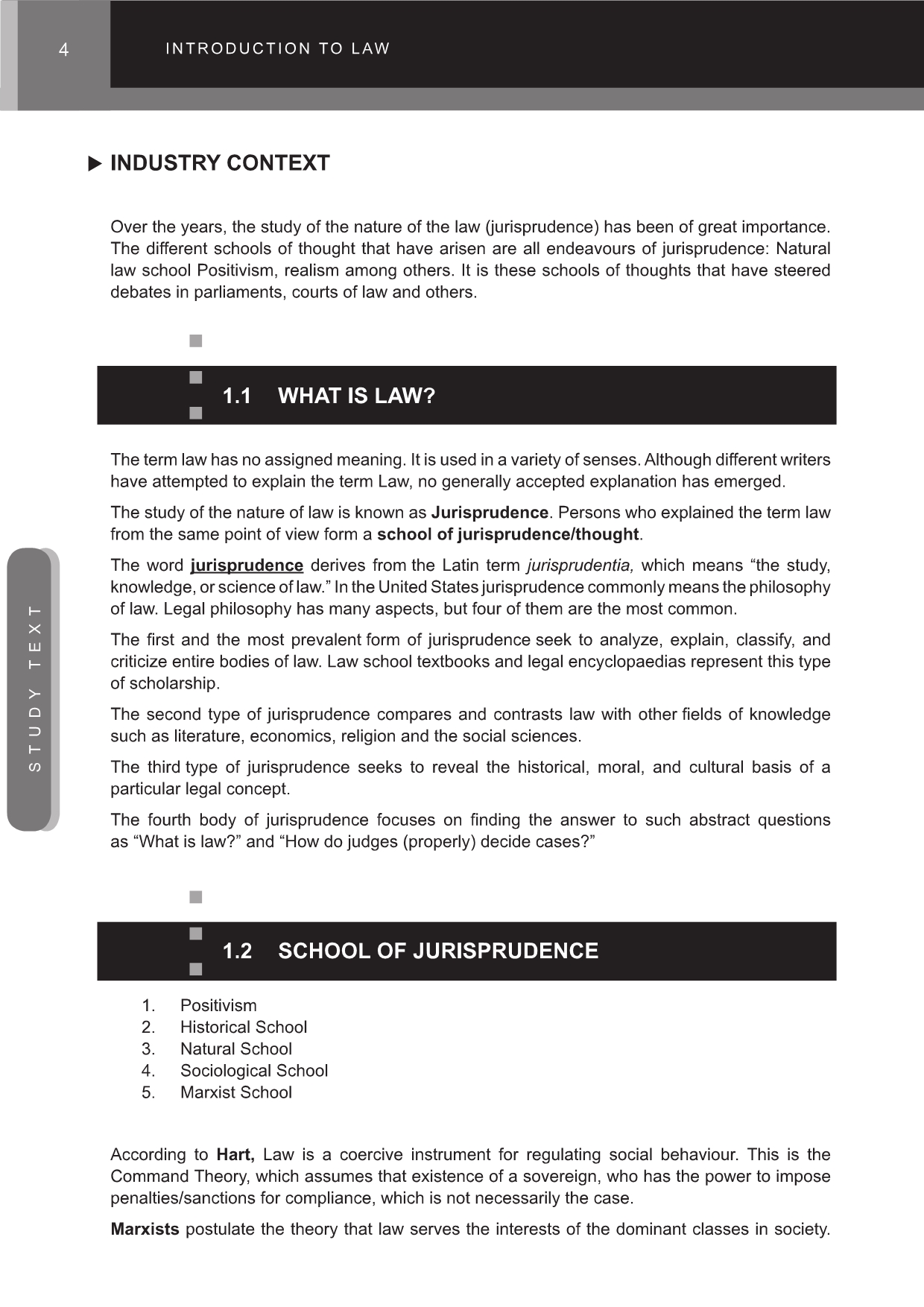
The term law has no assigned meaning. It is used in a variety of senses. Although different writers
have attempted to explain the term Law, no generally accepted explanation has emerged.
The study of the nature of law is known as Jurisprudence. Persons who explained the term law
from the same point of view form a school of jurisprudence/thought.
The word jurisprudence derives from the Latin term jurisprudentia, which means “the study,
knowledge, or science of law.” In the United States jurisprudence commonly means the philosophy
of law. Legal philosophy has many aspects, but four of them are the most common.
The first and the most prevalent form of jurisprudence seek to analyze, explain, classify, and
criticize entire bodies of law. Law school textbooks and legal encyclopaedias represent this type
of scholarship.
The second type of jurisprudence compares and contrasts law with other fields of knowledge
such as literature, economics, religion and the social sciences.
The third type of jurisprudence seeks to reveal the historical, moral, and cultural basis of a
particular legal concept.
The fourth body of jurisprudence focuses on finding the answer to such abstract questions
as “What is law?” and “How do judges (properly) decide cases?
Below is the document preview.

CONCRETE TECHNOLOGY KNEC NOTES
Trending!
Concrete is made by portland cement, water and aggregates. Portland cement is a hydraulic cement that hardens in water to form a water-resistant compound. The hydration products act as binder to hold the aggregates together to form concrete. The name portland cement comes from the fact that the colour and quality of the resulting concrete are similar to Portland stone, a kind of limestone found in England.
73 Pages
6222 Views
1 Downloads
2.42 MB
CONSTRUCTION MATERIALS KNEC NOTES
Trending!
Building material is material used for construction. Many naturally occurring substances, such as clay, rocks, sand, wood, and even twigs and leaves, have been used to construct buildings and other structures, like bridges.
69 Pages
6838 Views
2 Downloads
1.54 MB
TECHNICAL DRAWING KNEC NOTES
Trending!
Engineering depends mainly upon Engineering drawing, hence need for Engineers to acquire a good working knowledge about the subject in order to express and record the shape, size and other information necessary for the construction of various objects such as buildings, roads, bridges, machines etc.
96 Pages
6668 Views
1 Downloads
3.67 MB
WORKSHOP TECHNOLOGY MODULE 2 KNEC NOTES
Trending!
This module is to equip the trainee with the necessary knowledge, skills and attitude required to fully understand workshop tools, techniques and technology.
101 Pages
7128 Views
1 Downloads
4.15 MB
WORKSHOP TECHNOLOGY MODULE 1 KNEC NOTES
Trending!
This module 1 is to equip the trainee with the necessary knowledge, skills and attitude required to fully understand workshop tools, techniques and technology.
45 Pages
8100 Views
7 Downloads
1.3 MB
SURVEYING KNEC NOTES
Trending!
Surveying is defined as taking a general view of, by observation and
measurement determining the boundaries, size, position, quantity, condition,
value etc. of land, estates, building, farms mines etc. and finally presenting the
survey data in a suitable form. This covers the work of the valuation surveyor,
the quantity surveyor, the building surveyor, the mining surveyor and so forth, as
well as the land surveyor.
87 Pages
6922 Views
3 Downloads
1.88 MB
PHYSICAL SCIENCES KNEC NOTES
Trending!
General introduction is made to introduce the fundamentals of Chemistry and physics usually form the basis of practical in civil engineering.
50 Pages
6797 Views
7 Downloads
956.85 KB
GEOTECHNOLOGY MODULE 1 KNEC NOTES
Trending!
Geotechnology involves the application of technology to engineering problems caused by geological factors. In general, civil engineers deal with two types of earth materials: soils and rocks. Geotechnology is a term used in the literature to describe both the science and engineering of soil deposits, rock masses, and the fluids they contain.
87 Pages
7352 Views
1 Downloads
2.36 MB
Engineering Mathematics I
Trending!
This course is about the basic mathematics that is fundamental and essential component in all streams of undergraduate studies in sciences and engineering. The course consists of topics in differential calculus, integral calculus, linear algebra and differential equations with applications to various engineering problems.
321 Pages
7723 Views
1 Downloads
1.47 MB
ECE311: THEORY OF STRUCTURES I
Trending!
The course will provide the necessary analytical foundation and engineering insight on the behaviour of determinate structures.
33 Pages
5543 Views
0 Downloads
1.69 MB