INTRODUCTION TO C++ PROGRAMMING YEAR 1
| Institution | UNIVERSITY |
| Course | BACHELOR OF SCIENCE... |
| Year | 1st Year |
| Semester | Unknown |
| Posted By | stephen oyake rabilo |
| File Type | |
| Pages | 33 Pages |
| File Size | 207.62 KB |
| Views | 5281 |
| Downloads | 0 |
| Price: |
Buy Now
 Buy via
whatsapp Buy via
whatsapp
|


Description
First Class In C++
Adapted from : http://www.cplusplus.com/doc/tutorial/tut1-1.html
Structure of a C++ program
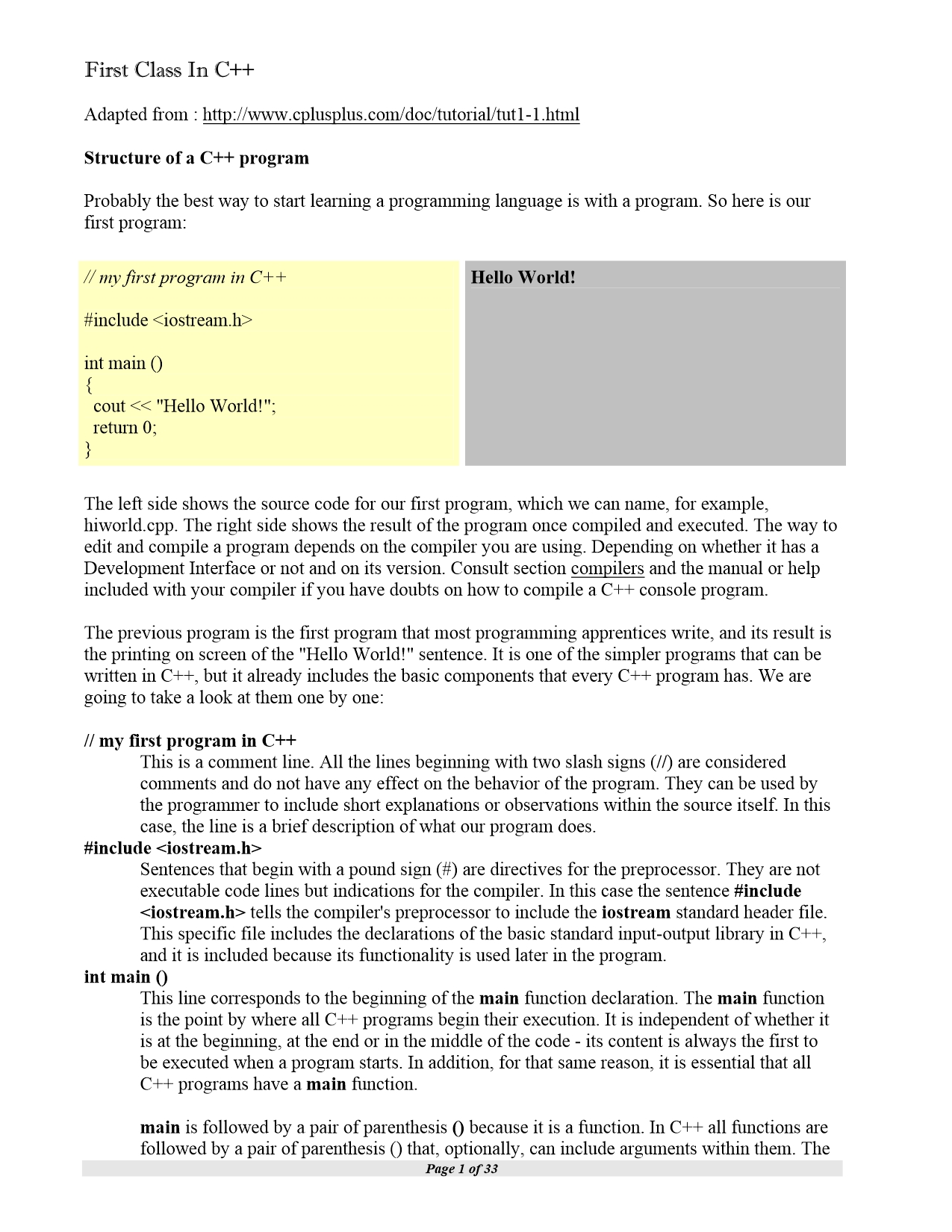
Probably the best way to start learning a programming language is with a program. So here is our
first program:
// my first program in C++
#include <iostream.h>
int main ()
{
cout << "Hello World!";
return 0;
}
Hello World!
The left side shows the source code for our first program, which we can name, for example,
hiworld.cpp. The right side shows the result of the program once compiled and executed. The way to
edit and compile a program depends on the compiler you are using. Depending on whether it has a
Development Interface or not and on its version. Consult section compilers and the manual or help
included with your compiler if you have doubts on how to compile a C++ console program.
The previous program is the first program that most programming apprentices write, and its result is
the printing on screen of the "Hello World!" sentence. It is one of the simpler programs that can be
written in C++, but it already includes the basic components that every C++ program has. We are
going to take a look at them one by one:
Below is the document preview.

BBM 215: FINANCIAL MANAGEMENT 1
Trending!
Financial management is that managerial activity which is concerned with the planning and controlling of the firms financial resources. it involves the decision of the firm
No pages found
7513 Views
1 Downloads
8.71 MB
FINANCIAL ACCOUNTING (MODULE1)
Trending!
Accounting is defined as the process of identifying, measuring and reporting economic information to the users of this information to permit informed judgement.
3 Pages
8682 Views
0 Downloads
220.68 KB
ECONOMETRICS AND STATISTICS
Trending!
Econometrics is the social science in which roots for economic theory, mathematics and statistical inference are applied to analyse economic phenomena. It uses mathematical and statistical methods to quantify economic theories. it involves estimation of unknown parameters and making statistical inference regarding the parameters
121 Pages
7837 Views
1 Downloads
2.15 MB
QUANTITATIVE TECHNIQUES
Quantitative techniques are those techniques which provides the decision maker with a systematic and powerful means of analysis and help based on quantitative data in exploring policies for achieving pre-determined goals involves the use of numbers symbols and other mathematical expressions
3 Pages
398 Views
0 Downloads
320.49 KB
232/1: PHYSICS PAPER 1 QUICK REVISION NOTES
QUICK REVISION NOTES WITH OVER 200 WORKED EXAMPLES AND QUICK PRACTICE QUESTIONS!
158 Pages
1172 Views
0 Downloads
1.84 MB
PRINCIPLES OF MARKETING NOTES
Various marketing concepts hold that customers will generally not buy a product
they don’t know or they have not been asked/convinced to buy.It is therefore the
role of the marketing function in any business to fill this gap and complete the
business operation.
110 Pages
1298 Views
5 Downloads
1.11 MB
BCB 316: BUSINESS RESEARCH METHODS
Trending!
Research involves a critical analysis of existing conclusions or theories with regard to newly discovered facts i.e. it’s a continued search for new knowledge and understanding of the world around us.
72 Pages
6579 Views
1 Downloads
778.83 KB
SOURCES OF FINANCE
Trending!
For small companies, this is personal savings (contribution of owners to the company). For large companies equity finance is made of ordinary share capital and reserves; (both revenue and capital reserves). Equity finance is divided into the following classes:
25 Pages
6610 Views
0 Downloads
372.41 KB
LIFE SKILLS NOTES
Life skills are psychosocial competencies that helps individual to deal effectively with demands and challenges of life.
30 Pages
1844 Views
0 Downloads
553.03 KB
MANAGEMENT ACCOUNTING
The present lesson explains the meaning, nature, scope and limitations of accounting. Further, it discusses the activities covered under management accounting and its difference with financial accounting.
666 Pages
1063 Views
0 Downloads
4.1 MB