APS 321 : ENVIRONMENTAL PSYCHOLOGY
| Institution | Kenyatta University |
| Course | BACHELORS OF ARTS PY... |
| Year | 1st Year |
| Semester | Unknown |
| Posted By | stephen oyake rabilo |
| File Type | |
| Pages | 32 Pages |
| File Size | 590.68 KB |
| Views | 4371 |
| Downloads | 0 |
| Price: |
Buy Now
 Buy via
whatsapp Buy via
whatsapp
|


Description
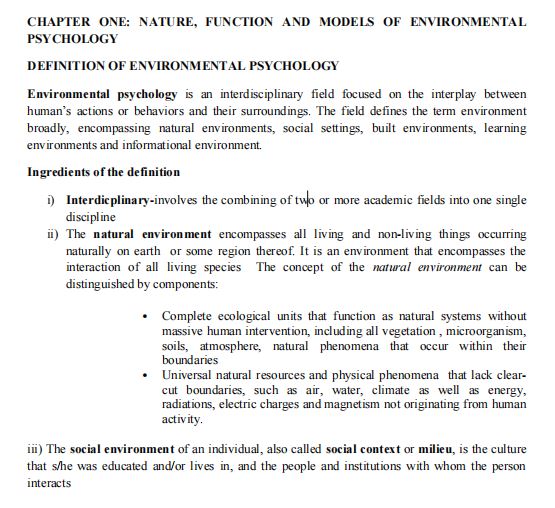
CHAPTER ONE: NATURE, FUNCTION AND MODELS OF ENVIRONMENTAL
PSYCHOLOGY
DEFINITION OF ENVIRONMENTAL PSYCHOLOGY
Environmental psychology is an interdisciplinary field focused on the interplay between human’s actions or behaviors and their surroundings. The field defines the term environment broadly, encompassing natural environments, social settings, built environments, learning environments and informational environment. Ingredients of the definition
i) Interdicplinary-involves the combining of two or more academic fields into one single
discipline
ii) The natural environment encompasses all living and non-living things occurring
naturally on earth or some region thereof. It is an environment that encompasses the
interaction of all living species The concept of the natural environment can be
distinguished by components:
Complete ecological units that function as natural systems without massive human intervention, including all vegetation , microorganism, soils, atmosphere, natural phenomena that occur within their boundaries
Universal natural resources and physical phenomena that lack clear cut boundaries, such as air, water, climate as well as energy,
radiations, electric charges and magnetism not originating from human activity.
iii) The social environment of an individual, also called social context or milieu, is the culture
that s/he was educated and/or lives in, and the people and institutions with whom the person
interacts
Below is the document preview.

ORAL LITERATURE IN KISWAHILI
GET MORE INFORMATION THE SWAHILI ORAL LITERATURE.THIS DOCUMENT WILL HELP YOU TO UNDERSTAND THE SWAHILI LITERATURE IN DEPTHS
125 Pages
1590 Views
0 Downloads
364.23 KB
NUTRITION IN COMMUNITY HEALTH
By the end of this unit the learner should understand how to: Assess food and nutrition security, Apply nutrition in Human development & Apply nutrition in disease management.
65 Pages
529 Views
0 Downloads
614.97 KB
HEALTH INFORMATION SYSTEM
The course is designed to equip the health records and information officers’ students with the competences that will enable them organize and manage health information system.
41 Pages
600 Views
0 Downloads
761.17 KB
COFFE GENOTYPES IN KENYA
Trending!
This study confirmed the low genetic diversity in Arabica coffee genotypes evaluated with dissimilarity of less than 5%. The study also widened the information on genetic diversity of coffee germplasm available for breeding programmes in Kenya since previous work was biased to commercial cultivars and donors of resistance to diseases. The molecular diversity shown among the Hibridode Timor (HDT) derivatives could be exploited in breeding programmes especially by subjecting more intensive molecular characterization and consequently selecting elite lines among them.
240 Pages
6316 Views
0 Downloads
9.49 MB
EDU 110: PHYSICAL AND SPORTS LITERACY NOTES
Trending!
This interactive module is designed to equip you with fundamental
knowledge on physical activity, exercise and sports that is necessary for you to engage and work collaboratively with other stakeholders to promote healthy physically active lifestyle and empower citizenry.
102 Pages
5890 Views
2 Downloads
1.81 MB
EET 101: MACROECONOMIC THEORY SHORT NOTES
Trending!
This document outlines the table of contents for a course on macroeconomic theory. It covers 8 lessons: 1) the nature of macroeconomics, 2) national income and expenditure, 3) public expenditure and taxation, 4) consumption and savings analysis, 5) investment demand theory, 6) money, 7) equilibrium in the money market, and 8) equilibrium in the goods market. Each lesson defines key terms, objectives, and macroeconomic concepts and models related to national income, expenditure, consumption, investment, money supply, and market equilibrium.
74 Pages
6362 Views
0 Downloads
1004.31 KB
ALT 442: DRAMA (NOTES)
Trending!
By the end of this document, the learner should have understood the evolution of drama in reference to the significant changes it has undergone in it's historical development
This is partly attributed to the fact that stage types have changed and have thus required a different form of acting. This section discusses the various stages of the evolution of drama and examines specific features that characterize each period .
13 Pages
6847 Views
0 Downloads
242.01 KB
EDUCATIONAL ECONOMICS, POLICY AND PLANNING
This is an interactive instructional module that will expose you to a variety of online learning experiences. The module will introduce you to three main areas which are educational economics, educational policy and educational planning.
123 Pages
608 Views
0 Downloads
1.43 MB
INTRODUCTION TO ENTREPRENEURSHIP NOTES
Trending!
This module will enable the learner to understand the meaning of entrepreneurship, factors that affect and influence it, social and business entrepreneurship, the theories of entrepreneurship and many more.
74 Pages
6709 Views
0 Downloads
1.04 MB
INSTRUCTIONAL RESEARCH AND PRACTICE NOTES
Trending!
By the end of the course, the teacher trainee should be able to:
a. Analyse knowledgeably classroom research studies
b. Differentiate the concept of research from reflective practice
c. Apply creativity and critical thinking skills in problem solving in research
d. Critically examine issues around collecting and analysing data
e. Design an analytical piece of research through problem solving
f. Use relevant methodologies to conduct research in the classroom: case study and
action research
g. Design small-scale classroom research
h. Engage in reflective and self-directed practice in a variety of settings
i. Write a research report
j. Disseminate research findings using appropriate research skills
87 Pages
4223 Views
0 Downloads
2.24 MB