History and Philosophy of Education Notes
| Institution | University |
| Course | EDUCATION |
| Year | 1st Year |
| Semester | Unknown |
| Posted By | Codred Agencies |
| File Type | |
| Pages | 41 Pages |
| File Size | 259.07 KB |
| Views | 4014 |
| Downloads | 0 |
| Price: |
Buy Now
 Buy via
whatsapp Buy via
whatsapp
|


Description
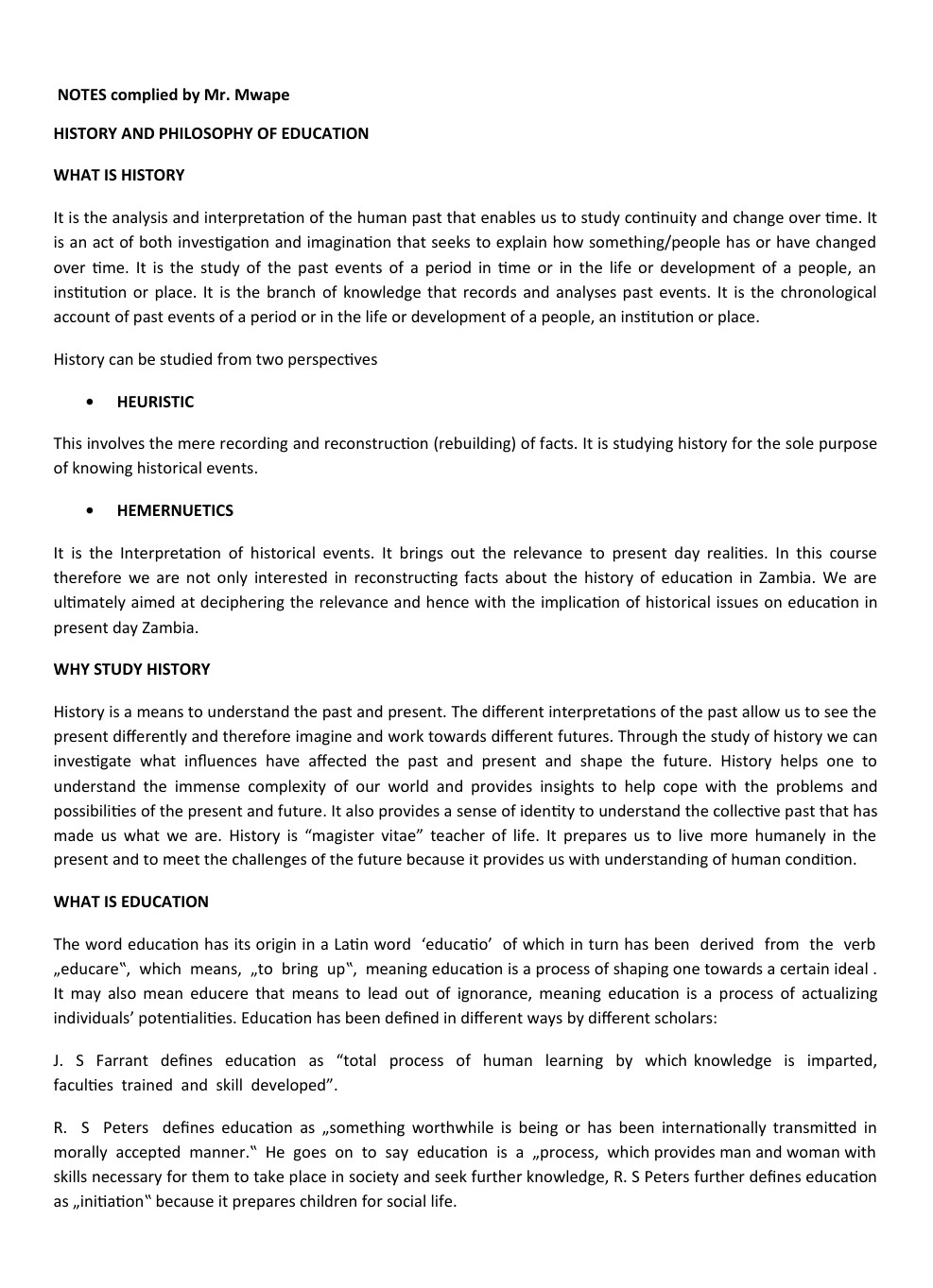
History is the analysis and interpretation of the human past that enables us to study continuity and change over time. It is an act of both investigation and imagination that seeks to explain how something/people has or have changed over time. It is the study of the past events of a period in time or in the life or development of a people, an institution or place. It is the branch of knowledge that records and analyses past events. It is the chronological account of past events of a period or in the life or development of a people, an institution or place.
Below is the document preview.

CORD PROLAPSE
Trending!
Its when the umbilical cord comes out of the uterus with or before the presenting part. The concern is that pressure on the cord from
the baby will compromise blood flow to the baby
26 Pages
4638 Views
0 Downloads
582.69 KB
ANATOMY & PHYSIOLOGY OF THE MALE REPRODUCTIVE SYSTEM
Trending!
Download full notes ANATOMY & PHYSIOLOGY OF THE
MALE REPRODUCTIVE SYSTEM that will equip informative and insightful information on matter reproductive system of male .
102 Pages
4249 Views
0 Downloads
12.54 MB
ACUTE INVERSION OF THE UTERUS
Trending!
Refers to a condition where the uterus partly or completely turns inside out, such that the inner surface of the fundus prolapses to appear at the internal cervical os level for the mild, mid-way in the vagina for the moderate and at the vaginal introitus or on the vulva for the severe.
29 Pages
4050 Views
0 Downloads
445.88 KB
Rupture of the Uterus
Trending!
• Rupture of the uterus is a serious complication, which should
not occur in today’s obstetric care where there is good prenatal and intra partum care.
• Its is one of the most serious complications in midwifery &
obstetrics.
• It is often fatal for the foetus & may also be responsible for the
death of the mother
• It remains a significant problem worldwide. However, with
effective antenatal and intrapartum care, some cases may be
avoided.
22 Pages
4328 Views
0 Downloads
1.01 MB
Primary Post Partum Hemorrhage
Primary (Immediate) PPH
Definition
• It’s excessive bleeding occurring during 3
rd stage or any
time within the first 24 hours of delivery.
Major causes
• Uterine atony or atonic uterus (Tone /tissue = 70% )
• Trauma along the genital tract. ( Trauma = 20% )
• Blood coagulation disorder. ( Thrombin = 1% )
(4 Ts – Tone, Tissue, Trauma, Thrombin)
44 Pages
461 Views
0 Downloads
1.24 MB
AMNIOTIC FLUID EMBOLISM
Trending!
It is a rare condition, but highly fatal. (5th most common
cause of maternal mortality.). It is a severe obstetrical emergency which occurs either as the first stage ends, though rare, or shortly after separation of the placenta. In either situation, the uterus is injured (torn) or uterine sinuses do not close instantly. So some
amniotic fluid is forced into the maternal circulation by the strong uterine contractions hence embolism.
15 Pages
4294 Views
0 Downloads
230.08 KB
Perineal tears
Trending!
Perineal tears are injuries that occur in the perineal area (the region between the vaginal opening and the anus).
• They are classified based on their severity and the structures
involved.
Risk factors
• Large baby (macrosomia)
• Instrumental delivery (forceps or vacuum)
• Primigravida
• Prolonged second stage of labour
• Shoulder dystocia
• Previous perineal tears
15 Pages
4383 Views
0 Downloads
834.55 KB
Nursing Theories and Models
Trending!
These are organized bodies of knowledge to define what nursing is,
what nurses do, and why they do it
76 Pages
4206 Views
0 Downloads
2.11 MB
Patients’ Rights and Responsibilities
Trending!
Right to emergency treatment in a health facility
• In emergency situations irrespective of the patient’s ability to pay for treatment, treatment to stabilize the patient’s condition shall be provided
• Right to be informed of all the provisions of one’s medical
scheme/health insurance policy
• Anyone enjoying the provisions of medical cover is entitled to know all the privileges accorded and also entitled to challenge, where and if necessary, the contents and decisions of the medical scheme and health insurance policy
11 Pages
4131 Views
0 Downloads
374.7 KB
OREM’S SELF CARE DEFICIT THEORY
Trending!
Dorothea Orem was born in 1914 in Maryland.
She began her nursing education in 1939 in Providence
hospital school of nursing in Washington DC where she
received a diploma.
She later earned her BSC in nursing education in 1939 and a
MSc. in nursing education in 1945.
Orem kept asking herself what conditions existed in a person
that made it necessary to bring in a nurse.
This led to the evolution of her idea of self- care.
32 Pages
4142 Views
0 Downloads
508.41 KB