Vehicle service management system project report
| Institution | Kisii National Polytechnic |
| Course | ICT/COMPUTER SCIENCE |
| Year | 3rd Year |
| Semester | Unknown |
| Posted By | MAKORI KERECHA |
| File Type | docx |
| Pages | |
| File Size | 3.2 MB |
| Views | 4517 |
| Downloads | 0 |
| Price: |
Buy Now
 Buy via
whatsapp Buy via
whatsapp
|


Description
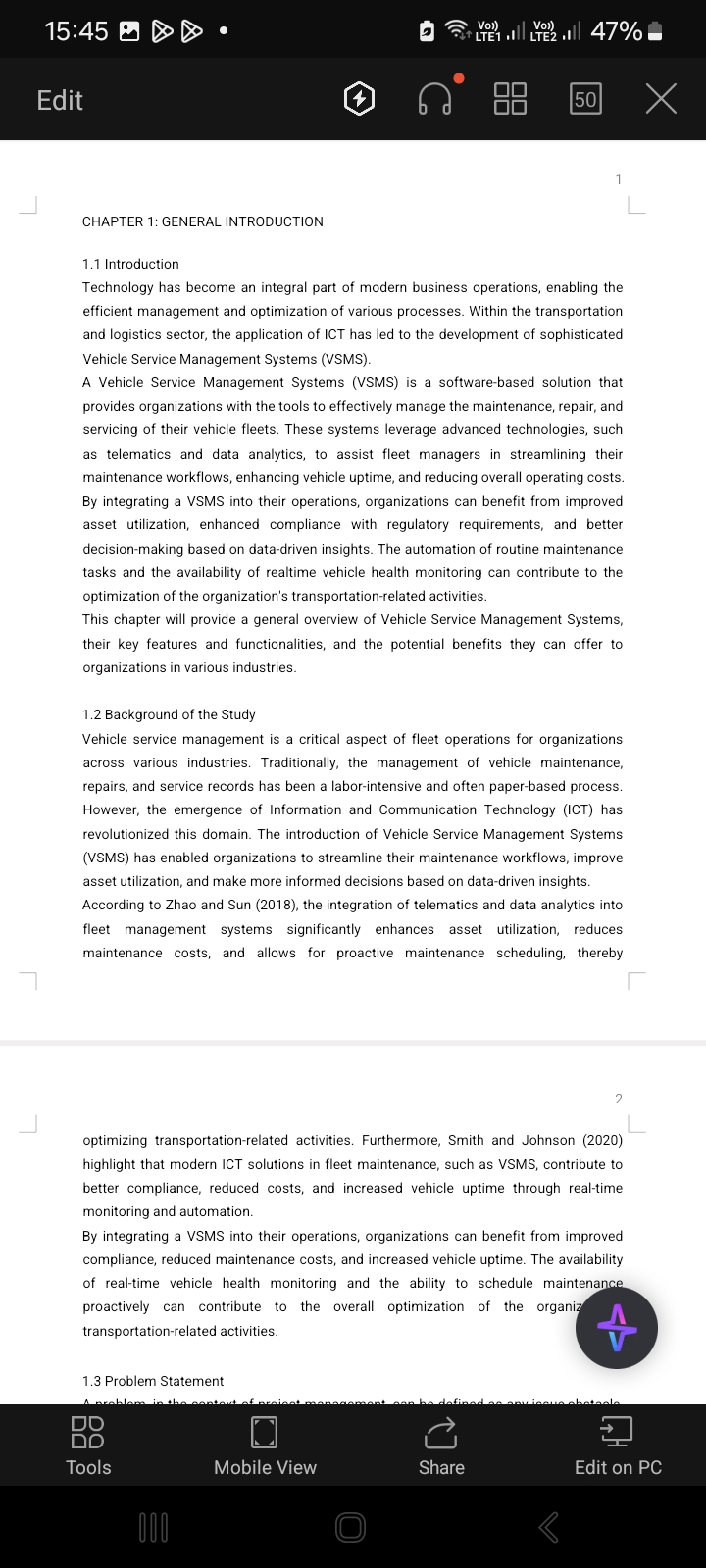
The Vehicle Service Management System is a comprehensive software application developed using PHP and a MySQL database. The system is designed to streamline the management of vehicle services and customer interactions, and it consists of two main modules: the User Module and the Admin Module.
The primary objective of the Vehicle Service Management System is to provide a user-friendly and efficient platform for managing the complete life cycle of vehicle services, from customer enquiries to service requests and administrative management.
Traditional vehicle service management often involves manual processes, fragmented data, and poor communication between customers and service providers. This can lead to inefficiencies, delays, and a lack of transparency in the service delivery process.
The system is developed using PHP, a popular server-side scripting language, and a MySQL database to store and manage all the relevant data. The integration of these technologies provides a robust and scalable solution for the management of vehicle services.
The User Module allows customers to access a dashboard to view the status of their total, rejected, and completed services. Users can also submit service requests, check the status of their requests, and print their payment slips. Additionally, users can manage their profiles, change their passwords, and recover their passwords.
The Admin Module offers a comprehensive set of features for managing the system. Administrators can manage mechanics, vehicle categories, registered users, service requests, customer queries, and conduct searches for enquiries and services. The admin dashboard displays key statistics, including the total number of registered users, total enquiries, total mechanics, and total services.
The implementation of the Vehicle Service Management System has demonstrated its effectiveness in streamlining the vehicle service process, improving communication between customers and service providers, and providing administrators with comprehensive data management capabilities. The system has been designed to enhance customer satisfaction, improve service efficiency, and offer a centralized platform for managing all aspects of the vehicle service process
Below is the document preview.

Alcohol Detection Driver System- electrical telecommunication option
Trending!
' is built and put into use to track drivers' blood alcohol content in real time, with the goal of improving road safety and preventing drunk driving in Kenya’s public transportation system. This system, which was created especially for the particular requirements of Kenya’s public transportation vehicles, combines sensors technology with clever control mechanisms to identify the presence of alcohol in a driver's breath. When the system detects alcohol concentrations above a set threshold, it sets off a sequence of safety measures, which may include warning the driver and maybe turning off the ignition to keep the car from running. The heart of the device is a highly sensitive alcohol sensor that is positioned carefully to guarantee reliable and consistent readings, especially when using public transportation. The system analyzes the sensor data in conjunction with a microcontroller unit to make judgments instantly depending on the amount of alcohol detected. The implementation makes sure that drivers are notified of their status in a clear and timely manner by including user-friendly interfaces for alarm notifications and system feedback. The danger of alcohol-related accidents within Kenya’s public transportation system can be greatly decreased by using this alcohol detection system, which will help make the country's roads safer and potentially save lives. Because of its design, which places a high priority on dependability, usability, and quick reaction, the system is a workable option for actual usage in the nation's transportation sector. In addition, the incorporation of this system into public transportation vehicles is a proactive measure to encourage safe driving practices and improve public safety throughout Kenya.
3404 Views
0 Downloads
463.62 KB
design an electronic siren circuit - electrical telecommunication option
Trending!
The aim of this project is to design an electronic siren circuit which can be used as a warning and alerting in emergency situations in order to make the lives of humans
This circuit can be used in civil defense sirens to give warning at the time of natural disasters.
This can be used in emergency signals such as search and rescue operations.
It can be used as an intruder alarm.
3461 Views
0 Downloads
302.69 KB
Automatic dustbin vacuum cleaner project report- electrical telecommunication option
Trending!
The World living situation and condition is getting critical especially in Africa as is with all developing countries due to: time shortage, Cleanness, size and accuracy. It is our task as engineers to make machines that will help people to adapt in current time with minimum negative effects. For the sake of people’s time management and human power saving in cleaning, We thought about an automatic dustbin vacuum cleaner (ADVC). The machine(ADVC) is a combination of two general systems which are Automatic dustbin system and vacuum cleaner system. Automatic dustbin is an improved normal dustbin to automate the lid with the help of : servo motor, which drive the lit at 90 degree and release it after; Arduino uno R3, to receive signal and command servo as it have been programmed by arduino IDE; ultrasonic sensor, is there to detect signal the hand approach to calculated and programmed limit and directly send signal to arduino uno R3 . Vacuum cleaner system is mainly made up of: Carbon brush DC-motor,RS445PA14233R, to rotate fan when supplied by 230v ac/dc; fan will play role of rotating to create vacuum region in the system; filter will prevent effective waste to reach the fan. The machine will open automatically if a hand is approached to cast the wastes and the cleaner will be able to remove waste particles by pointing the nozzle and press switch. This project is practical based on different theories and I recommend the lecture to teach with case studies such as the system of this machine(ADVC) and these important machines should be helped to be made on our land so as to limit decay of our economy in importation.
3487 Views
0 Downloads
833.45 KB
AUTOMATIC POWER THIEF DETECTOR- ELECTRICAL TELECOMMUNICATION OPTION
Trending!
The proposed work in this project aims on the design and implementation model of electrical energy theft detection. A high percentage of electricity income is lost due to power theft and improper management. However, a bulk of these losses are caused by electricity theft. The illegal usage of electricity must be solved by electronic means, without any human interaction. The purpose of this work is to provide an implementation methodology for electricity theft detection and controlling which allows violators to be detected at a remote location. This design integrates effective solutions for problems faced by electricity distribution system such as power theft and transmission line fault. It includes microcontroller based embedded technology and wireless communication method to find out the electric theft and transmission line fault. Moreover, collecting the meter readings for billing processes from all consumers is a difficult and time-consuming task which requires a great number of labors. In the proposed method global System for Mobile communication (GSM)based technology is used to transmit the meter reading and detection alert automatically to the authorized energy provider via an alert message which eliminates the various issues related to the meter reading and theft detection.
3326 Views
0 Downloads
845.92 KB
Design of a single output converter project report electrical telecommunication option
Trending!
This project report covers the design and implementation of a single-output inverter. It converts a single 12V DC input to a 70V AC output at 7watts using Arduino-controlled MOSFETs. This setup is cost- efficient because one inverter can supply different loads, saving money and space, especially in renewable energy systems. The goal is to develop an inverter that provides multiple AC outputs from one DC source for various uses, including renewable energy and portable power supplies.
The core of the system is an Arduino microcontroller. It generates precise pulse-width modulation (PWM) signals to control the MOSFET switches, ensuring efficient conversion and stable output. The design process involves choosing the right MOSFETs and developing protective circuits to prevent overvoltage, under voltage, and short-circuits.
Experimental results show that the inverter can produce a stable 70V AC output with low harmonic distortion, maintaining performance under different load conditions. The system's efficiency, output quality, and response to changing loads are thoroughly analyzed. This project demonstrates the effective combination of Arduino control with power electronics, providing a high-performance solution for converting DC to AC power.
3482 Views
0 Downloads
694.76 KB
Design and implementation of a smart automatic food dispenser project report- electrical telecommunication opinion
Trending!
This project presents the design and implementation of a smart automatic food dispenser in a farm, tailored for agricultural environments, aimed at improving livestock feeding processes. The proposed methodology consists of an IoT system and automation technologies to deliver precise and timely portions of food to animals, based on their specific dietary needs and feeding schedules. The distributor is designed to monitor and analyze animal behavior and consumption patterns, thus adjusting food distribution to promote optimal health and growth. The Blynk IoT application allows farmers to remotely manage and customize feeding protocols, ensuring flexibility and control. The part of coding use Arduino IDE that make IoT system operational. This smart system minimizes human labor, reduces food waste, and ensures consistent and balanced nutrition for livestock. Field tests have demonstrated its effectiveness in improving animal well-being and farm productivity. The implementation of this innovative solution promises significant advancements in efficiency, sustainability, and the overall management of farm feeding practices.
3500 Views
0 Downloads
1.43 MB
Design and implementation of a Smart door locking system projectreport- electrical telecommunication option
Trending!
This project focuses on the design and implementation of smart door locking system to enhance security and user convenience. The system eliminates the need for traditional keys by using biometric authentication, specifically fingerprints, to grant access. The research includes the development of the lock system, user testing, and evaluation of both technical and usability performance. Data were collected through questionnaires, interviews, and system logs to assess user satisfaction, ease of use, and security perceptions. The system’s technical performance was measured through key metrics such as the False Rejection Rate (FRR) and False Acceptance Rate (FAR). Results showed that 87% of users found the system easy to use, 95% felt it provided improved security, and the system exhibited a low FRR of 2% and FAR of 0.5%. These results demonstrate the effectiveness of the fingerprint-based door lock system in offering secure, reliable, and user-friendly access control.
3459 Views
0 Downloads
473.85 KB
Design and implementation of a smart home appliances control system for individuals with lowe limb impairments - electrical telecommunication option
Trending!
“Smart Home Appliances Control System” is an (IoT)-based project which will be designed and implemented to provide individuals with physical disability the ability to control household appliances using their smartphones. The project utilizes nodemcu as the microcontroller and blynk platform for IoT integration. The smart home appliance control system will enable remote control, automation, and real-time monitoring of appliances such as lights, TVs, fans, air conditioning, etc. The successful implementation of this system will contribute to improving the quality of life for individuals with physical disabilities and promote inclusivity in smart home technology.
3415 Views
0 Downloads
392.41 KB
Design and implementation of a smart maize crop storage monitoring system project report- electrical telecommunication option
Trending!
The agricultural sector in Kisii Central District, Kisii , faces significant post-harvest losses, especially in maize storage, due to inadequate monitoring and management of essential storage conditions. During my research, I visited a store called Rumbuka Seeds in Kisii Central District, which uses a system that fills maize into slots and monitors only humidity and temperature. This limited approach highlights a gap in comprehensive monitoring, as other crucial parameters like CO2 levels are not tracked.
To address these challenges, this project aims to develop and implement a smart maize crop storage monitoring system using the Thing speak cloud platform. The system will utilize NodeMCU, DHT11 sensors, and smoke gas detectors to monitor key storage parameters, including temperature, humidity, and CO2 levels. Integrating the Thing Speak platform allows the system to monitor and manage these parameters in real time effectively.
NodeMCU, a microcontroller with Wi-Fi capabilities, acts as the core unit, collecting sensor data and transmitting it to the Thingspeak cloud server. This data is then processed and stored, enabling farmers to access real-time and historical trends through a user-friendly mobile interface. This interface, provided by the Thingspeak application, allows farmers to view data, analyze trends, and receive alerts, facilitating timely interventions without needing to be physically present at the storage site.
By continuously monitoring storage conditions and providing actionable insights, the smart maize storage system aims to reduce spoilage and post-harvest losses, promote sustainable storage practices, and enhance productivity and profitability for maize farmers in Kisii Central District. The alert system within the Thingspeak platform ensures that farmers are promptly informed of adverse conditions, enabling swift corrective actions. This innovative approach leverages IoT technology and the Thingspeak cloud to provide a more efficient and reliable maize storage solution, addressing a critical need in the region's agricultural sector.
3418 Views
0 Downloads
963.57 KB
DESIGN AND IMPLEMENTATION OF AN AC OR DC POWER HARVESTING USING HUMAN FOOT STEP PROJECT REPORT- ELECTRICAL TELECOMMUNICATION OPTION
Trending!
As the demand of energy is increasing day by day, so the ultimate solution to deal with these sorts of problems is just to implement the renewable sources of energy Humans are using the renewable energy which are solar, wind etc. but we still could not satisfy our power needs, because of that we have to generate electricity through each and every possible ways. The objective of this work is to produce power through footsteps as a source of renewable energy that we can obtained while walking or standing on to the certain arrangements like footpaths, stairs, plate forms and these systems can be install specially in the more populated areas. In this project the force energy is produced by human foot step and force energy is converted into mechanical energy by the rack and pinion mechanism. Electricity is produced by DC generator. We are supposed to study existing methods of foot step power generation that are rack and pinion arrangement and piezoelectric crystals and supposed to modify the existing system.
3515 Views
0 Downloads
1.65 MB