Impact of Application of Information and Communication Technology (ICT) On Office Managers’ Performance- business research project
| Institution | Kisii National Polytechnic |
| Course | Business |
| Year | 3rd Year |
| Semester | Unknown |
| Posted By | MAKORI KERECHA |
| File Type | docx |
| Pages | |
| File Size | 139.82 KB |
| Views | 2426 |
| Downloads | 0 |
| Price: |
Buy Now
 Buy via
whatsapp Buy via
whatsapp
|


Description
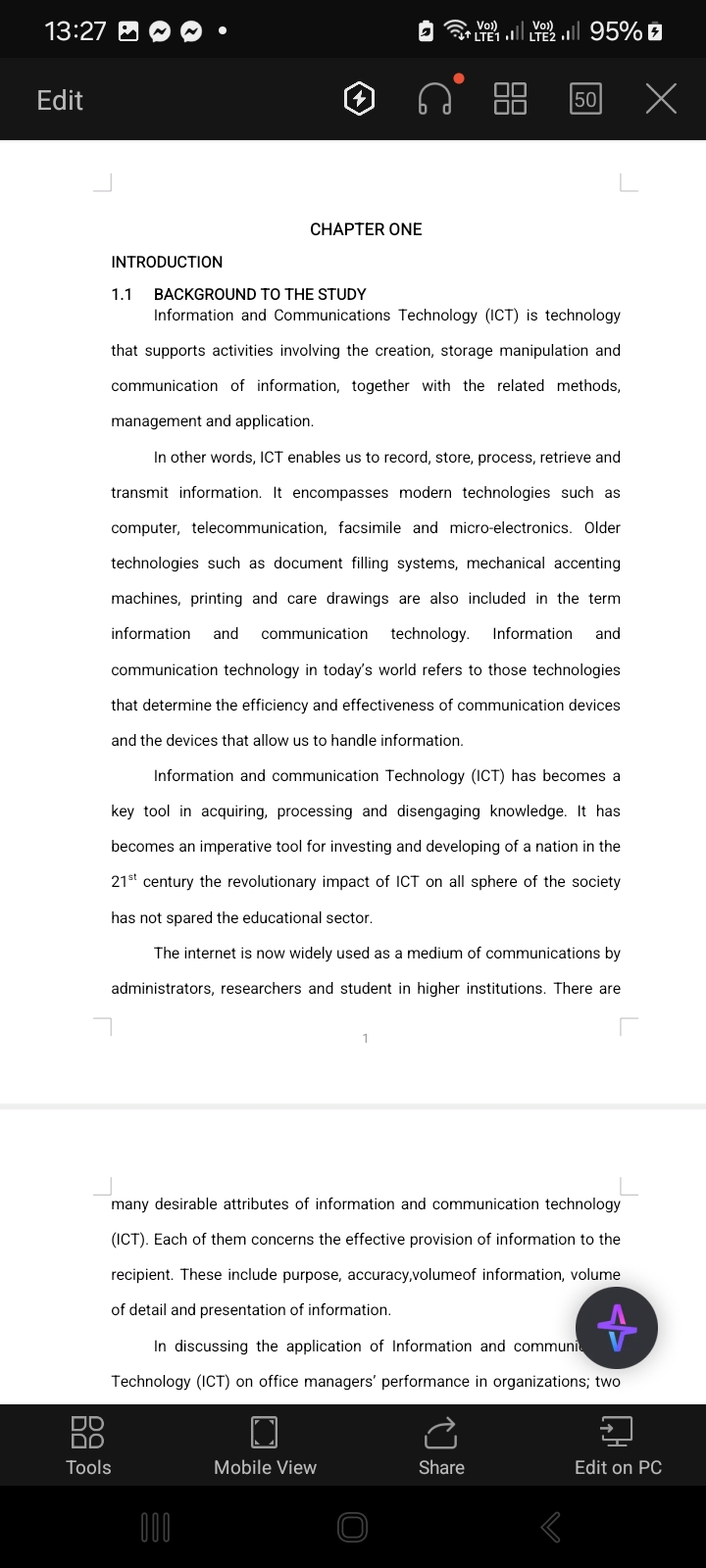
The topic of this study is Application of Information and Communication Technology (ICT) On Office Managers’ Performance (A Case Study of University of Ibadan).The instrument used in gathering data for this study is questionnaire. The scope of the study covered tenunits in the University of Ibadan. The sample size used by the researcher was 50;the data gathered were analyzed using Analysis of variance (ANOVA) and table presentations. The research findings reveal that information and communication technology motivates the job performance of office manager’s and makes work easier and faster. Again, that lack of maintenance will reduce the effectiveness of these machines and bring slowdown in processing.From the summary of the findings, the researcher therefore concludes that information and communication technology should be provided to office manager’s so as to attain their job performance. The researcher recommends that the role of office technology in the development of office manager profession should be encouraged and office managers should have the required skills needed in operating thisequipment.
Below is the document preview.

effect of the involvement of key stakeholders on the success of the project
Trending!
A number of literatures have pointed to the importance of stakeholders’ role in the success of construction projects. As construction projects are complex and unique in their nature, stakeholders with diverse backgrounds of knowledge, skill, power, and interest such as owners, consultants, contractors, end users, and other primary and secondary stakeholders involve in achieving the project success. The main purpose of this paper is to investigate the determinants of the involvement of stakeholders on the success of the project under the study. Both the qualitative and quantitative methods were used together to collect and analyzed necessary data from envisaged sources. The quantitative data obtained through structured questionnaire survey to 50 respondents were analyzed via regression techniques by using the Statistical Package of Social Science (SPSS20) and by using text analysis to analyze the qualitative data. According to the SPSS analysis results, project supply management, stakeholders’ financial contribution, project monitoring and stakeholders’ active decision makings are found to be the major determinants on the success of the project. Lastly, the researcher attempted to put his recommendations which mainly emphasizes on the following realities such as, first there should be strong contractual and legal relationships, obligations, liability, and enforcement among the key stakeholders; promoting and convincing the local community towards the aim and goal of the project; and phase based project implementation are the major one.
Keywords: Project, stakeholders, stakeholders’ involvement, project success, water supply project, Oromia, Kisii County.
3772 Views
0 Downloads
116.18 KB
factors affecting deposit mobilization of private commercial banks in Kenya- accounting, Banking and finance research project
Trending!
Deposit mobilization is a fundamental part of banking activity. Thus,the main objective of the study is to examine the factors affecting deposit mobilization of private commercial banks in Kenya. The study used balanced panel model in examining the regression model and collect data from six private commercial banks covering the period of Twenty(20) consecutive years, 2000-2019 with a total of 120 observations. To this end, the study employed a quantitative research approach by documentary analysis based on their audited financial statement. The study used panel data techniques specifically fixed effect model on the regression analysis and used E-view8 software. The study used one dependent variable total deposit amount (DEP) and nine independent variables that are Bank’s size, Number of Bank’s Branch, Bank Reserve, Deposit interest rate, Loan to Deposit Ratio, Lending Rate, Exchange Rate, Inflation rate and Gross domestic product (GDP). The regression result of Exchange Rate and Deposit Interest Rate show that positive and significant effect at 5% significance level on deposit mobilization of private commercial bank in Kenya and Bank Size, Bank Reserve, Loan to Deposit Ratio, Number of Bank’s Branch and Lending rate show that positive and significant at 1% significance level on Deposit Mobilization.Whereasinflation rate has negative and insignificant impact at 5% significance level on deposit mobilization of private commercial bank and GDP show that positive and insignificant impact at 5% significance level on deposit mobilization. The study recommended that
Kenyan private commercial banks should give attention to Bank Size, Bank Reserve, and Loan to Deposit Ratio, Lending Rate, Exchange Rate, Deposit Interest Rate and Number of Bank’s Branchthat could affect deposit mobilization and significantly enhance their deposit.
2475 Views
0 Downloads
200.79 KB
Factors affecting the adoption of agent banking in Kenyan Banking Industry (Evidence from some Selected Private Banks)- accounting, Banking and finance
Trending!
This study is carried out to identify the factors affecting the adoption of Agency banking in Kenya. The commercial banks operating in Kenya are taken as Population of the study that is 18 commercial banks. Among them the research was conducted and data gathered on the three pioneers banks in agent banking service (Co-operative bank, united bank, and lion international bank). So as to meet the research objective 58 questioners were distributed to e-banking department employees and structured interview were also held with E banking department managers of sampled banks. Purposive sampling method was employed to draw the sample from the population. The study statistically analyzed data obtained from the survey using Statistical Package for Social Sciences 20.0 V (SPSS) and descriptive statistics particularly data mean used for interpretation purpose.
The result of the study regarding the major driving forces that initiate Kenyan banks to adopt agency banking are: the desire to cover wide geographical area, desire to satisfy rapid change of customer needs & preferences and the desire to improve productivity and Organizational Performance. The major factors affecting the adoption of agent banking are: lack of giving proper attention to the service as its given to other conventional banking services, Board of directors, top management and staffs resistance to change in technology, Lack of proper coordination among stakeholders of the bank - in setting goals and following up the implementation process of the service and high cost of implementation of agent banking, lack of adequate public awareness and low level of customers & agents’ technology literacy (mobile phones), Lack of adequate coordination between banks and other decision making centers in agent banking; Lack of adequate infrastructural facilities in the remote area; lack of strong push from the government to promote mobile and agent banking and Lack of sufficient legal frameworks,, customer fear of risk to use agent banking service; absence of common network that links different banks and lack of confidence in relation with the security aspects, Loss of Audit Trail and Users do not trust the agent banking services. The study also tried to identify various benefits from adopting of agency banking, among the benefits overcoming geographical limitations, reduction of queues in the banking hall, enhancement of productivity in the banking industry and Reduction of paper work are the leading benefit banks in Kenya realized from the adoption of agency. The existing opportunities for adoption of agency banking are Expansion of mobile phone users, Commitment of the government to facilitate the expansion of ICT infrastructure, Increment of educated potential customer, the relative increase of the public awareness about the service are among the leading opportunities. The study suggests a series of measures which need to be taken by commercial banks so as to address various factors affecting its adoption among them: Public awareness on the use of ICT, e-commerce and e-Payment need to be raised and enhanced. The government should also legalize the acceptance of electronic receipts as a mode of transaction confirmation. This removes the past requirement of providing paper-based receipts for cash in and cash-out transactions, in doing so the desire to use the agency banking service will rise.
3868 Views
0 Downloads
555.83 KB
IMPACT OF COMPUTER BASED ASSESSMENT SYSTEM ON CUSTOMER SATISFACTION
This study aimed at identifying the impact of customer satisfaction during computer based assessment. Customers here in this research were candidates of computer based assessment system (CBAs) that includes teachers, students, assessors, focal persons, shop assistants and other experts. These all taken part in the assessment using CBAs, using explanatory research method through both quantitative and qualitative approach. The data were collected from six different TVET colleges and other office experts. The collected data were analyzed through SPSS version 20 form, in this research multi-criteria satisfaction analysis variables (system quality, information quality, technical quality and service quality) was taken as independent variable used to measure customer’s satisfaction of CBAs and system ease of use, efficiency, interaction, memorability, learnability, response time and satisfaction were considered as sub-variables and customer satisfaction as dependent variable, The result of descriptive statistics shows that CBA system has better performance on system quality; The correlation analysis also indicates a moderate and positive relationship between all selected variables and customer satisfaction. Multiple regressions were also applied by selecting the major controlling variables of predictor, the result also show that system quality of CBAs is greater than the other independent variables that is system quality has greater impact on customer satisfaction and also all variables are statistically significant.The researcher recommended that CBAs satisfaction factors i.e. system quality, information quality, technical quality and service quality all have significant value over customer satisfaction. It implies that this factors can improve the system for better performance and also can improve
645 Views
0 Downloads
333.82 KB
IMPACT OF ECONOMIC ENVIRONMENT ON SCHOOL ATTENDANCE IN NYAMACHE SUB- COUNTY OF KISII COUNTY- SOCIAL WORK AND COMMUNITY HEALTH RESEARCH PROJECT
The study was undertaken to find out the effects of the economic environment in Nyamache Sub- County of Kisii County and its impact on school attendance and the possible mechanisms that could be put in place to improve regular school attendance. The sample of the study consisted of students who obtained less than 30% of attendance, parents of such children and teachers and head teachers in the selected school.
Two principal research instruments were used. These were interview schedule for students and their parents, and questionnaire for the teachers and head teachers.
The study brought to light these major findings: Children who engaged in the economic activities especially the craft activities recorded low school attendance. Surprisingly, the study revealed that a substantial proportion of children stayed with their mothers only, hence the ease with which they play truant at school.
It was also noticed that, boys out numbered the girls in the case of absenteeism, because most of the economic activities they engage in are the crafts which in most cases are the preserve of men or boys. Poverty was also a hindrance to regular school attendance, as most of the children use the money they got from their engagement in the economic activities to supplement their family income.
To improve attendance the under listed strategies could adopt: Adaption of craft activities as an integral part of the curriculum counselors to move round and talk to parents on the importance of formal education.
608 Views
0 Downloads
138.38 KB
Influence of change management strategies on employee engagement in multinational companies in Kenya
The business environment has become more uncertain due to macroeconomic headwinds, shifting political climates and evolving consumer needs triggering organizational change in response to disruption. Manufacturing firms have more recently led the stage in organizational changes due to their vulnerability to the rising cost of goods threatening their margins. However, multiple organizational change initiatives have been known to flop by either not meeting their objectives or resulting in a worse position than before the change. Various change management strategies can be employed to mitigate the negative effects of uncertainty which leads to decreased employee engagement during change. There are limited empirical studies investigating change management strategies’ influence on employee engagement within the context of multinational companies in Kenya within the consumer goods industry. This study investigated the link between change management strategies and employee engagement in multinational companies in the consumer goods industry in Kenya. The study was anchored on Kurt Lewin’s change theory and Kotter’s eight-step change model. The study used a descriptive cross-sectional research design where the unit analysis was the 25 multinational consumer goods companies in Kenya. The representative of each of the 25 multinational companies in the consumer goods manufacturing industry was the chief executive officer (CEO) and chief human resources officer because they hold the requisite information on employee matters and relations, bringing the total number of respondents to 50. The research instrument for primary data collection was structured closed-ended questionnaires. The findings were analyzed through descriptive and inferential statistics and the statistical package for social science (SPSS) was the key analysis tool. The study found that the influence of change management strategies on employee engagement bears different magnitudes depending on the industry. Employee involvement strategy had the most significant positive influence on employee engagement while internal communication, training and coaching were positively associated with employee engagement but only to a moderate magnitude contrary to similar past studies in other sectors where all the key change management variables strongly influenced employee engagement. Recommendations from the study are that organizations should not single out a strategy but employ a combined approach for a stronger effect on employee engagement. It is also vital to foster an environment of trust between employees and leadership as it is a measure of engagement. The study acknowledges it was limited in that being quantitative and anonymous, was constrained in accounting for the experiences of the respondents as the researcher could not probe for further explanations of some responses. The study narrowed down on three change management strategies: internal communication, employee involvement and training and coaching and their influence on employee engagement while there could be other strategies that also strongly influence employee engagement. The study is also based on the perceptions of executive leadership which introduces bias.
619 Views
0 Downloads
3.97 MB
Online notice board system project report
Trending!
The design and the implementation of the project entitled “Analysis, design and implementation of KNP notice board information management system” which aims of developing and deploying an innovative system which allows the Head of Faculty to create accounts for Heads of Departments, who can login to prepare and publish announcements online, where the minister of information can suggest announcements to HODs for approval. Students can login to view these announcements from any location. This system improves efficiency and accessibility, reduces paper usage, enhances information security, and saves time and transportation costs for students and staffs.
The used methodologies such as Agile, for collecting requirements which will be translated into comprehensive system specifications, for guidance in the development process effectively. Throughout the implementation phase, we have used object oriented system analysis and design methodology, in addition to this during the data collection I have used documentation, interview and observation for gathering data for decision making; regarding technologies used, JavaScript,PHP, HTML, CSS,MSQL and Xampp for implementation of the system.
The findings regarding the noticeboard system were seen as the solution for handling the challenges which were being faced by both university and students during their daily activities by helping in notifying and generating SMS to students whenever the notice was set by the department in charge.
This system improves efficiency and accessibility, reduces paper usage, enhances information security, and saves time and transportation costs for students and staff.
By summing up the noticeboard system will be the ideal for KNP to maintain the notification record and to students getting easily the information published or notice whenever it pops up and be updated as well as university to generate the report of daily activities; also, I recommend the university to put the library and use this system and the future to implementation advanced embedded system and incorporate the security.
4050 Views
0 Downloads
3.64 MB
Vehicle service management system project report
Trending!
The Vehicle Service Management System is a comprehensive software application developed using PHP and a MySQL database. The system is designed to streamline the management of vehicle services and customer interactions, and it consists of two main modules: the User Module and the Admin Module.
The primary objective of the Vehicle Service Management System is to provide a user-friendly and efficient platform for managing the complete life cycle of vehicle services, from customer enquiries to service requests and administrative management.
Traditional vehicle service management often involves manual processes, fragmented data, and poor communication between customers and service providers. This can lead to inefficiencies, delays, and a lack of transparency in the service delivery process.
The system is developed using PHP, a popular server-side scripting language, and a MySQL database to store and manage all the relevant data. The integration of these technologies provides a robust and scalable solution for the management of vehicle services.
The User Module allows customers to access a dashboard to view the status of their total, rejected, and completed services. Users can also submit service requests, check the status of their requests, and print their payment slips. Additionally, users can manage their profiles, change their passwords, and recover their passwords.
The Admin Module offers a comprehensive set of features for managing the system. Administrators can manage mechanics, vehicle categories, registered users, service requests, customer queries, and conduct searches for enquiries and services. The admin dashboard displays key statistics, including the total number of registered users, total enquiries, total mechanics, and total services.
The implementation of the Vehicle Service Management System has demonstrated its effectiveness in streamlining the vehicle service process, improving communication between customers and service providers, and providing administrators with comprehensive data management capabilities. The system has been designed to enhance customer satisfaction, improve service efficiency, and offer a centralized platform for managing all aspects of the vehicle service process
4480 Views
0 Downloads
3.2 MB
Architectural and structural design of building apartment- building and Civil engineering project report
Trending!
This project, titled “Structural and Architectural Design of a G+3 Residential Apartment in Kisii Town,
Kisii County,” was undertaken as part of the requirements for obtaining an Diploma at KNP Polytechnic Institute. The project encompasses both architectural conception and structural design, with a strong emphasis on effective communication to all stakeholders. Each section of the project is clearly numbered to facilitate easy navigation, allowing users to quickly access specific areas of interest. The design process was informed by a wide range of references and follows the standards set out in various authoritative documents, particularly the British Standards (BS). The structural analysis began with the calculation of all expected loads, including the building’s self-weight. The architectural design includes detailed plans showing the dimensions and overall shape of the building. The structural design covers critical elements such as beams, slabs, columns, stairs, and foundations, adhering to the guidelines of BS 8110-1:1997. Detailed plans and reinforcement schedules for these elements are also provided. The total cost of the building is estimated at 281,433,500 Ksh. The design criteria are primarily based on British Standards.
4170 Views
0 Downloads
1.96 MB
structural design of G4 commercial building - building and Civil engineering project report
Trending!
This project, titled “Structural and Architectural Design of a G+3 Residential Apartment in Kisii Town,
Kisii County,” was undertaken as part of the requirements for obtaining an Diploma at KNP Polytechnic Institute. The project encompasses both architectural conception and structural design, with a strong emphasis on effective communication to all stakeholders. Each section of the project is clearly numbered to facilitate easy navigation, allowing users to quickly access specific areas of interest. The design process was informed by a wide range of references and follows the standards set out in various authoritative documents, particularly the British Standards (BS). The structural analysis began with the calculation of all expected loads, including the building’s self-weight. The architectural design includes detailed plans showing the dimensions and overall shape of the building. The structural design covers critical elements such as beams, slabs, columns, stairs, and foundations, adhering to the guidelines of BS 8110-1:1997. Detailed plans and reinforcement schedules for these elements are also provided. The total cost of the building is estimated at 281,433,500 Ksh. The design criteria are primarily based on British Standards.
3952 Views
0 Downloads
5.36 MB