EFFECT OF FINTECH ON FINANCIAL INCLUSION OF SMES IN NAIROBI COUNTY, KENYA
| Institution | Kisii National Polytechnic |
| Course | Business |
| Year | 3rd Year |
| Semester | Unknown |
| Posted By | MAKORI KERECHA |
| File Type | docx |
| Pages | |
| File Size | 123.83 KB |
| Views | 3780 |
| Downloads | 0 |
| Price: |
Buy Now
 Buy via
whatsapp Buy via
whatsapp
|


Description
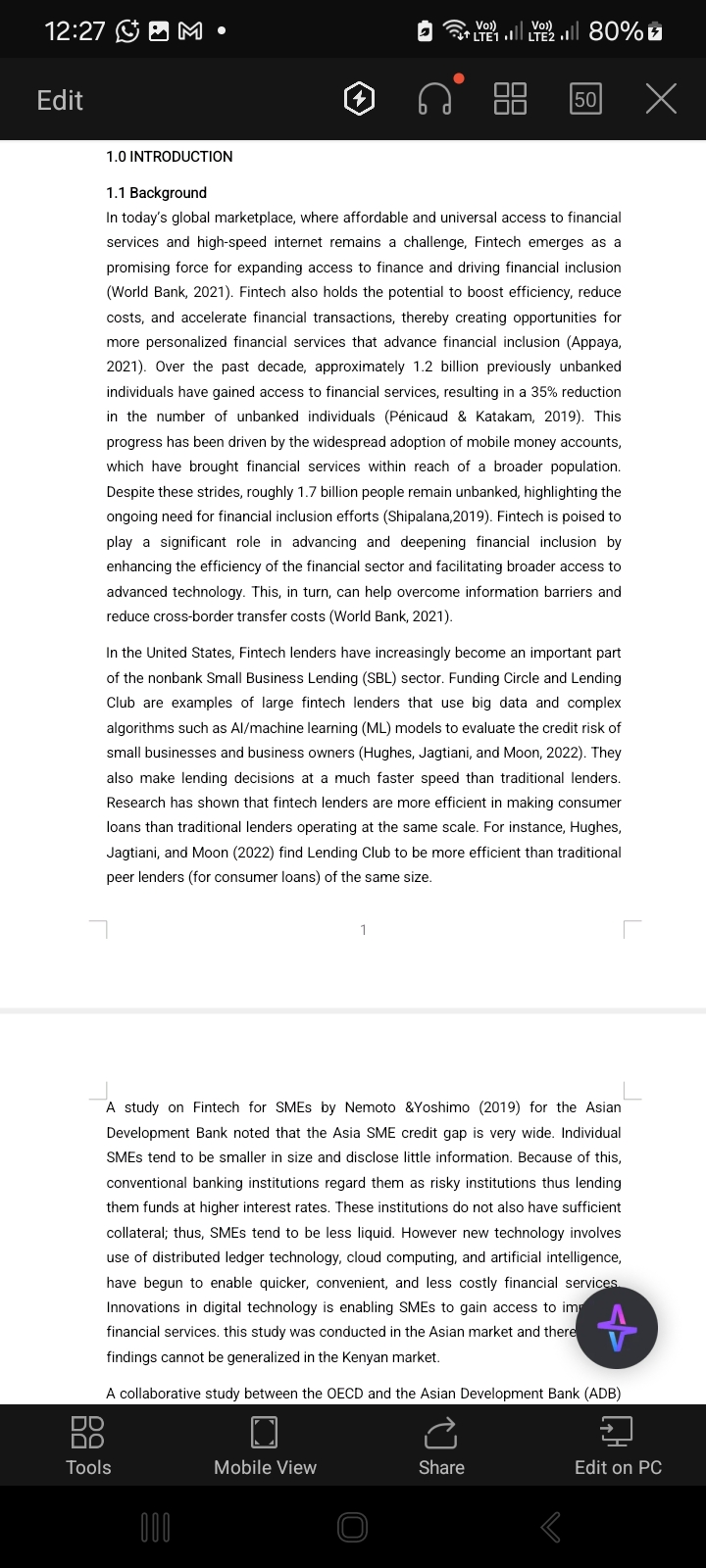
The general objective of the study was to investigate the effect of Fintech on the financial inclusion among small and medium enterprises in Nairobi County. To achieve this goal, the study was grounded on four objectives which included to assess the effect of online banking, to examine the effect of digital lending applications, to determine the effect of agency banking, and to establish the effect of mobile money services on financial inclusion among SMEs in Nairobi County. The study utilized a descriptive research design, while targeting a population of approximately 50,000 SMEs located within Nairobi County. Given the substantial number of SMEs, the research employed a stratified sampling method, using Slovin’s formula to select a representative sample of 400 respondents, SME owners, distributed across two distinct respondent categories.
On the first objective, respondents generally recognized that online banking has expanded their client base and enhanced their operational efficiency. They appreciated the reduced overhead costs and the lower costs compared to traditional banking methods. The convenience of managing financial transactions from anywhere at any time significantly improved, allowing business owners to focus more on their core activities. However, there were reservations about the speed and ease of accessing information through online platforms. On the second objective, digital lending applications were noted for providing quicker access to credit and facilitating faster information retrieval, which are crucial for timely business decisions. Despite these advantages, respondents were skeptical about the affordability of credit through these platforms. They also noted that while digital loans reduced the time needed to access funds, the overall costs were perceived to be lower than those associated with traditional banking. The convenience of using digital lending applications over traditional bank visits was recognized, though not overwhelmingly.
On the third objective, agency banking was well-received for its ability to speed up transactions and deposit processes. Respondents valued the extended working hours and the greater cost-effectiveness compared to traditional banking. The method was particularly praised for reducing transaction times and enhancing access to banking services, thus allowing business owners to dedicate more time to their businesses. The overall sentiment towards agency banking was favorable, highlighting its efficiency and convenience. On the fourth objective, mobile money was unanimously lauded for its role in facilitating accessible and convenient financial transactions. Respondents appreciated the ability to conduct transactions at any time and noted the speed at which they could access information and complete financial transactions. The cost-effectiveness of mobile money transactions compared to traditional methods was a significant advantage. Furthermore, the ease of receiving business payments and accessing bank accounts through mobile platforms greatly enhanced operational efficiency and customer satisfaction.
The analysis demonstrated that fintech services have a marked positive impact on financial inclusion. Online banking showed a significant influence, evidenced by a correlation coefficient (r) of 0.543 and an F-statistic of 137.818, with a p-value of 0.01, highlighting its strong statistical significance. Digital lending applications also made a positive impact, with a correlation coefficient of 0.627 and an F-statistic of 63.265, signaling very high significance with a p-value less than 0.001. Similarly, agency banking registered a correlation coefficient of 0.649 and an F-statistic of 239.128, with a p-value of 0.01, demonstrating its effectiveness. Mobile banking also contributed positively, reflected by a correlation coefficient of 0.621 and an F-statistic of 205.622, with a p-value less than 0.001.
The analysis concluded that online banking not only improves access to financial services and operational efficiency but also presents opportunities for further innovations to meet the evolving needs of small businesses. Digital lending applications provide SMEs with quick and straightforward access to capital. Agency banking effectively bridges service gaps in underserved areas, enhancing financial literacy and inclusion at the grassroots level. Enhancements in training, service offerings, and technology could amplify its benefits. Lastly, mobile banking transforms SME financial management by offering unparalleled convenience and rapid access to services.
To enhance financial inclusion for SMEs, it was recommended that financial institutions integrate advanced technologies like AI and blockchain into online banking and conduct regular training for SME owners to boost their engagement and trust. Additionally, fintech companies should expand digital lending with tailored loan products, simplify applications, and ease approval processes. For agency banking, expanding the agent network in rural areas with intensified training and offering incentives for remote operations is advised. Improving the usability and security of mobile banking applications, increasing smartphone penetration, and partnering with mobile network operators can also significantly benefit SME owners, especially in underserved regions. These initiatives aim to broaden the accessibility and impact of fintech solutions across diverse business sectors.
Below is the document preview.

Design and implementation of smart extinguishing system for gas cooking room project report- electrical telecommunication option
Trending!
This research focuses on developing a smart fire extinguishing system for gas cooking rooms to enhance household safety. The system is designed to detect gas leaks and fires, and automatically extinguish them before they escalate. It employs gas sensors, smoke detectors, a GSM (Global System for Mobile Communications) for notification, and automatic extinguishing mechanisms.
Key components of the system include gas sensors that detect leaks, smoke detectors that identify fire, GSM (Global System for Mobile Communications) technology is incorporated to send realtime alerts to occupants' mobile phones and emergency services, ensuring immediate awareness and response, and an automatic response system that activates water sprinklers or chemical extinguishers. The system also alerts occupants and emergency services.
Tests show that the system quickly detects hazards and responds in real-time, significantly reducing response times and effectively preventing gas cooking fires. This innovative solution enhances domestic safety and can be integrated with smart home technologies for improved risk management.
In conclusion, the smart fire extinguishing system for gas cooking rooms offers a reliable, automatic response to fire hazards, improving household safety and providing a foundation for future advancements in smart home safety solutions.
3201 Views
0 Downloads
513.34 KB
Design and implementation of Smart home fire fighting system project report- electrical telecommunication option
Trending!
My project is designed to ensure security based on a Smart home firefighting system. This idea comes after observing some problems and risks caused by fire. Therefore, a smart home firefighting system was designed as one of the solutions needed for building protection because it uses some components to do it tasks based on its design and implementation composed of a smoke sensor used to sense the smoke in the serve room
The project is used to notify user about the fire accident at home and correct those fire by using water pump in avoiding the absence of people and people’s goods. Otherwise, user can receive the short message about their house wherever they are using mobile phone. It is designed to reduce the risk of more severe fire damage when the fire broke and make it minimum. With this system, it can help users in many aspects, especially to notify the user to make a call and send a message to user, so you can take early steps that can overcome the blaze spread rapidly
The hardware implementation in this project is a smoke sensor, GSM, buzzer, microcontroller and water pump. The result from this project is useful to be implemented in home and industrial to help in the risk of death and injuries furthermore to avoid the losses that need to be borne by the victims.
3354 Views
0 Downloads
219.62 KB
Design and implementation of smart livestock monitoring system research project- electrical telecommunication option
modern agriculture, the integration of technology is becoming increasingly pivotal for enhancing livestock security and efficiency. This project, titled “Design and Implement Smart livestock monitoring system,” aims to develop a comprehensive solution utilizing three ESP32CAMs and three ultrasonic sensors to safeguard agricultural assets and improve real-time monitoring. The core objectives of this project are twofold: first, to detect and alert the presence of people or other animals approaching the farm, and second, to provide farmers with instant video access for remote monitoring and assessment. The system operates by strategically placing ESP32CAMs at key points within the farm, equipped with ultrasonic sensors for precise detection. Upon detecting any potential intrusion, the system triggers an immediate SMS notification to the farmer, allowing for rapid response to potential threats.
Furthermore, the ESP32-CAMs continuously capture and store video footage, which can be accessed remotely by the farmer at any time. This feature not only aids in security but also serves as a valuable tool for farm management and surveillance. The " Design and Implement Smart livestock Monitoring System” represents an innovative and cost-effective solution that enhances livestock security, reduces potential losses, and empowers farmers with real-time insights into their agricultural operations. By leveraging the capabilities of ESP32-CAMs and ultrasonic sensors, this project contributes to the modernization of agriculture, ensuring its sustainability and productivity.
1959 Views
0 Downloads
1.12 MB
Design and implementation of three phase motor using single phase supply and capacitor project report- electrical telecommunication option
Trending!
The design and implementation of a 3-phase motor using a single-phase power supply with the aid of a capacitor addresses a key challenge in electrical motor systems, particularly in areas where 3-phase power is unavailable or impractical. 3-phase motors are known for their efficiency, reliability, and smooth operation, which makes them ideal for industrial applications. However, many environments only provide single-phase power, necessitating conversion techniques to operate these motors effectively.
This project explores the development of a phase conversion method using a start and run capacitor to create the required phase shift that allows a 3-phase motor to run on a singlephase power source. Capacitors are used to generate an artificial phase, thereby creating a pseudo-3-phase system. The design focuses on the optimal selection of capacitors to ensure the balance between phases, improve motor efficiency, and reduce vibration and noise. This approach is both cost-effective and practical for small to medium-scale motor applications.
The implementation involved the detailed analysis of the motor's electrical requirements, the calculation of capacitance values necessary to achieve proper phase shifting, and the design of the connection circuitry. Testing and performance evaluation showed that while the 3-phase motor operating with a single-phase input through a capacitor arrangement does not achieve the full performance of a true 3-phase power system, it is still adequate for many applications where high power or precision control is not critical.
This system provides a practical and affordable solution for running 3-phase motors in environments constrained by single-phase power supplies, making it a viable option for industries and small businesses like development country as Rwanda.
3313 Views
0 Downloads
57.01 KB
DESIGN AND IMPLEMENTATION OF THREE PHASE MOTOR PROJECT REPORT- ELECTRICAL TELECOMMUNICATION OPTION
Trending!
The design and implementation of a 3-phase motor using a single-phase power supply with the aid of a capacitor addresses a key challenge in electrical motor systems, particularly in areas where 3-phase power is unavailable or impractical. 3-phase motors are known for their efficiency, reliability, and smooth operation, which makes them ideal for industrial applications. However, many environments only provide single-phase power, necessitating conversion techniques to operate these motors effectively.
This project explores the development of a phase conversion method using a start and run capacitor to create the required phase shift that allows a 3-phase motor to run on a single-phase power source. Capacitors are used to generate an artificial phase, thereby creating a pseudo-3phase system. The design focuses on the optimal selection of capacitors to ensure the balance between phases, improve motor efficiency, and reduce vibration and noise. This approach is both cost-effective and practical for small to medium-scale motor applications.
The implementation involved the detailed analysis of the motor's electrical requirements, the calculation of capacitance values necessary to achieve proper phase shifting, and the design of the connection circuitry. Testing and performance evaluation showed that while the 3-phase motor operating with a single-phase input through a capacitor arrangement does not achieve the full performance of a true 3-phase power system, it is still adequate for many applications where high power or precision control is not critical.
This system provides a practical and affordable solution for running 3-phase motors in environments constrained by single-phase power supplies, making it a viable option for industries and small businesses like development country
3189 Views
0 Downloads
284.83 KB
DESIGN AND IMPLEMENTATION OF TRANSMISSION LINE -ELECTRICAL TELECOMMUNICATION OPTION
Trending!
Abstract Transmission line is the most important part of the power system. Transmission lines a principal amount of power. the major role of a transmission line is to transmit electric power from the source area to the distribution network. The exploded between limited production, and a tremendous claim has grown the focus on minimizing power losses. Losses like transmission loss and also conjecture factors as like as physical losses to various technical losses, another thing is the primary factor it has a reactive power and voltage deviation are momentous in the long-range transmission power line. In essentially, fault analysis is a very focusing issue in power system engineering to clear fault in short time and re-establish power system as quickly as possible on very minimum interruption. However, the fault detection that interrupts the transmission line is itself challenging task to investigate fault as well as improving the reliability of the system. The transmission line is susceptible given all parameters that connect the whole power system. This paper presents a review of transmission line fault detection.
3168 Views
0 Downloads
991.49 KB
IMPLEMENTATION OF A DC MICROGRID PROJECT REPORT- ELECTRICAL TELECOMMUNICATION OPTION
Trending!
This project presents a comprehensive study on DC microgrids, emphasizing their significance, design, and implementation in modern energy systems. As the demand for efficient, reliable, and sustainable energy solutions grows, DC microgrids emerge as a promising alternative to traditional AC grids. This book explores the fundamental concepts and benefits of DC microgrids, including their ability to enhance energy efficiency, integrate renewable energy sources, and improve power quality. The proposal outlines a systematic approach to designing a DC microgrid, incorporating key components such as energy storage systems, power converters, and control strategies. By examining case studies and current advancements in the field, this book provides a detailed framework for the successful deployment and optimization of DC microgrids. The insights offered aim to guide researchers, engineers, and policymakers in advancing the development of resilient and innovative energy infrastructure.
The increasing demand for reliable and sustainable energy solutions has led to significant advancements in microgrid technology. Unlike traditional AC grids, DC microgrids offer several advantages such as reduced conversion losses, improved system stability, and enhanced compatibility with renewable energy sources. This book aims to provide a comprehensive overview of the design, implementation, and management of DC microgrids.
3292 Views
0 Downloads
578.05 KB
DESIGN OF A SMART RUNWAY ILLUMINATION RESEARCH PROJECT REPORT- ELECTRICAL TELECOMMUNICATION OPTION
Trending!
There is always a need to improve technology for safety, efficiency, and reliability in aviation and in operating airports. This is under this project on " Implementation of a Smart Runway Illumination: Radar-Controlled Lighting System" that has noted most of the limitations mentioned against the traditional runway lighting systems. This research mainly aims to develop an intelligent runway lighting system that can use real-time radar information in combination with highintensity LED light and smart control algorithms to adapt to oncoming aircraft information, including its position, speed, and direction, and environmental factors. It consists of advanced LED and radar technologies, with a developed smart control algorithm that allows runway illumination to be adjusted in real-time, optimizing lighting conditions for aircraft at landing or take-off.
Research has found that the smart runway illumination system not only deals with the drawbacks of the existing systems but also helps in overcoming high-energy consumption. The integration of radar information with such an LED lighting system by the use of intelligent algorithms is a significantly more reliable and efficient lighting system, ensuring the overall safety of the airport's operation. This paper is of high relevance in proposing a possible solution toward the operational constraints of the conventional runway lighting systems, with further potential to save energy and improve safety. Installation of this system in airports to enhance operational efficiency and safety is recommended. Future work that is carried out to study the integration of other environmental data and to free this system for other uses in the airport would greatly beneficial the airport operations. Availing such a remarkable contribution to the aviation
2001 Views
0 Downloads
1 MB
DESIGN OF AUTOMETED GAS LEAK DETECTION SYSTEM- PROJECT REPORT ELECTRICAL TELECOMMUNICATION OPTION
Trending!
This project presents the design and implementation of automated Gas leak detector and ventilation system, aimed at enhancing safety in environments where LPG is used. The system utilizes an Arduino Uno microcontroller, an MQ2 gas sensor, an SG90 micro servo motor, a fan, and a buzzer to detect gas leaks, alert users, and initiate a ventilation process. The MQ2 sensor detects LPG concentrations and triggers the fan and buzzer when dangerous levels are detected, ensuring timely mitigation of potential hazards.
Key findings from the system's evaluation showed that the gas detection mechanism was effective, with the MQ2 sensor detecting LPG concentrations as low as 500 ppm and triggering the fan and alarm at 1000 ppm. The system demonstrated a response time of less than 5 seconds, and the ventilation system reduced gas concentration by 50% within the first 5 minutes of operation. The components used, including the servo motor and fan, functioned reliably throughout the testing phase.
The project successfully meets its objective of responsive, and reliable LPG leak detection system. However, improvements such as enhanced sensor sensitivity, integration of wireless communication for remote monitoring, and the addition of features like automatic gas supply shutdown are recommended for future work to broaden the system’s applicability and functionality.
3454 Views
0 Downloads
1.13 MB
DESIGN OF SMART HOME FIRE FIGHTING PROJECT REPORT- ELECTRICAL TELECOMMUNICATION OPTION
Trending!
My project is designed to ensure security based on a Smart home firefighting system. This idea comes after observing some problems and risks caused by fire. Therefore, a smart home firefighting system was designed as one of the solutions needed for building protection because it uses some components to do it tasks based on its design and implementation composed of a smoke sensor used to sense the smoke in the serve room
The project is used to notify user about the fire accident at home and correct those fire by using water pump in avoiding the absence of people and people’s goods. Otherwise, user can receive the short message about their house wherever they are using mobile phone. It is designed to reduce the risk of more severe fire damage when the fire broke and make it minimum. With this system, it can help users in many aspects, especially to notify the user to make a call and send a message to user, so you can take early steps that can overcome the blaze spread rapidly
The hardware implementation in this project is a smoke sensor, GSM, buzzer, microcontroller and water pump. The result from this project is useful to be implemented in home and industrial to help in the risk of death and injuries furthermore to avoid the losses that need to be borne by the victims.
3308 Views
0 Downloads
414.51 KB