Introduction to Company Law
| Institution | UNIVERSITY OF NAIROBI |
| Course | Bachelor of Laws (LL... |
| Year | 1st Year |
| Semester | Unknown |
| Posted By | Mwalimu Evans Okoyo. |
| File Type | |
| Pages | 21 Pages |
| File Size | 543.85 KB |
| Views | 10185 |
| Downloads | 0 |
| Price: |
Buy Now
 Buy via
whatsapp Buy via
whatsapp
|


Description
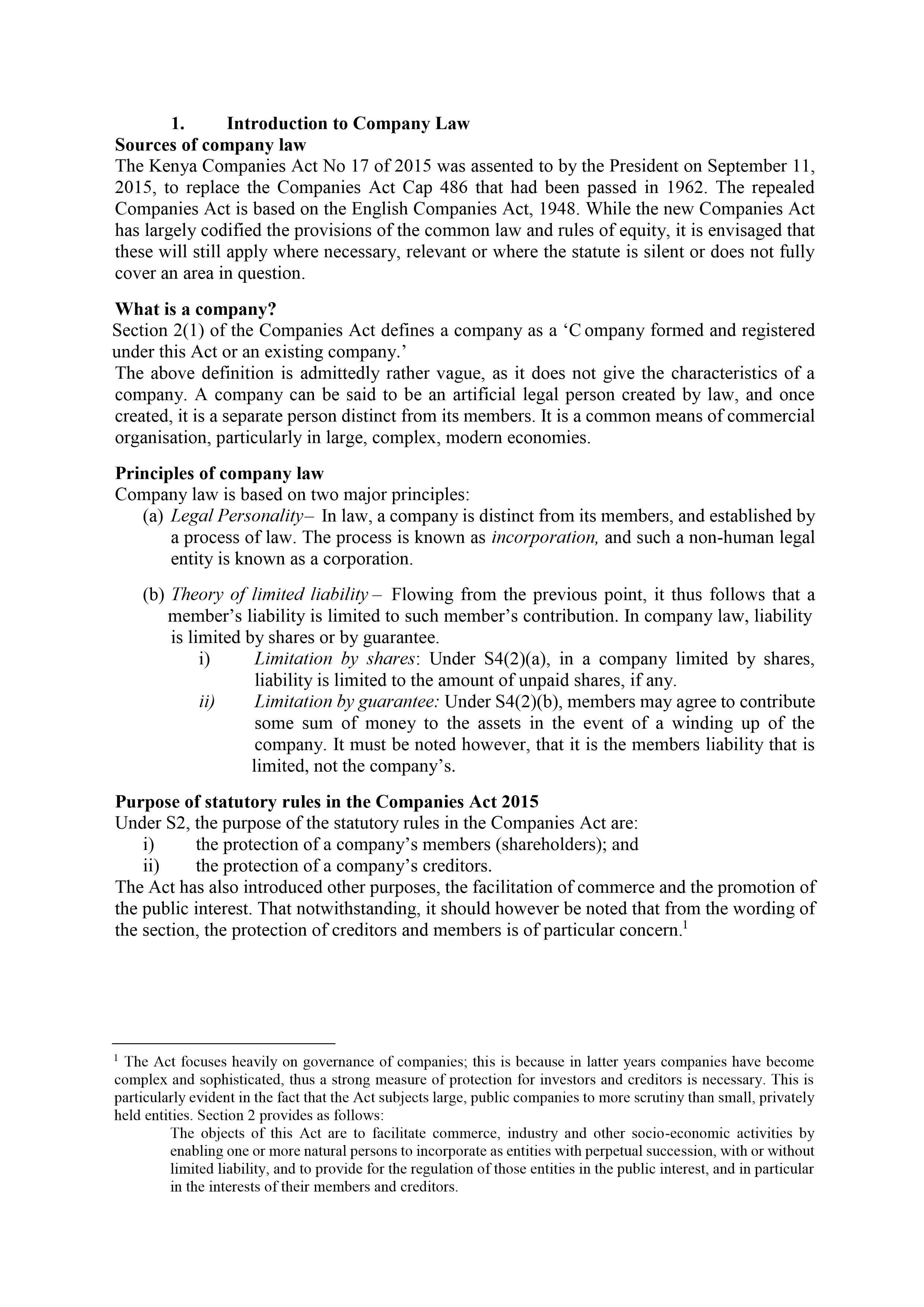
The Kenya Companies Act No 17 of 2015 was assented to by the President on September 11, 2015, to replace the Companies Act Cap 486 that had been passed in 1962. The repealed Companies Act is based on the English Companies Act, 1948. While the new Companies Act has largely codified the provisions of the common law and rules of equity, it is envisaged that these will still apply where necessary, relevant or where the statute is silent or does not fully cover an area in question.
Below is the document preview.

BIOCHEMISTRY
DBY 2101 BIOCHEMISTRY
Introduction
The term ‘biochemistry’ was first introduced by a German chemist Carl Neuberg in 1903. Biochemistry
may be defined as a science concerned with the chemical nature and chemical behavior of the living
matter. Biochemistry is the study of the chemical basis of life. Biochemistry helps us understand how
biological systems work.
‘A biochemist is an investigator who utilizes chemical, physical or biological techniques to study
chemical nature and behavior of living matter
234 Pages
1477 Views
0 Downloads
5.29 MB
APPLIED ORGANIC CHEMISTRY
Trending!
OCTANE RATING AND MOTOR FUELS
i) Gasoline consisting primarily of straight chain
alkanes has poor combustion characteristics
when burned in an internal combustion engine.
ii) Consequently air and vaporized gasoline
mixture tends to ignite spontaneously in the
engine’s cylinder before it is completely
compressed and ignited by the spark plug. This
may result in “Engine knocks” resulting in “loss
of power.
82 Pages
9464 Views
0 Downloads
3 MB
BENZENE AND AROMATICITY
Trending!
Aromatic Compounds
• Aromatic was used to described some fragrant compounds in early 19th century
• Not correct: later they are grouped by chemical behavior (unsaturated
compounds that undergo substitution rather than addition)
• Current: distinguished from aliphatic compounds by electronic configuration.
36 Pages
8794 Views
0 Downloads
1.44 MB
HR1202:LABOUR LAWS
Trending!
The aim of the course is to introduce the institutions and processes of employee and industrial relations with an emphasis on laws,institutions and social processes. It combines theoretical and historical understandings of industrial relations with a detailed examination of the current problems andstrategies of the key industrial relations players.
8108 Views
0 Downloads
181.55 KB
Lesson Plan Template
Trending!
Download a copy of the lesson plan template.
3 Pages
8470 Views
0 Downloads
39.27 KB
SETS AND SET THEORY
Trending!
A set is a well defined list, collection or class of objects.
8121 Views
0 Downloads
32.68 KB
LABOUR LAWS LECTURE NOTES
Trending!
Subject matter of labour law consists of the rules which govern the employment
relationship but a broader perspective would see labour law as the normative framework for the existence and operation of all the institutions of the labour market.
7620 Views
1 Downloads
158 KB
ECONOMICS FULL NOTES
The study of economics begins with understanding of human “wants”. Scarcity forces us to economise. We weigh up the various alternatives and select that particular assortment of goods which yields the highest return from our limited resources. Modern economists use this idea to define the scope of their studies.
1835 Views
1 Downloads
1.61 MB
Money and Banking
There has been no precise definition of money which has conveniently covered its functions. It appears that there are many definitions of money as there are writers of economics. However there are four approaches to definition of money including Conventional approach, Chicago approach.
88 Pages
1758 Views
0 Downloads
532.13 KB
LABOUR & INDUSTRIAL RELATIONS
Trending!
Industrial relations is the relationship between employers and employees or trade union. It has been defined also as that part of management which is concerned with the man power of the enterprise i.e. skilled, semi-skilled and unskilled.
7685 Views
1 Downloads
112.28 KB