Introduction to Company Law
| Institution | UNIVERSITY OF NAIROBI |
| Course | Bachelor of Laws (LL... |
| Year | 1st Year |
| Semester | Unknown |
| Posted By | Mwalimu Evans Okoyo. |
| File Type | |
| Pages | 21 Pages |
| File Size | 543.85 KB |
| Views | 10253 |
| Downloads | 0 |
| Price: |
Buy Now
 Buy via
whatsapp Buy via
whatsapp
|


Description
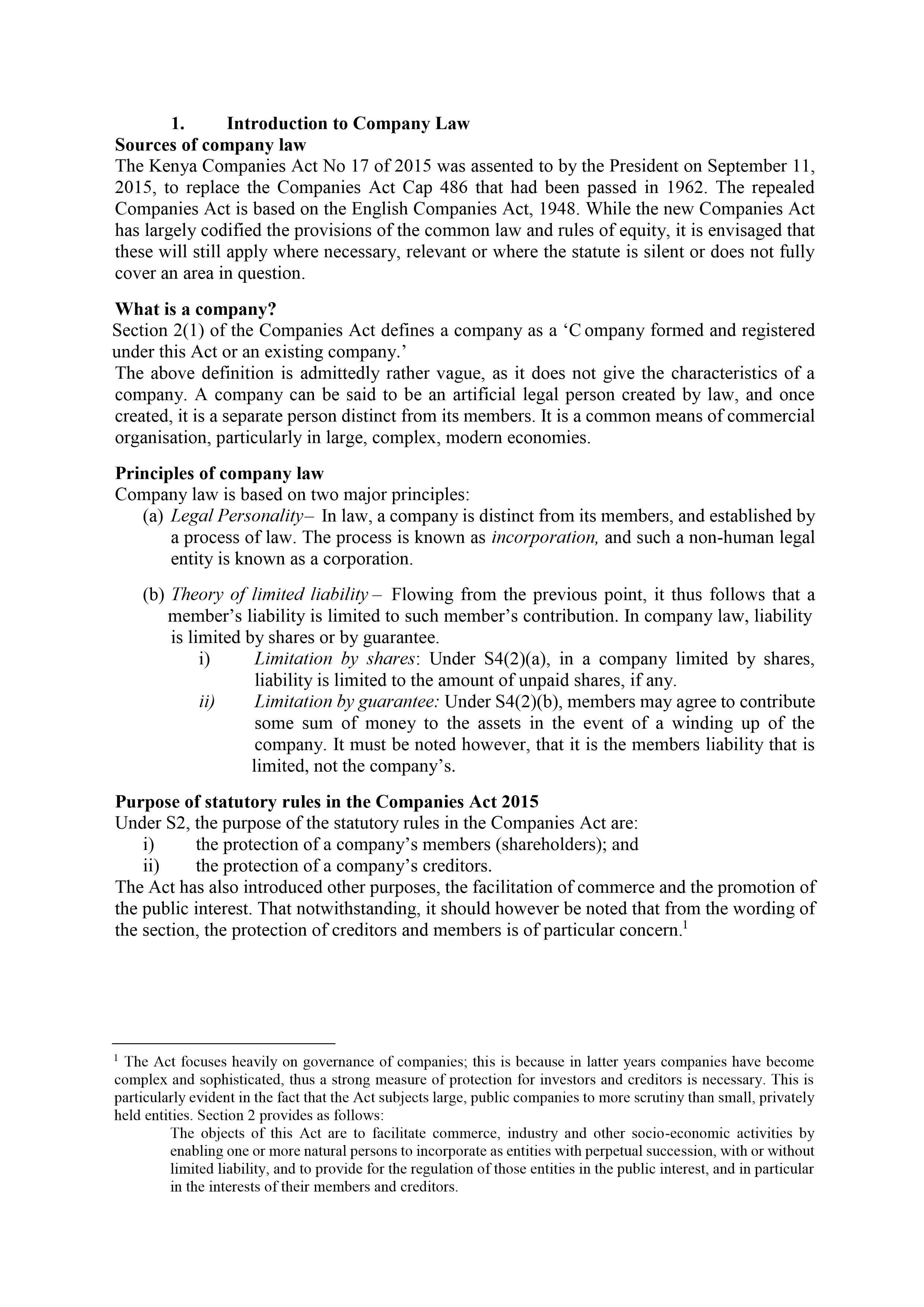
The Kenya Companies Act No 17 of 2015 was assented to by the President on September 11, 2015, to replace the Companies Act Cap 486 that had been passed in 1962. The repealed Companies Act is based on the English Companies Act, 1948. While the new Companies Act has largely codified the provisions of the common law and rules of equity, it is envisaged that these will still apply where necessary, relevant or where the statute is silent or does not fully cover an area in question.
Below is the document preview.

INTRODUCTION TO COMMUNICATION
communication is the giving, receiving, or exchange of information, opinions or ideas by writing, speech or visual means or a combination of the three so that the material communicated is completely understood by everyone concerned.
68 Pages
461 Views
0 Downloads
1.04 MB
Public Relations
Public relations describes the various methods a company uses to disseminate messages about its products, services, or overall image to its customers, employees,
stockholders, suppliers, or other interested members of the community. The point of
public relations is to make the public think favorably about the company and its
offerings. Commonly used tools of public relations include news releases, press
conferences, speaking engagements, and community service programs.
31 Pages
579 Views
0 Downloads
1.13 MB
ACCOMMODATION OPERATIONS MANAGEMENT II
Trending!
This course unit is intended to equip the trainee with knowledge skills and attitude to enable him/her work efficiently in catering and accommodation establishment.
22 Pages
10310 Views
0 Downloads
283.62 KB
HOUSEKEEPING
Housekeeping is defined as the provision of a clean comfortable and safe environment. It can also be defined as that section in a hotel, hospital or hostel that is involved with ensuring high standards of hygiene.
168 Pages
617 Views
1 Downloads
1.48 MB
EMPLOYEES’ RECORDS
Trending!
Personnel records are documents and files relating to the human resources of an
organization and includes or contains information on manpower planning, recruitment and selection, training, compensation, appraisal etc.
9 Pages
8148 Views
0 Downloads
461.21 KB
FRONT OFFICE OPERATIONS KNEC NOTES
Trending!
Front office: Marketing, sales, and service departments that come in direct contact with the customers, and liaise with the back-office (administrative) departments to maintain a two way flow of information.
19 Pages
12524 Views
7 Downloads
313.45 KB
BUSINESS PLAN FORMAT
Trending!
You are expected to write the business plan in the order in which it is presented to you. Do not interchange chapters or rearrange the sub-topics within chapters.
14 Pages
10323 Views
0 Downloads
791.98 KB
APS 301: HUMAN LEARNING
Trending!
So, a baby beginning to walk, a guy taking guitar lessons so he play well enough to impress
girls, a single mom taking real estate classes to get her real estate license and switch careers, a
kid figuring out how to advance to the next level on a video game without resorting to cheat
codes, a grandfather regaining lost function in a hand after a stroke, all of these reflect types of learning. These types of learning aren't all the same, don't all use the same psychological
processes or require the same parts of the brain, but they're still learning according to our
definition.
94 Pages
7225 Views
0 Downloads
1.02 MB
APS 321: ENVIRONMENTAL PSYCHOLOGY
Trending!
Environmental psychology is an interdisciplinary field focused on the interplay between human’s actions or behaviors and their surroundings. The field defines the term environment broadly, encompassing natural environments, social settings, built environments, learning environments and informational environment
30 Pages
2129 Views
0 Downloads
1.21 MB
DATABASE MANAGEMENT SYSTEM
Database management system (DBMS) are computer software applications that interact with the user, other applications, and the database itself to capture and analyze data. A general-purpose DBMS is designed to allow the definition, creation, querying, update, and administration of databases. It’s a set of software programs that controls the organization, storage and retrieval of data (fields, records and files) in a database. It also controls the security and integrity of the database.
72 Pages
705 Views
0 Downloads
1.52 MB