DPTE/DECTE: SOCIOLOGICAL AND PHILOSOPHICAL FOUNDATION OF EDUCATION
| Institution | College |
| Course | DIPLOMA IN EDUCATION |
| Year | 1st Year |
| Semester | Unknown |
| Posted By | Mwalimu Evans Okoyo. |
| File Type | |
| Pages | 63 Pages |
| File Size | 584.77 KB |
| Views | 3251 |
| Downloads | 1 |
| Price: |
Buy Now
 Buy via
whatsapp Buy via
whatsapp
|


Description
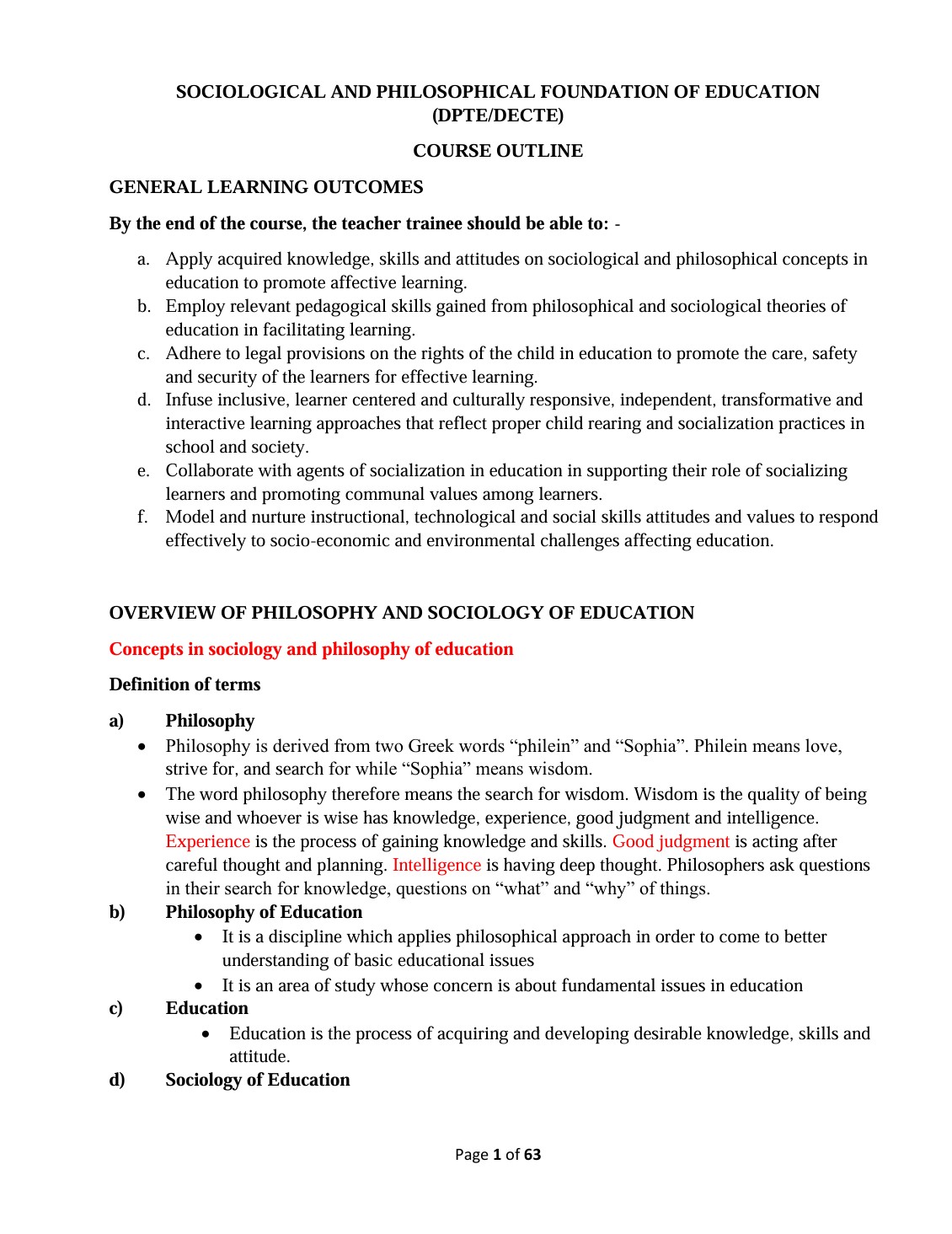
SOCIOLOGICAL AND PHILOSOPHICAL FOUNDATION OF EDUCATION(DPTE/DECTE)COURSE OUTLINEGENERAL LEARNING OUTCOMES By the end of the course, the teacher trainee should be able to: - a.Apply acquired knowledge, skills and attitudes on sociological and philosophical concepts in education to promote affective learning.b.Employ relevant pedagogical skills gained from philosophical and sociological theories of education in facilitating learning.c.Adhere to legal provisions on the rights of the child in education to promote the care, safety and security of the learners for effective learning. d.Infuse inclusive, learner centered and culturally responsive, independent, transformative and interactive learning approaches that reflect proper child rearing and socialization practices in school and society.e.Collaborate with agents of socialization in education in supporting their role of socializing learners and promoting communal values among learners.f.Model and nurture instructional, technological and social skills attitudes and values to respond effectively to socio-economic and environmental challenges affecting education. OVERVIEW OF PHILOSOPHY AND SOCIOLOGY OF EDUCATIONConcepts in sociology and philosophy of education Definition of termsa)Philosophy Philosophy is derived from two Greek words “philein” and “Sophia”. Philein means love, strive for, and search for while “Sophia” means wisdom.
Below is the document preview.

ENGINEERING STRUCTURES DESIGN
Trending!
1 Introduction of the Unit of Learning
This unit specifies the competencies required to design engineering structures. This involves load estimation, designing structural elements, assessing of cost effectiveness of edesigns, analysing site test data and modifying structural designs.
28 Pages
2535 Views
0 Downloads
587.72 KB
MATERIAL TESTING
Trending!
This unit specifies the competencies required to Conduct Material Testing. It involves preparing for material testing, sampling construction materials, and performing tests on alignment soils, concrete, structural steel, bitumen materials and timber. It also includes documenting test results.
50 Pages
2682 Views
0 Downloads
488.22 KB
CON/OS/CET/CR/02/6/A: PERFORM HIGHWAY SURVEY
Be ahead of the rest by grabbing a copy of PERFORM HIGHWAY SURVEY QUESTIONS AND ANSWERS PAPERS for your revision purposes.
9 Pages
544 Views
0 Downloads
1.13 MB
MATERIAL TECHNOLOGY AND METALLURGY COMPLETE KNEC NOTES
Trending!
The knowledge of materials and their properties is of great significance for a design engineer. The machine elements should be made of such a material which has properties suitable for the conditions of operation. In addition to this, a design engineer must be familiar with the effects which the manufacturing processes and heat treatment have on the properties of the materials. In this chapter, we shall discuss the commonly used engineering materials and their properties in Machine Design.
95 Pages
3196 Views
0 Downloads
871.07 KB
Fabric Decoration Notes
Trending!
The document provides an overview of fabric design and decoration techniques, highlighting various methods such as painting, batik, tie and dye, block printing, and screen printing. It discusses the functions of decorated fabrics, including aesthetic, cultural, social, ritual, religious, political, and economic purposes. Additionally, it outlines the materials and tools required for each technique, emphasizing the importance of design planning and execution in fabric decoration.
19 Pages
2448 Views
0 Downloads
133.77 KB
General Building and Construction KNEC Notes Diploma Year 1
Trending!
The document discusses the evolution of built environments from prehistoric times to modern dwellings. It begins by defining built environment and exploring early dwellings like cave homes and temporary structures made of leaves, branches, and stones. As humans transitioned to agriculture, permanent settlements emerged with round houses made of mud bricks and plaster. The document then outlines traditional dwellings from regions in Africa and other parts of the world. Finally, it describes modern dwellings like bungalows, mansions, and apartment buildings that make use of sophisticated materials and straight walls.
147 Pages
3117 Views
0 Downloads
8.23 MB
Computer Application in Business
Computer Application in Business
112 Pages
587 Views
0 Downloads
3.18 MB
Mathematics Curriculum for Teacher Education
Trending!
The Mathematics course in DSTE aims at equipping the trainee with the necessary knowledge, skills and competencies for effective implementation of Secondary Mathematics both at Junior and Senior Schools. The Mathematics course entails Computations in numbers and development of algebraic thinking, Analysis and Calculus, Measurements and the study of Geometry for the development of Spatial relations.
123 Pages
2974 Views
0 Downloads
344.35 KB
PERIOPERATIVE THEATER INSTRUMENTS EXAM PAPER
Trending!
Institution: College
Year: 2021/2022
Semester: 1st Year, 1st Semester (1.1)
STRUCTURAL DESIGN AND ANALYSIS
This Unit describes the competencies required to Perform Structural Design and Analysis. It involves analysing structural designs, designing structural elements, preparing structural drawings interpreting structural drawings and applying structural drawings.
28 Pages
1961 Views
0 Downloads
538.53 KB