ADHERENCE AND ASSOCIATED FACTORS TO TYPE 1 DIABETES MELLITUS CARE AMONG ADOLESCENTS AT KISII COUNTY- NURSING RESEARCH PROJECT
| Institution | Kenya Medical Training College |
| Course | Nursing |
| Year | 3rd Year |
| Semester | Unknown |
| Posted By | MAKORI KERECHA |
| File Type | docx |
| Pages | |
| File Size | 123.01 KB |
| Views | 2284 |
| Downloads | 0 |
| Price: |
Buy Now
 Buy via
whatsapp Buy via
whatsapp
|


Description
ADHERENCE AND ASSOCIATED FACTORS TO TYPE 1 DIABETES MELLITUS CARE AMONG ADOLESCENTS AT KISII COUNTY
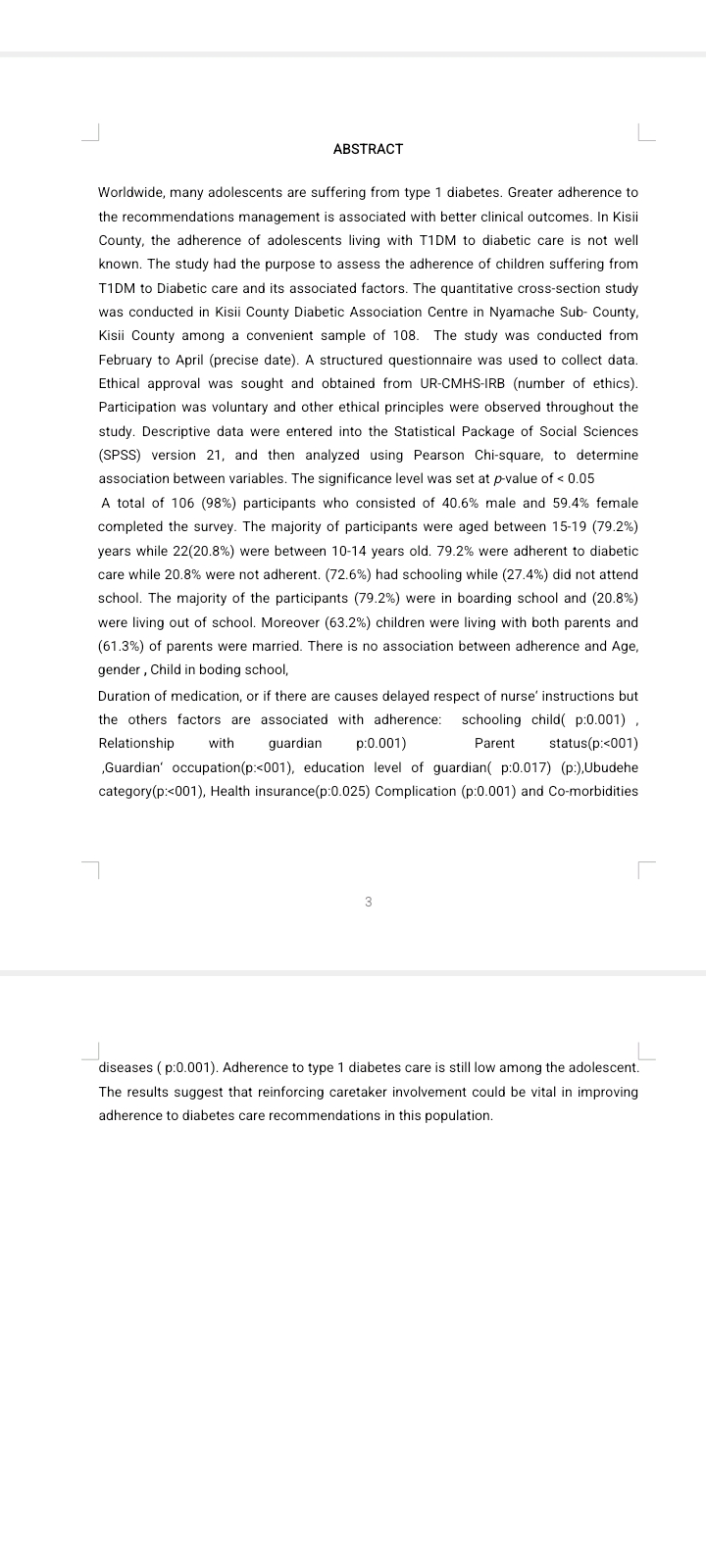
the recommendations management is associated with better clinical outcomes. In Kisii County, the adherence of adolescents living with T1DM to diabetic care is not well known. The study had the purpose to assess the adherence of children suffering from T1DM to Diabetic care and its associated factors. The quantitative cross-section study was conducted in Kisii County Diabetic Association Centre in Nyamache Sub- County, Kisii County among a convenient sample of 108. The study was conducted from February to April (precise date). A structured questionnaire was used to collect data. Ethical approval was sought and obtained from UR-CMHS-IRB (number of ethics). Participation was voluntary and other ethical principles were observed throughout the study. Descriptive data were entered into the Statistical Package of Social Sciences (SPSS) version 21, and then analyzed using Pearson Chi-square, to determine association between variables. The significance level was set at p-value of < 0.05
A total of 106 (98%) participants who consisted of 40.6% male and 59.4% female completed the survey. The majority of participants were aged between 15-19 (79.2%) years while 22(20.8%) were between 10-14 years old. 79.2% were adherent to diabetic care while 20.8% were not adherent. (72.6%) had schooling while (27.4%) did not attend school. The majority of the participants (79.2%) were in boarding school and (20.8%) were living out of school. Moreover (63.2%) children were living with both parents and (61.3%) of parents were married. There is no association between adherence and Age, gender , Child in boding school,
Duration of medication, or if there are causes delayed respect of nurse‘ instructions but the others factors are associated with adherence: schooling child( p:0.001) , Relationship with guardian p:0.001) Parent status(p:<001) ,Guardian‘ occupation(p:<001), education level of guardian( p:0.017) (p:),Ubudehe category(p:<001), Health insurance(p:0.025) Complication (p:0.001) and Co-morbidities
Below is the document preview.

Prevalence of Diabetes Mellitus among patients attendingTabaka Mission Hospital, Kisii County .- Health science and medicine
Trending!
Prevalence of Diabetes Mellitus among patients attendingTabaka Mission Hospital, Kisii County .
ABSTRACT
In today’s world, 180 million people are suffering from diabetes. Out of these, 162 million have type 2 diabetes. Type 2 diabetes, a state of diminished systemic sensitivity to insulin, has its root in the lifestyle of the subjects. The prevalence of diabetes in the WHO African Region was estimated at 1.02 million (10%) had type 1 diabetes and 6.3 million (90%) had type 2 diabetes. The main objective of the study will be to determine the prevalence of Diabetes mellitus among patients above 18 years attending Tabakamissin hospital, kisii County. The study will adopt quantitive descriptive cross sectional as it will be hospital based. The study shall employ only 100 patients selected systematically out of total patients tested will represent all patients who will be tested. blood specimen will be used in analyzation of Diabetes mellitus. The method can be used on cases of emergency, it is reliable and easy to use. The study data shall be presented by use of bar graphs and pie charts. Ethical issues shall be adhered where research shall be carried upon grant of permission from relevant authorities.
33 Pages
3184 Views
0 Downloads
261.55 KB
FACTORS CONTRIBUTING TO HIGH PREVAILENCE OF MALARIA AMONG CHILDREN UNDER-FIVE YEARSATTENDING KISUMU DISTRICT HOSPITAL
Malaria is a life-threatening disease that has adverse effects on child development. The effects include absenteeism from school and pains associated with malaria. Malaria is an urgent public health priority and has resulted families in a cycle of illness, suffering and poverty. The study described the existing relationship, between socio-demographic characteristics of caregivers; household’s socioeconomic factors; maternal healthcare and immunization against childhood disease and health status of children under-five years. The general objective was to determine risk factors associated with occurrence of malaria among children attending Kisumu district hospital in Kisumu county. The specific objectives were to determine the socio-economic, demographic and environmental factors associated with occurrence of malaria among children attending Kisumu hospital. The sample size of this study was 248 household with children under-five years based on the target population of 681 elements in Kisumu county. The study used both primary and secondary data for study. Primary data was collected using questionnaires and secondary data derived from Kenya Malaria Indicator Survey (KMIS) conducted in 2017.Data was analyzed using tables, mean and percentage by use of Statistical Package for Social Sciences (SPSS) version 17. The response rate was high for male gender representing 62.1% and female 37.9%. The study also revealed that age, place of residence, level of anemia, wealth quintile, availability of electricity and cluster altitude were significant predictors of malaria. The study revealed that aspects such as source of household food, number of meals taken during food shortage, main source of drinking water, where healthcare is sought and ownership of agricultural land are not statistically significant. From findings we concluded that gender of the household head has an influence on the health status of children under-five years. Furthermore, level of education and occupation of the caregiver had an influence on health status of children under-five years. The study recommends that greater efforts need to be put in place by the government to ensure provision of affordable water, nutrition education, provision of employment and proper healthcare to fight the under five mortality
44 Pages
646 Views
0 Downloads
377.66 KB
FACTORS ASSOCIATED WITH NEW HIV INFECTIONS AMONG INFANTS BORN TO MOTHERS ON PREVENTION OF MOTHER TO CHILD TRANSMISSION PROGRAMME - health science and medicine
Trending!
FACTORS ASSOCIATED WITH NEW HIV INFECTIONS AMONG INFANTS BORN TO MOTHERS ON PREVENTION OF MOTHER TO CHILD TRANSMISSION PROGRAMME
ABSTRACT
The goal of prevention of mother to child transmission (PMTCT) is to minimize new HIV infection with PMTCT interventions the chance of infection has been reduce to as low as 2%. Gusii region is number five among counties that contribute 65% of new HIV infections in Kenya. To determine the factors associated with new HIV infections among infants born of HIV positive mothers on PMTCT follow up at Kisii Teaching and Referral Hospital. This was a cross sectional study conducted at Kisii Teaching and Referral hospital among HIV positive mothers with infants on PMTCT follow up and health care workers over a period of 1 month. Mixed method design was used to collect data from both mothers with infants below 18 months and HIV tested on PMTCT follow up and health care workers at the MCH clinic. A structured questionnaire was used for HIV mothers with infants and in-depth interview guide for health care workers to collect information on perception of PMTCT uptake. A sample size of 96 out of 128 mothers with infants were conveniently selected and sampling frame was used to select 10 health care workers who had worked for more than 5 months in the Maternal and Child Health clinic. The data collected was cleaned, entered and analyzed using the Statistical Package of Social Sciences (SPSS) version 20. Descriptive and inferential statistical methods were used to summarize data and determine association between study variables. Quantitative results were presented in descriptive statistical format using frequency tables, bar charts and pie charts. Qualitative data obtained was coded through content analysis according to themes.
A total of 96 mothers with infants and 10 health care workers were included in the analysis. A total of 13(13.5%) infants were infected with HIV. Hospital delivery, infant prophylaxis at birth, follows up medication of the infant and infant feeding methods (p-value=0.001) were significantly and independently associated. Hospital delivery, breastfeeding for 6 months and use on antiretroviral treatment at birth and follow up treatment to infants were found to reduce the transmission of HIV infections with support from government and donors improved the delivery of PMTCT services in the facility. Counseling on Infant feeding and use of anti-retroviral treatment with support from partners should be strengthened in the PMTCT program to ensure reduction of new HIV infections in the setting.
78 Pages
3069 Views
0 Downloads
693.98 KB
FACTORS CONTRIBUTING TO HIGH PREVAILENCE OF MALARIA AMONG CHILDREN UNDER-FIVE YEARSATTENDING KISUMU DISTRICT HOSPITAL-Diploma in pharmaceutical technology
Trending!
Diploma in pharmaceutical technology
Malaria is a life-threatening disease that has adverse effects on child development. The effects include absenteeism from school and pains associated with malaria. Malaria is an urgent public health priority and has resulted families in a cycle of illness, suffering and poverty. The study described the existing relationship, between socio-demographic characteristics of caregivers; household’s socioeconomic factors; maternal healthcare and immunization against childhood disease and health status of children under-five years. The general objective was to determine risk factors associated with occurrence of malaria among children attending Kisumu district hospital in Kisumu county. The specific objectives were to determine the socio-economic, demographic and environmental factors associated with occurrence of malaria among children attending Kisumu hospital. The sample size of this study was 248 household with children under-five years based on the target population of 681 elements in Kisumu county. The study used both primary and secondary data for study. Primary data was collected using questionnaires and secondary data derived from Kenya Malaria Indicator Survey (KMIS) conducted in 2017.Data was analyzed using tables, mean and percentage by use of Statistical Package for Social Sciences (SPSS) version 17. The response rate was high for male gender representing 62.1% and female 37.9%. The study also revealed that age, place of residence, level of anemia, wealth quintile, availability of electricity and cluster altitude were significant predictors of malaria. The study revealed that aspects such as source of household food, number of meals taken during food shortage, main source of drinking water, where healthcare is sought and ownership of agricultural land are not statistically significant. From findings we concluded that gender of the household head has an influence on the health status of children under-five years. Furthermore, level of education and occupation of the caregiver had an influence on health status of children under-five years. The study recommends that greater efforts need to be put in place by the government to ensure provision of affordable water, nutrition education, provision of employment and proper healthcare to fight the under five mortality
44 Pages
3917 Views
0 Downloads
377.66 KB
FACTORS INFLUENCING NON-ADHERENCE TO ANTI RETROVIRAL THERAPY AMONG HIV/AIDS PATIENTS VISITING GUCHA SUB COUNTY HOSPITAL
Trending!
FACTORS INFLUENCING NON-ADHERENCE TO ANTI RETROVIRAL THERAPY AMONG HIV/AIDS PATIENTS VISITING GUCHA SUB COUNTY HOSPITAL
An antiretroviral therapy (ART) adherence of at least 95% has been proven necessary in order for treatment to be effective. Failure to meet this level results in poor immunological and virological outcomes. The objective of study was to determine factors influencing non-adherence to Antiretroviral therapy among HIV and AIDS patients visiting Gucha Sub County hospital. Cross sectional study was carried out at Gucha Sub County hospital in Kisii County Kenya in December 2015. Patients in comprehensive care clinic meeting the inclusion criteria were selected using systematic random sampling method. Both qualitative and quantitative methods of data collection were utilized, where structured questionnaire with open and closed type questions where an approximate of 69 participants was selected using fishers et-al method. Key informant interviews for health care providers were conducted. Data was analyzed using SPSS software version 22. Data is presented using charts, graphs and frequency tables. Level of adherence was sub-optimal (83%). Taking ARV drugs without eating any food made patients suffer from side effects thus making them avoid taking the medication. Poverty contributes to lack of food which had a 39.73% on affecting ARV’s followed by Stress having 34.25% lastly lack of proper education having 26.02% effect. Stigma was 32.20% showing highly affecting patients on accessibility of ART’s due to social circle around the HIV patients, negative perception, lack of family and community support is some obstacles to ART adherence. Long travel and distance to hospital for ART and poor weather is barrier to accessibility of ART during such rainy seasons having 20.55% hence a major hinder to optimal adherence. This study is set to be useful to other scholars doing studies in this area and for planning interventions and effective strategies for maximizing long-term adherence to ART for successful treatment of HIV and AIDS from the findings we concluded that lack of meals during medication led to avoidance of taking medicine and long distances of travel from health facilities made the patients lose morale to access the facilities.The study recommended development strategies to enhance food security in household with people living with HIV Aids, intensify health education complains against stigma and promote family and community support for people living HIV.
41 Pages
3521 Views
0 Downloads
453.07 KB
THE SIDE EFFECTS OF IMPROPER PHARMACEUTICAL WASTES DISPOSAL IN THE ENVIRONMENT-pharmaceutical technology
Trending!
THE SIDE EFFECTS OF IMPROPER PHARMACEUTICAL WASTES DISPOSAL IN THE ENVIRONMENT
Diploma in pharmaceutical technology
ABSTRACT
Medication disposal is an alarming issue today and gaining more and more awareness from the healthcare professionals as well as consumers. Pharmacists have the potential to be on the forefront of this movement as a healthcare professionals and pharmacists are in an admirable position to educate patients about safe drug disposal. Proper patient counselling on safe medication disposal can make a significant difference to public health and the environment. The knowledge on method of disposal of unused medicines is equally important as that of consumption of medicines. This study aims to determine the methods of pharmaceutical wastes disposal within Kisii town, determine the side effects of improper pharmaceutical wastes disposal within Kisii and to determine the classes of pharmaceutical wastes segregation in the environment within Kisii town.
The information about methods of proper disposal as well as consequence of improper disposal was collected by extensive literature survey of all available resources as well as primary data obtained from questionnaires.Till date, researchers have acknowledged many human and veterinary pharmaceutical compounds at serious concentrations in drinking water resources and they are a major contributor to environmental pollution. Emphasis is also given on pharmacist role in proper disposal of unwanted and expired medicine makes a significant impact on the environment as well as it prevents accident, poisoning and intentional violence. So it will lead to the welfare of society and trudge towards goal of health for all. Among the findings, included the major impacts of improper pharmaceutical wastes disposal i.e. pollution, antibiotics resistance, effects on animals populations. Both unwanted drugs i.e. expired and discontinued medications as well as their packaging materials were found in the environment within Kisii. Among others the most disposal means of pharmaceutical wastes were to be use of flash sinks, open burning and incineration.
42 Pages
3218 Views
0 Downloads
270.38 KB
HE/CU/TT/CC/02/6/A: BASIC HOSPITAL PROCEDURES NOTES
Trending!
This unit specifies the competencies required to apply basic hospital procedures. It involves demonstrating the knowledge of a health facility set up, medical equipment in basic patient care identifying elements of total-patient-care and applying basic patient care procedures
3687 Views
0 Downloads
16.97 KB
HE/CU/TT/CR/05/6/A: EXECUTION OF PERIOPERATIVE THEATRE ADMINISTRATIVE SERVICES
Trending!
This unit describes the competencies required to execute Perioperation Theatre administrative services. It involves implementation of Perioperation Theatre policies and performing administrative duties. It also entails the day to day running of Perioperation Theatre facility.
3865 Views
3 Downloads
1.17 MB
HE/CU/TT/CR/07/6/A: PARTICIPATION IN PERIOPERATIVE THEATRE CLINICAL SERVICES
Trending!
This unit describes the competencies required to participate in provision of Perioperation Theatre Clinical Services. It involves preparing emergency trolley, undertaking patients’ and procedure verification, patient wheeling, assisting in inducing, monitoring and reversal of the patient.
3613 Views
3 Downloads
2.3 MB
HEALTH STATISTICS 1
Trending!
This unit will help you understand basic concepts in statistics and it's application in health.
20 Pages
4179 Views
2 Downloads
663.72 KB