ADHERENCE AND ASSOCIATED FACTORS TO TYPE 1 DIABETES MELLITUS CARE AMONG ADOLESCENTS AT KISII COUNTY- NURSING RESEARCH PROJECT
| Institution | Kenya Medical Training College |
| Course | Nursing |
| Year | 3rd Year |
| Semester | Unknown |
| Posted By | MAKORI KERECHA |
| File Type | docx |
| Pages | |
| File Size | 123.01 KB |
| Views | 2305 |
| Downloads | 0 |
| Price: |
Buy Now
 Buy via
whatsapp Buy via
whatsapp
|


Description
ADHERENCE AND ASSOCIATED FACTORS TO TYPE 1 DIABETES MELLITUS CARE AMONG ADOLESCENTS AT KISII COUNTY
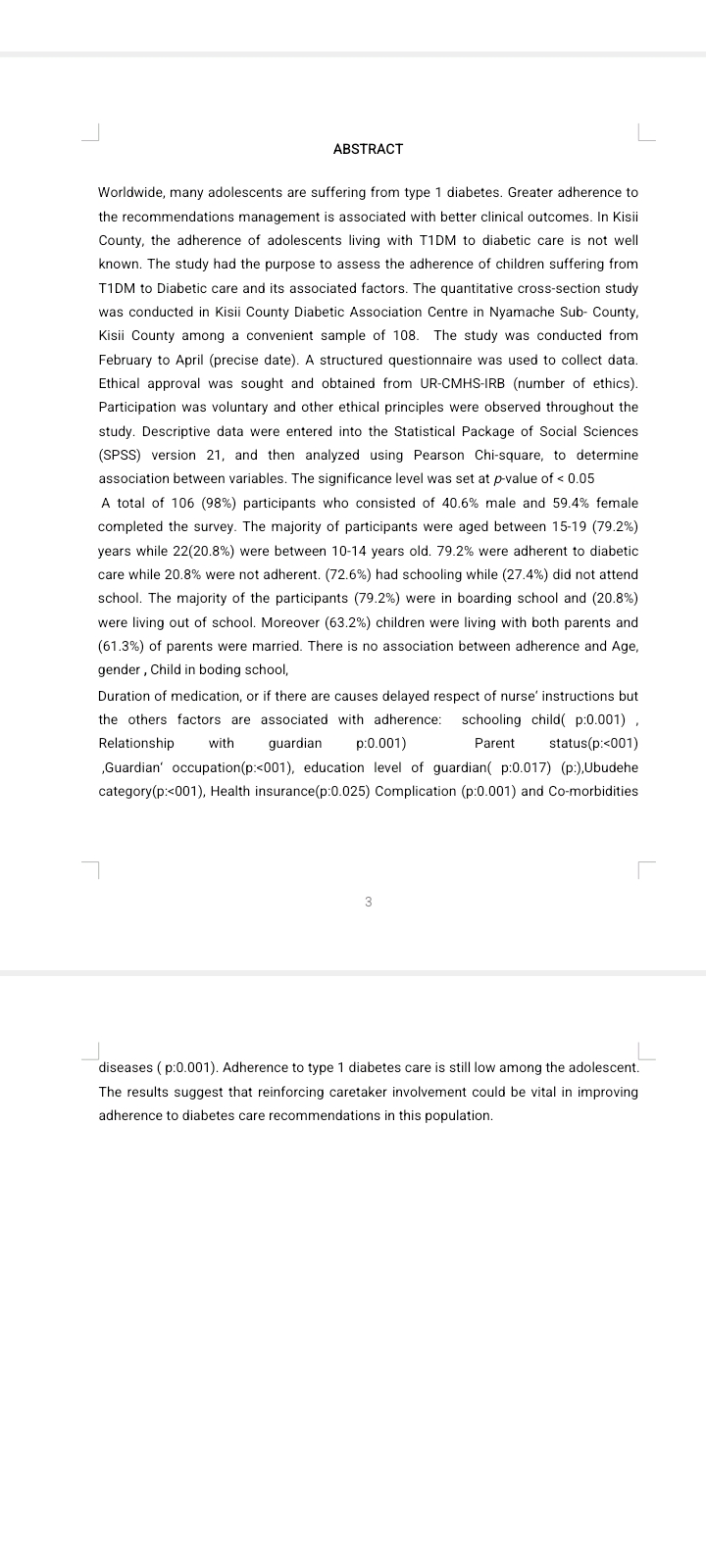
the recommendations management is associated with better clinical outcomes. In Kisii County, the adherence of adolescents living with T1DM to diabetic care is not well known. The study had the purpose to assess the adherence of children suffering from T1DM to Diabetic care and its associated factors. The quantitative cross-section study was conducted in Kisii County Diabetic Association Centre in Nyamache Sub- County, Kisii County among a convenient sample of 108. The study was conducted from February to April (precise date). A structured questionnaire was used to collect data. Ethical approval was sought and obtained from UR-CMHS-IRB (number of ethics). Participation was voluntary and other ethical principles were observed throughout the study. Descriptive data were entered into the Statistical Package of Social Sciences (SPSS) version 21, and then analyzed using Pearson Chi-square, to determine association between variables. The significance level was set at p-value of < 0.05
A total of 106 (98%) participants who consisted of 40.6% male and 59.4% female completed the survey. The majority of participants were aged between 15-19 (79.2%) years while 22(20.8%) were between 10-14 years old. 79.2% were adherent to diabetic care while 20.8% were not adherent. (72.6%) had schooling while (27.4%) did not attend school. The majority of the participants (79.2%) were in boarding school and (20.8%) were living out of school. Moreover (63.2%) children were living with both parents and (61.3%) of parents were married. There is no association between adherence and Age, gender , Child in boding school,
Duration of medication, or if there are causes delayed respect of nurse‘ instructions but the others factors are associated with adherence: schooling child( p:0.001) , Relationship with guardian p:0.001) Parent status(p:<001) ,Guardian‘ occupation(p:<001), education level of guardian( p:0.017) (p:),Ubudehe category(p:<001), Health insurance(p:0.025) Complication (p:0.001) and Co-morbidities
Below is the document preview.

NEUROLOGICAL NURSING: INTRODUCTION,SPACE OCCUPYING LESION, TRANSIET ISCHEMIC ATTACK, CEREBROVASCULAR ACCIDENT,ANEURYSMS
Trending!
HISTORY TAKING
Opening the consultation
Wash your hands and don PPE if appropriate.
Introduce yourself to the patient including your name and role.
Confirm the patient’s name and date of birth.
Explain that you’d like to take a history from the patient.
Gain consent to proceed with history taking
2830 Views
0 Downloads
1003.95 KB
Health Information System (HIS)
Trending!
Grab a full copy of Health Information System (HIS) notes for your studies .
102 Pages
2523 Views
0 Downloads
2.14 MB
HEALTH DATA CLASSIFICATION
Health Data Classification refers to the process of organizing health-related information into categories based on type, sensitivity, and purpose. This helps in proper storage, security, analysis, and decision-making.
25 Pages
458 Views
0 Downloads
524.35 KB
RESPIRATORY SYSTEM & URINARY SYSTEM LECTURE NOTES
Trending!
The respiratory system is a vital biological system responsible for exchanging gases (oxygen and carbon dioxide) between the body and the environment.
It includes the lungs and airways (trachea, bronchi, bronchioles), as well as structures like the diaphragm and chest wall.
The primary function of the respiratory system is to deliver oxygen to the blood, which then distributes it throughout the body, while also removing carbon dioxide, a waste product of cellular respiration
3017 Views
1 Downloads
872 KB
CARDIOVASCULAR SYSTEM LECTURE NOTES
Trending!
Heart
The heart is the central organ of the cardiovascular system, acting as a pump to circulate blood throughout the body.
It's a muscular organ with four chambers that work together to move blood into the arteries, which then distribute it to the body's tissues and organs.
The heart also receives deoxygenated blood from the body and sends it to the lungs to be oxygenated, completing the circulation cycle
2919 Views
2 Downloads
1.96 MB
TRIAGE AND CATEGORIES OF TRIAGE PAEDIATRICS LECTURE NOTES
Trending!
Triage is the term derived from the French verb trier meaning to sort or to choose
It’s the process by which patients classified according to the type and urgency of their conditions to get the Right patient to the Right place at the Right time with the Right care provider
3071 Views
0 Downloads
69.95 KB
TREATMENT FOR THE CHILD GOING HOME PEADIATRICS LECTURE NOTES
Trending!
TEACH THE MOTHER/CAREGIVER TO GIVE ORAL DRUGS AT HOME
Follow the instructions below for every oral drug to be given at home.
Also follow the instructions listed with each drug’s dosage table.
» Determine the appropriate drugs and dosage for the child’s age or weight.
» Tell the mother/caregiver the reason for giving the drug to the child.
» Demonstrate how to measure a dose.
2994 Views
0 Downloads
466.04 KB
KMTC: TONSILITIS PEADIATRICS LECTURE NOTES
Trending!
Tonsils are protective (lymph) gland that are situated on both sides in the throat.
Tonsils constitute an important part of the body’s immune system and are vital defense organ.
They protect the body from bacteria and viruses by fighting these as soon as they enter the body via the oral / nasal cavity.
Most cases bacterial tonsillitis are caused by group A beta- hemolytic streptococcus pyogenes (GABHS).
2051 Views
0 Downloads
1.06 MB
SPINA BIFIDA PAEDIATRIC LECTURE NOTES
Trending!
Spina bifida (SB ) is a condition that affects the spine and is usually apparent at birth. It is a type of neural tube defect (NTD).
Spina bifida can happen anywhere along the spine if the neural tube does not close all the way.
3267 Views
0 Downloads
1.09 MB
SORE THROAT PEADIATRIC LECTURE NOTES
Trending!
• Sore throat is essentially an acute tonsillitis and/or pharyngitis. It is characterised by redness and oedema of mucosa, pseudo membrane formation, and enlargement of cervical lymph nodes.
2300 Views
0 Downloads
7.52 MB