ADHERENCE AND ASSOCIATED FACTORS TO TYPE 1 DIABETES MELLITUS CARE AMONG ADOLESCENTS AT KISII COUNTY- NURSING RESEARCH PROJECT
| Institution | Kenya Medical Training College |
| Course | Nursing |
| Year | 3rd Year |
| Semester | Unknown |
| Posted By | MAKORI KERECHA |
| File Type | docx |
| Pages | |
| File Size | 123.01 KB |
| Views | 2310 |
| Downloads | 0 |
| Price: |
Buy Now
 Buy via
whatsapp Buy via
whatsapp
|


Description
ADHERENCE AND ASSOCIATED FACTORS TO TYPE 1 DIABETES MELLITUS CARE AMONG ADOLESCENTS AT KISII COUNTY
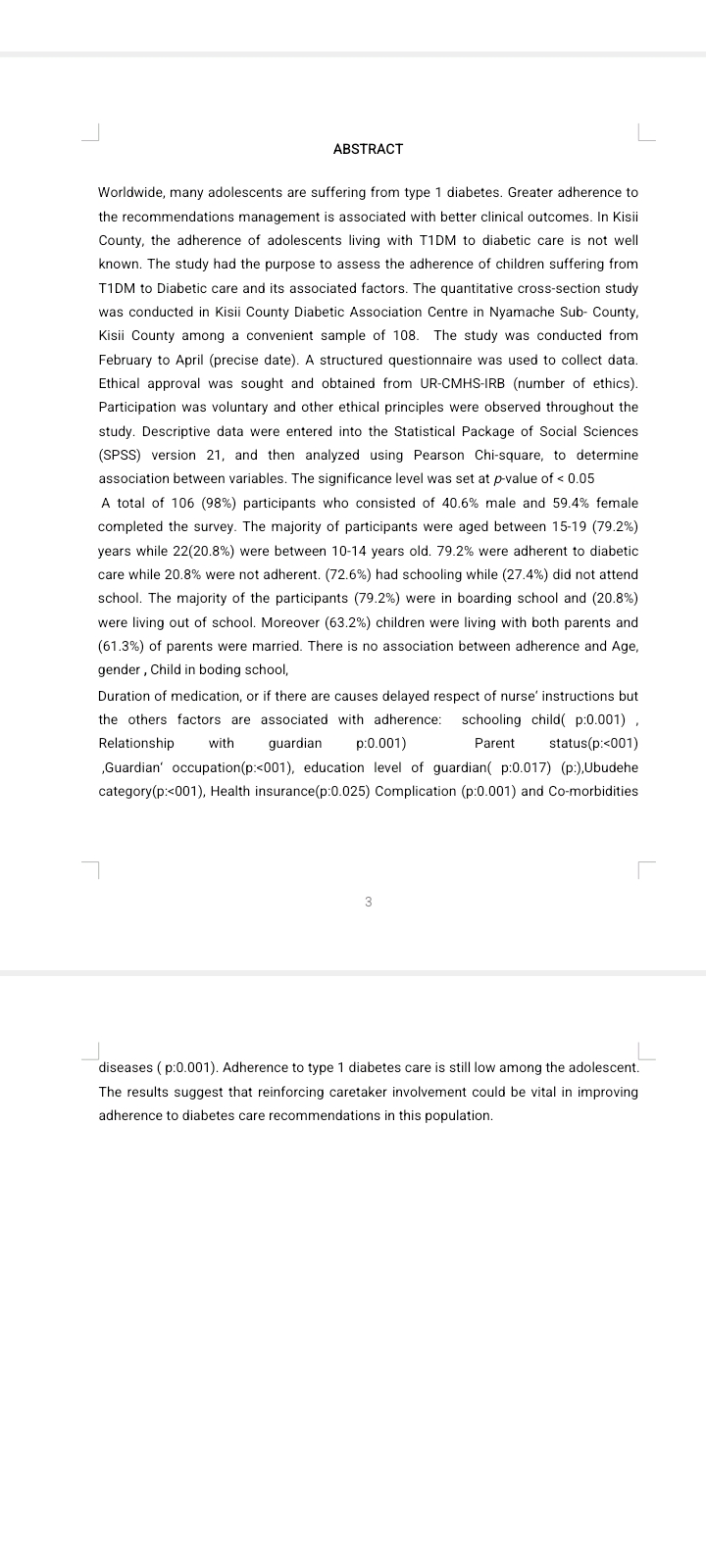
the recommendations management is associated with better clinical outcomes. In Kisii County, the adherence of adolescents living with T1DM to diabetic care is not well known. The study had the purpose to assess the adherence of children suffering from T1DM to Diabetic care and its associated factors. The quantitative cross-section study was conducted in Kisii County Diabetic Association Centre in Nyamache Sub- County, Kisii County among a convenient sample of 108. The study was conducted from February to April (precise date). A structured questionnaire was used to collect data. Ethical approval was sought and obtained from UR-CMHS-IRB (number of ethics). Participation was voluntary and other ethical principles were observed throughout the study. Descriptive data were entered into the Statistical Package of Social Sciences (SPSS) version 21, and then analyzed using Pearson Chi-square, to determine association between variables. The significance level was set at p-value of < 0.05
A total of 106 (98%) participants who consisted of 40.6% male and 59.4% female completed the survey. The majority of participants were aged between 15-19 (79.2%) years while 22(20.8%) were between 10-14 years old. 79.2% were adherent to diabetic care while 20.8% were not adherent. (72.6%) had schooling while (27.4%) did not attend school. The majority of the participants (79.2%) were in boarding school and (20.8%) were living out of school. Moreover (63.2%) children were living with both parents and (61.3%) of parents were married. There is no association between adherence and Age, gender , Child in boding school,
Duration of medication, or if there are causes delayed respect of nurse‘ instructions but the others factors are associated with adherence: schooling child( p:0.001) , Relationship with guardian p:0.001) Parent status(p:<001) ,Guardian‘ occupation(p:<001), education level of guardian( p:0.017) (p:),Ubudehe category(p:<001), Health insurance(p:0.025) Complication (p:0.001) and Co-morbidities
Below is the document preview.

Introduction to ECG(Electrophysiology)
Trending!
The electrocardiogram is the graphical representation of the electrical activity of the heart
• It records the electrical activity of atrial ventricular cells in form of specific waveforms and complexes.
• The first ECG was introduced by Willem Einthoven, a Dutch physiologist, in the early 1900s
• ECG is an important diagnostic method in cardiac conditions.
27 Pages
3485 Views
0 Downloads
1.51 MB
Introduction to ECG (Basic Electrocardiogram)
Trending!
Indications For ECG Monitoring
Indicated for:-
• To monitor a patient’s heart rate and rhythm
• Evaluate the effects of disease or injury on heart function
• Evaluate pacemaker function
• Evaluate the response to medications
• Obtain a baseline recording before, during, and after a medical procedure
80 Pages
2984 Views
0 Downloads
3.72 MB
Junctional Rhythms ( Electrophysiology)
Trending!
The (AVN) Atrial Ventricular Node is a group of specialized cells located in the lower part of the right atrium above the tricuspid valve base. Its function is to Delay, Relay and Filter impulses as they pass through the Ventricles.
The nodal cells have pacemaker properties and can pace the heart at a rate of 40-60b/min. Rhythms coming from the AV junction are called .Junctional dysrhythmias. The electrical impulse must travel backward
( Retrograde) to activate the atria.
17 Pages
2974 Views
0 Downloads
624.95 KB
Sinus Mechanisms
Trending!
A normal heartbeat results from an electrical impulse that originates from the hearts primary pace maker-(SA node)
• The Normal sinus rhythm records the hearts electrical impulse that starts in the SAN spreading through the normal conduction pathway.
• The SAN dominates other areas that may pace the heart slower and abnormally.
All other rhythms will be compared to the Normal Sinus
Rhythm
44 Pages
3265 Views
0 Downloads
1.72 MB
Ventricular Rhythms
Trending!
The ventricles (purkinje fibres) may assume the function of pacing the heart, they pace at a slower rate 20-40b/min which cannot sustain the body's perfusion requirements. Rhythms originating from the ventricles are called ventricular arrhythmias because they originate in the ventricles.
Ventricular arrhythmias occur when:-
a) The SAN fails to initiate an impulse
b) The AVN does not pick to pace
c) There is an irritable foci in the ventricular muscle
61 Pages
3007 Views
0 Downloads
2.42 MB
Sickle cell Crisis
Trending!
Sickle cell disease (SCD)
• A group of hereditary disorders in which the normal adult hemoglobin (hemoglobin A) is partly or completely replaced by abnormal sickle hemoglobin (HgbS).
• The most common genetic hematologic condition in children
• Transmitted by autosomal recessive pattern of inheritance.
• Patient with this condition is homozygous for the sickle cell gene, i.e. both genes are abnormal.
• The basic defect responsible for the sickling of
erythrocytes is contained in the globin fraction of hemoglobin
• The mode of transmission is hereditary
• The gene that determines the production of HgbS is situated on an autosome.
47 Pages
2824 Views
0 Downloads
833.89 KB
Treatment modalities for hematological disorders
Trending!
These are therapies aimed at preventing, alleviating the underlying cause or treating the hematological disorder
• They include
1. Nutritional therapy: meal management to ensure rich sources of iron, vitamin K, vitamin B9.
2. Supplements: administration of folate, iron sulfate.
3. Treatment of underlying cause: antimalarial, deworming, ulcer treatment
21 Pages
2792 Views
0 Downloads
318.84 KB
Valvular heart disease
Trending!
Outline
1. Review the role of valves in cardiac cycle
2. Define valvular heart disease
3. Identify types of VHD
4. Explain the assessment and diagnostic tests
5. Describe the management of patient with VHD
46 Pages
2756 Views
0 Downloads
680.83 KB
Assessment and diagnostic evaluation of patient with haematological disorder
Trending!
History taking
1. Nutrition: feeding habits; typical meal – to determine deficiencies
2. use of prescription and over-the-counter medications: most hematological conditions can result from herbs, or certain medications.
3. Prior chemotherapy or radiotherapy
16 Pages
2772 Views
1 Downloads
372.41 KB
Disseminated intravascular coagulation (DIC)
Trending!
It is a condition of combine platelet and coagulation factor disorder.
• It is characterized by widespread coagulation and bleeding in the vascular compartment.
• DIC occurs secondary to inappropriate systemic activation of normal clotting mechanisms.
• It is associated with underlying disease manifested as uncontrolled activation of coagulation and fibrinolysis.
21 Pages
3277 Views
1 Downloads
309.13 KB