HIV AIDS Question & Answers
| Institution | Kenya Medical Training College |
| Course | COMMUNITY HEALTH |
| Year | 1st Year |
| Semester | Unknown |
| Posted By | Rose Oloo |
| File Type | |
| Pages | 6 Pages |
| File Size | 248.89 KB |
| Views | 2794 |
| Downloads | 0 |
| Price: |
Buy Now
 Buy via
whatsapp Buy via
whatsapp
|


Description
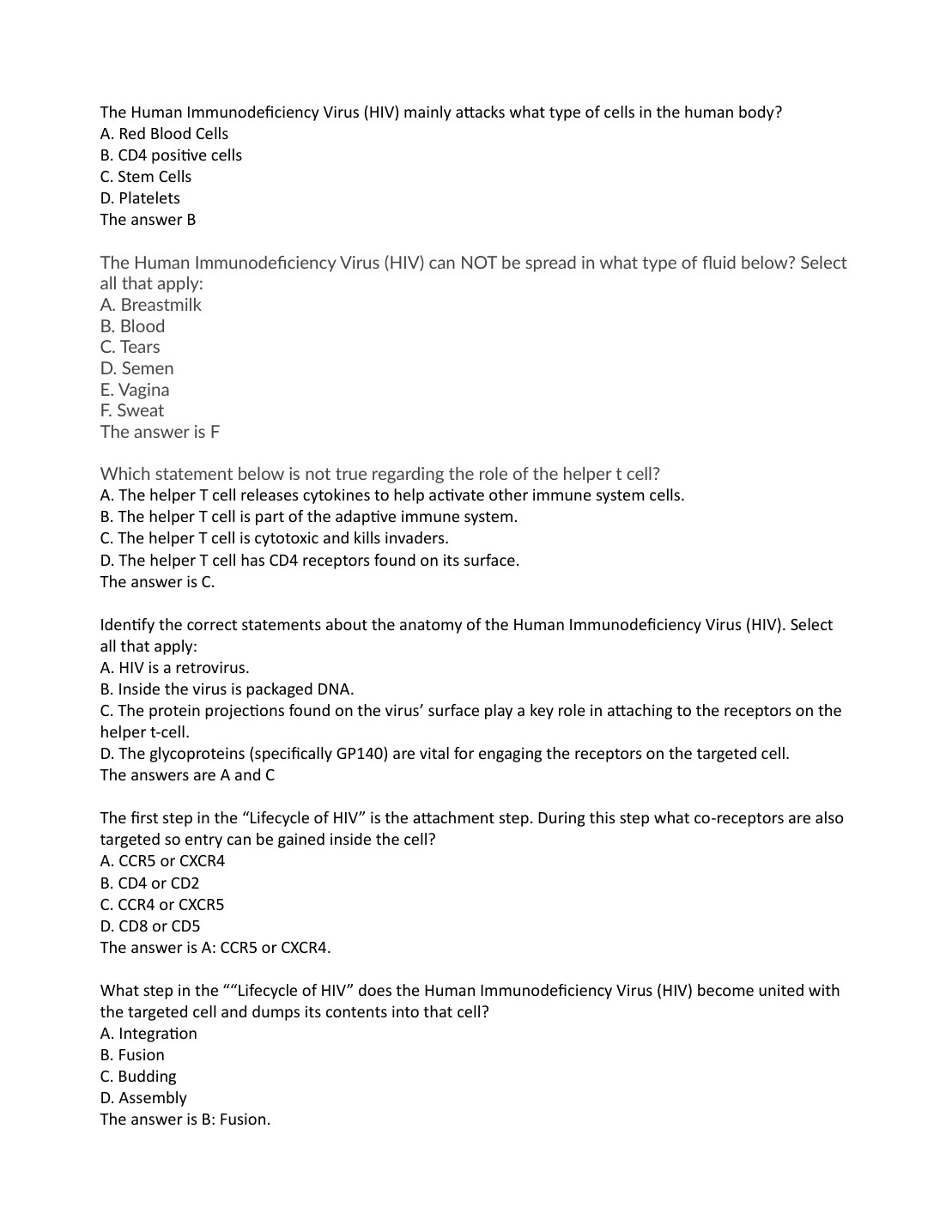
The document contains questions and answers about HIV/AIDS. It addresses topics like: - Which cells HIV attacks (CD4 positive cells) - How HIV is transmitted (not through sweat) - The role of helper T cells (they don't kill invaders) - The anatomy and lifecycle of HIV - HIV testing methods and window periods - Opportunistic infections associated with AIDS - CD4 counts and disease progression - Post-exposure prophylaxis and prevention of mother-to-child transmission - Classes of antiretroviral medications and their mechanisms of action
Below is the document preview.

KMTC: RHEUMATIC HEART DISEASE LECTURE NOTES
Trending!
Rheumatic fever is an inflammatory disease that can develop when strep throat or scarlet fever isn't properly treated , it can caused rheumatic heart disease . Strep throat and scarlet fever are caused by an infection with group A beta hemolytic streptococcus bacteria.
3511 Views
0 Downloads
1.1 MB
KMTC: RHEUMATIC FEVER LECTURE NOTES
Trending!
Rheumatic fever is an inflammatory disease that may develop after an infection with Streptococcus bacteria (such as Strep throat or scarlet fever).
This disease is a multisystem inflammatory disease which can affect the heart, joints, skin and brain.
It is an immunologically mediated.
It can be acute or chronic.
2900 Views
0 Downloads
3.78 MB
KMTC: POISONING IN CHILDREN LECTURE NOTES
Trending!
Ingestion of toxin substances is a common problem in the pediatric age group.
Common causes are household products including kerosene oil, drugs (barbiturates), chemicals (corrosives) and pesticides (organophasphate compound.
Majority of poison are ingested by children at home, include products that are familiar and visual appealing due to glossy packing.
The inherent curiosity and tendency for exploration in children contributes the high incidence of accidental poisoning below 5 years of age.
Usually classified as accidental, homicidal or suicidal, whereas in a majority of cases are accidental
3301 Views
0 Downloads
288.5 KB
KMTC: PERITONITIS LECTURE NOTES
Trending!
Peritonitis :is an inflammation (irritation) of the peritoneum, the thin tissue that lines the inner wall of the abdomen and covers most of the abdominal organs
3038 Views
0 Downloads
909.5 KB
KMTC: OTITIS MEDIA LECTURE NOTES
Trending!
Definition: Presence of a middle ear infection
Acute Otitis Media: occurrence of bacterial infection within the middle ear cavity
Otitis Media with Effusion: presence of nonpurulent fluid within the middle ear cavity
OM is the second most common clinical problem in childhood after upper respiratory infection
3394 Views
0 Downloads
489 KB
KMTC: NEPHROTIC SYNDROME LECTURE NOTES
Trending!
Nephrotic syndrome is a symptom complex manifested by massive edema, hypoalbuminemia, marked albuminuria and hyper lipidemia (hypercholestremia).
3083 Views
1 Downloads
5.41 MB
KMTC: CHILDHOOD MALIGNANCIES LECTURE NOTES
Trending!
Childhood malignancies in paediatric nursing kmtc lecture notes for both Kenya registered community health nursing and enrolled community health nursing
19 Pages
2814 Views
0 Downloads
421.81 KB
KMTC: HIV RELATED DISEASES LECTURE NOTES
Trending!
HIV related diseases in paediatrics complete lecture notes for both Kenya registered community health nursing and enrolled community health nursing for students and lecturers
2643 Views
0 Downloads
20.27 KB
KMTC: CONVULSIVE DISORDERS LECTURE NOTES
Trending!
Conculsive disorders in peadiatrics complete lecturer/student notes for paediatric nursing for both Kenya registered community health nursing and enrolled community health nursing..full notes
44 Pages
2628 Views
0 Downloads
5.02 MB
KMTC: BRONCHOPNEUMONIA LECTURE NOTES
Bronchopneumonia peadiatrics complete notes for paediatric nursing for students and lecturers for both Kenya registered community health nursing and enrolled community health nursing
45 Pages
1616 Views
0 Downloads
15.34 MB