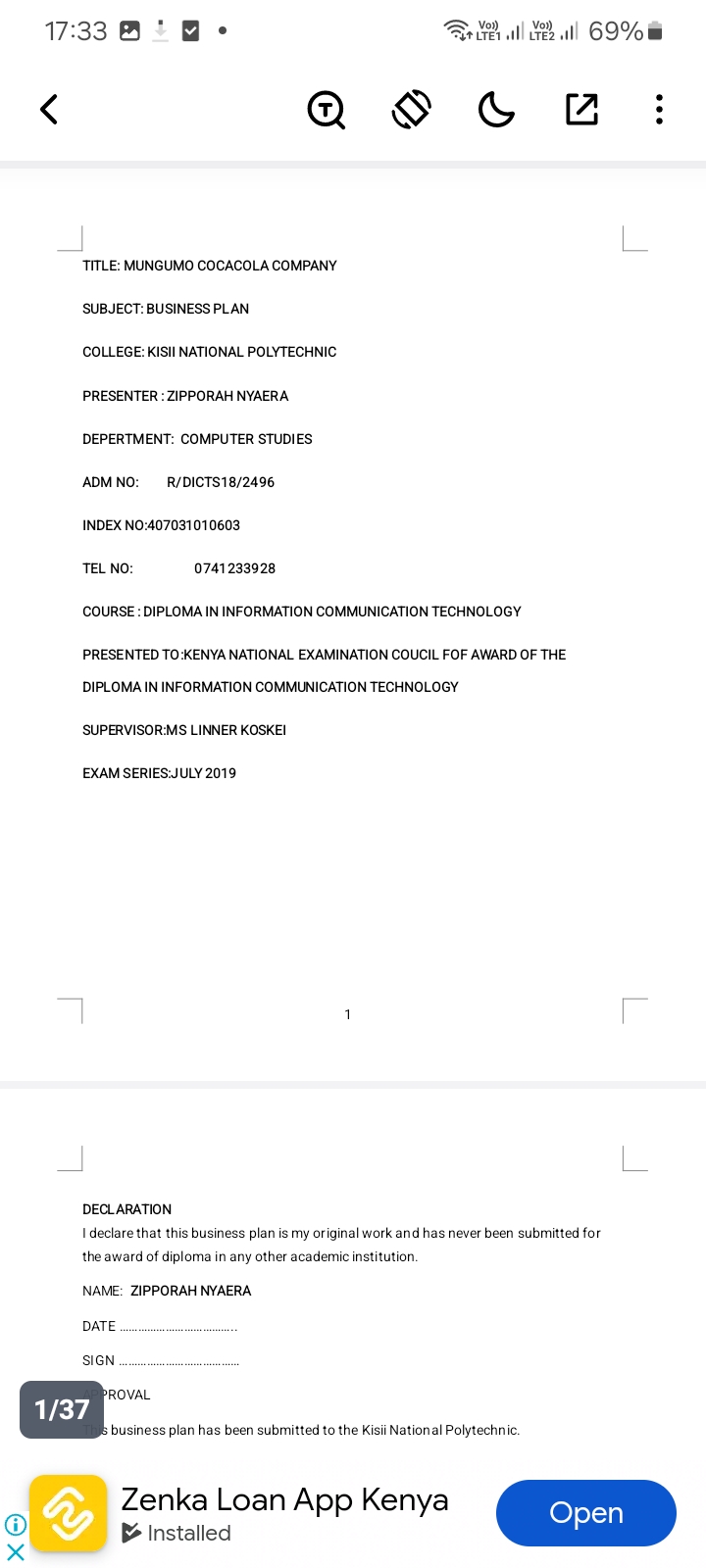
Coca-Cola company business plan
| Institution | Kisii National Polytechnic |
| Course | Food and beverage |
| Year | 3rd Year |
| Semester | Unknown |
| Posted By | MAKORI KERECHA |
| File Type | docx |
| Pages | |
| File Size | 121.17 KB |
| Views | 4136 |
| Downloads | 0 |
| Price: |
Buy Now
 Buy via
whatsapp Buy via
whatsapp
|


Description
This is a business plan for a Coca-Colacompany.
EXECUTIVE SUMMARY
CHAPTER ONE
This chapter contains business description, owner’s background information, business name, business location, address, forms of ownership, type of business products and services, goals and objectives and others.
CHAPTER TWO
Here we have market plan which contains customers, domestic customers, institution, government department, market share/size, competition, promotion and advertisement and many more
CHAPTER THREE
We have organization/management plan which contains the management team, organization charts, other personnel, recruitment, training and promotion, recruitment of employees, training, remuneration and incentives, licenses, permit and by-laws
CHAPTER FOUR
It contains production facilities and capacity, production strategy, process and regulations affecting operations. The process involves the steps to be followed in producing garments especially commercial paper patterns and offering services of high standard than competitors. Besides this, it also contains expenses incurred in the business with regulation affecting all operations with the premise.
CHAPTER FIVE
Contains financial plan, pre-operational costs, cash flow statement, Performa, balance sheets, break even analysis and even others which have been indicated in table contain chapter five
The financial statement helps to compare the performance of the business with another business. The interpretation will also enable the business to compare the current performance and also predict the future.
Below is the document preview.

Insurance management system project report
Trending!
Insurance Management System project focuses on creating an automated solution to improve the efficiency and accuracy of managing insurance policies. The system is designed to streamline processes such as policy application, approval, and management, offering a user-friendly interface for both customers and administrators. By incorporating modern technology into the insurance management workflow, the project aims to eliminate manual errors, reduce delays, and enhance the overall user experience.
This project addresses the significant inefficiencies found in traditional, manual insurance management systems. These systems often suffer from slow processing times, frequent errors, and a lack of transparency, all of which contribute to customer dissatisfaction and increased administrative burden. The project seeks to resolve these issues by introducing a more efficient and reliable automated solution that minimizes delays, simplifies the tracking of policy statuses, and effectively manages large volumes of data.
The project employs a structured approach to system analysis and design, focusing on the critical challenges of the current system and developing a comprehensive automated solution. The implementation leverages PHP and MySQL, prioritizing scalability, security, and ease of use. The development process is rigorous, involving multiple testing phases including unit testing, validation testing, integration testing, and system testing to ensure that the system meets all performance and reliability criteria.
The new system effectively addresses the problems identified in the traditional process, resulting in significant improvements in efficiency and user satisfaction. The automated approach reduces errors, speeds up policy approvals, and provides a transparent, responsive service to users. This enhanced system not only benefits the organization and its customers but also lays the groundwork for future technological innovations in insurance management.
3548 Views
0 Downloads
3.86 MB
Multi vendor shopping portal system project report
Trending!
The multi-vendor e-commerce platform, "Crafters," is developed to address the challenges faced by small and medium-sized enterprises (SMEs) in Rwanda, particularly those involved in crafting and handmade goods. The main objective of this platform is to streamline and automate the online selling process, ensuring an efficient, secure, and user-friendly experience for both vendors and customers. Currently, many local artisans and small businesses struggle with limited digital presence, cumbersome vendor management processes, and inadequate customer reach. These challenges hinder their ability to scale and effectively market their unique products, which in turn impacts their revenue and growth potential. There is a clear need for a centralized system that simplifies these processes and enhances the online visibility of local artisans.
To address these issues, a structured development methodology was adopted, beginning with a comprehensive analysis of the current market landscape and the specific needs of Rwandan artisans. This was followed by the design and implementation of the "Crafters" platform using modern web technologies, including React for the front-end interface and Node.js with PostgreSQL for robust back-end management. secure payment gateways, were implemented to protect sensitive information and transactions, ensuring trust and reliability for all users. The development process also involved extensive testing to ensure that the platform meets its objectives, providing a seamless and secure online marketplace for handcrafted goods.
The proposed platform offers a comprehensive solution that automates the entire lifecycle of product management, from vendor registration and product listing to order processing and customer communication. Vendors can easily register, list their products, and manage their inventory through a dedicated dashboard, while customers can browse, search, and purchase items with ease. The system supports real-time order tracking, and automated email notifications to keep users informed at every step of the transaction. By streamlining these processes, the platform not only reduces the operational overhead for vendors but also enhances the shopping experience for customers, making it easier to discover and purchase unique handmade products.
3428 Views
0 Downloads
1.54 MB
Online booking wedding venue management system project report
Trending!
Planning a wedding can be both thrilling and challenging, particularly when it comes to finding and booking the ideal venue. In Kigali, Rwanda, couples face difficulties due to the absence of a comprehensive online resource for wedding venues. This lack of centralized information complicates the comparison of options based on factors such as location, size, aesthetics, and cost, while the traditional booking process is often marred by cumbersome phone calls, in-person visits, and complicated paperwork.
To alleviate these issues, this project introduces the Online Booking Wedding Venue Management System, designed to streamline the venue selection and booking process for couples in Kigali. The system provides a centralized database of available wedding venues, accessible through a userfriendly web interface. Built using HTML, CSS, Node.js, Express, and MongoDB, the platform simplifies the search for and reservation of wedding venues, thereby reducing stress and saving time for users.
The project aims to address the challenges faced by couples by offering a seamless and efficient booking experience. The system’s core features include real-time availability tracking, detailed venue descriptions, and an intuitive booking process. By improving accessibility to venue information and facilitating a more straightforward booking procedure, the platform provides significant benefits to couples, venue managers, and related stakeholders.
In summary, the Online Booking Wedding Venue Management System addresses key issues in the wedding planning process in Kigali by offering an innovative, user-centric solution. The system enhances convenience, reduces administrative burdens, and improves overall user satisfaction. Future enhancements could include mobile application development and advanced features to further refine user experience and operational efficiency.
3470 Views
0 Downloads
2.9 MB
Online contractor-client management system project report
Trending!
The way in which professionals and clients interact has changed due to the increasing demand for freelance services and on-demand skill-sharing platforms. The concept and development of Skill Share Connect , an online platform intended to promote smooth communication between customers looking for specialized services and employees offering professional experience, is presented in this dissertation.
The main goal of this study was to develop a system that is easy to use and efficient enough to let clients locate, get in touch with, and hire experts without having to deal with the hassles of job management, internal communication, or payment processing. The platform's main goal is to give service providers easy-to-use means of direct communication—like phone and email—while also giving them a place to display their abilities.
To maintain a balance between adaptive development methods and rigorous system design, a hybrid development approach that combines Agile and Structured Systems Analysis and Design approach (SSADM) was used. Three user categories—clients, employees, and administrators—each with unique features were considered when designing the platform. Worker accounts and service categories are managed by administrators, and clients can find workers by category and get in touch with them directly through their profiles. Conversely, employees have the ability to design comprehensive profiles that highlight their qualifications, offerings, and contact details.
In order to construct a scalable, secure, and responsive system, HTML , CSS , PHP , and MySQL were used in the platform's development. A user login system, category-based search capabilities, and profile management for both employees and clients are important elements.
By means of this project, the research shows how straightforward and uncomplicated communication solutions can improve the experience for clients and service providers alike, lowering barriers to entry and building confidence. The finished product provides independent contractors looking to network with possible clients in a cutthroat industry with an approachable, effective alternative.
3395 Views
0 Downloads
1.59 MB
Online employee planning and scheduling management system project report
Trending!
Each project tends to have different objectives and goals to be achieved. This project will also have both general and specific objectives as they are stated below:
1.4.1 General objective
For example, your general objective could be, “determine how work environment affects performance.” In that case, your specific objectives might be. “Determine whether sunlight improves performance,” and “Measure how performance changes when the work environment changes.”
1.4.2 Specific objectives
Each The primary goal of this study is to enhance employee planning and scheduling in the beverage manufacturing industry by developing a comprehensive system. The specific objectives of the study are as follows:
Design a user-friendly interface that integrates modules for employee shift scheduling, task allocation, attendance tracking, and leave management.
Implement automated shift scheduling algorithms that assign shifts based on employee availability, skills, and production demands, ensuring optimal resource utilization and minimizing scheduling conflicts.
Incorporate real-time attendance tracking features to monitor employee check-ins and check-outs, enabling managers to track workforce performance and dynamically adjust staffing based on production needs.
Integrate automated task assignment and resource management features to allow managers to allocate tasks efficiently and monitor employee productivity, ensuring seamless operations and timely task completion.
Evaluate the performance of the system by measuring improvements in workforce productivity, scheduling efficiency, and overall operational cost reduction compared to manual methods.
Document the development process and provide a comprehensive guide on implementing and utilizing the system to enhance employee planning and scheduling in the beverage manufacturing industry.
These objectives are designed to be Specific, Measurable, Achievable, Relevant, and Timebound (SMART), ensuring they are within the scope of the study and effectively contribute to achieving the overall goals of the project.
3457 Views
0 Downloads
3.06 MB
Employee leave management system project report
Trending!
Employee leave management system combine number of processes and systems to automate and easily manage employee data, leave request, track and grant leave. In many institution staff are entitled to different types of leave, this leave are granted according to institution policy. Administrative department is mostly responsible for managing and granting leave request. To this end, most institution used conventional method of requesting, granting and managing leave. In conventional method, leave is manually request by writing letter to head of department. The head of department minutes and forward the request to higher staff for approval. This method is time consuming, prone to error, require more paper work and difficult to manage. Hence the need for an automated leave management system that is faster, error free, less paper work and easy to manage. The system was achieved by developing an automated employee leave management system using the three-tier software architectural model. The System is implemented using web based technologies which include CSS, JS, HTML, MySQL, PHP and runs on Windows operating system. The overall functionality of the system shows that it work satisfactory and the result obtained shows that the system is error free, faster and allows staff to request for leave in a timely manner. Hence the system can be used by both academic staff and administrative department of an institution for effective and efficient management of employee leave. An employee leave management system (ELMS) is a digital platform designed to streamline the process of managing employee leave requests. The system automates tasks such as application submission, approval workflows, record-keeping, and reporting. By centralizing leave data, ELMS minimizes errors, reduces administrative burdens, and enhances efficiency. It offers real-time access to leave balances and schedules, facilitating better planning and decisionmaking. Ultimately, ELMS improves transparency and responsiveness in managing employee leaves, leading to higher employee satisfaction and operational effectiveness.
3432 Views
0 Downloads
896.6 KB
Online equivalent application system project report
Trending!
Online equivalence application management system is as web based application system that apply for admission Equivalence degree as well as process their system admission details the manual the process of applying for and processing a student's admission is very stressful and time-consuming. Forms and files are lost during the process, and students must wait days for admission details to be processed while staff members sit through long, exhausting shifts tending to students. These issues have been looked into, and an appropriate solution has been offered: the online equivalency application and tracking system, which has a centralized database to maintain track of all the students' records in the system. Prospective students can apply for Equivalency using a module, where they can also submit their information and upload all necessary documents. Additionally, there is an administrator module that allows system administrators to view student details and deliver created equivalencies to shortlisted students by email or SMS.
A three-tiered application design strategy will be used in the development and implementation of this task. MySQL is the preferred database, and PHP will be used to link the user to the database's contents. Hypertext Mark-UP Language (HTML) will be utilized to construct the graphical user interface. The SDLC (Systems Development Life Cycle) Waterfall model will serve as the foundation for the methodology. Planning, Analysis, Design, and Implementation are the stages. An interactive web-based solution that addresses the issues of the manual record-keeping system is anticipated as the final product.
3634 Views
0 Downloads
1.17 MB
Online examination attendance system project report
Trending!
Online Examination Attendance System Using Internet of Things is an electronic device embedded into electronic student card designed to capture attendance records for students during examinations at the Kisii National Polytechnic (KNP). It facilitates the management of attendance for each student in a particular examination room and helps in generating reports to ensure accurate attendance tracking. Instead of manually signing an attendance sheet, attendance records are captured electronically into a database, making them easier to manage. The study will conduct in the examination department at KNP and resulted in the development of an Online Examination Attendance System Using Internet of Things (OEASUIOT) that assists management in automatically handling students' attendance records during exams. The primary objective of the study will be to develop an Automated Examination Attendance Records Management System for KNP. This system enables the management to automatically capture and compute students' attendance records during examinations. The specific objectives included investigating the current manual system, gathering requirements for the new system, and designing, implementing, and testing the developed electronic system. Data was gathered using interviews, observation, and questionnaires. The collected data was sorted and analyzed, revealing that the current manual system is inefficient, time-consuming, and insecure, making it unsuitable for managing attendance records. With the newly developed system (OEASUIOT), management can electronically capture, store, compute, and generate attendance reports automatically. The system also allows for data backup on movable devices, ensuring data security and accessibility and reduce the time consumed by the traditional system of recording daily attendance in examination room. So, everything here in turn gets automated.
3567 Views
0 Downloads
1.68 MB
Online furniture management system project report
Trending!
The Online Furniture Management System aims to address the complexities faced by the cargo management and logistics industry, particularly in the transportation, storage, and tracking of furniture. Companies often struggle with issues like inventory mismanagement, damage during transit, delayed deliveries, and inefficient space utilization, all of which negatively impact operational efficiency and customer satisfaction. The system is designed to streamline these processes, ensuring better organization, resource management, and operational control for businesses.
Specifically, the system is tailored to the needs of businesses in areas like Gisozi Gakinjiro, providing solutions for managing stock, tracking furniture, and optimizing space usage. By integrating technology into cargo handling, the system enables businesses to overcome common logistical challenges, reducing the likelihood of inventory loss or damage, and minimizing delays in delivery. This not only improves operational efficiency but also enhances customer service through timely and accurate deliveries.
Additionally, the Furniture Management System offers financial management tools, helping businesses monitor expenses and generate cost savings. With better resource utilization and streamlined operations, companies can reduce overheads and focus on growth. Overall, the system provides an all-encompassing solution for the management of furniture logistics, leading to increased efficiency, reduced costs, and improved customer ex
3521 Views
0 Downloads
798.58 KB
Online hospital services management system project report
Trending!
In the digital age, it's crucial to have an easy and direct way for doctors and patients to interact. This is especially important for making appointment booking faster, storing medical information securely, and ensuring effective communication during emergencies. This thesis focuses on the creation and implementation of a Web-based Platform and Mobile Application for Improved Healthcare Access in remote and underserved areas. The main goal is to make healthcare services more accessible, boost the efficiency of healthcare delivery, and enhance health data management.
The " Web-based Platform and Mobile Application for Improved Healthcare Access " was developed using React.js for the front end and Node.js for the back end. The application offers various features, including appointment scheduling, patient record management, and real-time communication between patients and healthcare providers. By using mobile technology, the application seeks to overcome the geographical and logistical challenges that often limit access to quality healthcare in remote regions.
This research uses qualitative case studies. Data from pilot implementations in selected communities show notable improvements in healthcare access and operational efficiency. Moreover, the application's data management capabilities provide valuable insights into public health trends, which can support better policy-making and resource distribution.
The results of this study suggest that mobile clinic applications like this one can significantly improve healthcare delivery in Rwanda by making it more accessible, efficient, and data-driven. The thesis concludes with recommendations for expanding the application to more regions and integrating it with existing healthcare systems to maximize its benefits.
3452 Views
0 Downloads
2.03 MB