ALT202: Survey Of African Literature
| Institution | KENYATTA UNIVERSITY |
| Course | BACHELOR OF EDUCATIO... |
| Year | 2nd Year |
| Semester | Unknown |
| Posted By | Brian Mike |
| File Type | |
| Pages | 146 Pages |
| File Size | 840.07 KB |
| Views | 10359 |
| Downloads | 2 |
| Price: |
Buy Now
 Buy via
whatsapp Buy via
whatsapp
|


Description
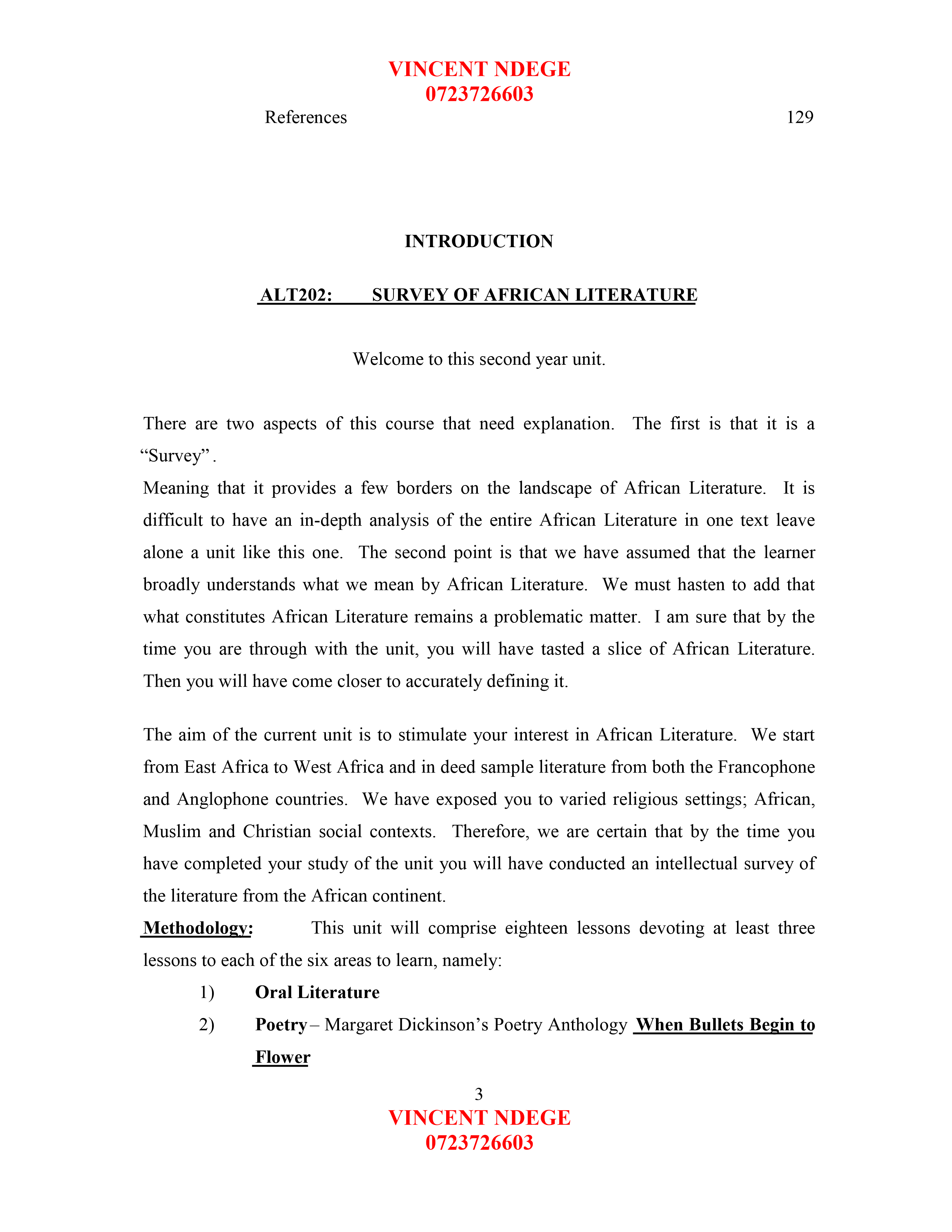
The aim of the current unit is to stimulate your interest in African Literature. We start
from East Africa to West Africa and in deed sample literature from both the Francophone and Anglophone countries. We have exposed you to varied religious settings; African, Muslim and Christian social contexts.
Below is the document preview.

Gauging and Gauge Design
Trending!
Updated notes on Gauging and gauge design
7 Pages
9086 Views
0 Downloads
1.05 MB
The Origin of HIV/AIDS
This module states detailed notes on the origin of HIV/AIDS
236 Pages
252 Views
0 Downloads
10.09 MB
Respiratory Physiology
Trending!
Updated notes on respiratory physiology
8760 Views
0 Downloads
5.1 MB
KFI 201: CONSUMER THEORY
Trending!
Latest detailed notes on consumer theory
32 Pages
6992 Views
0 Downloads
1.1 MB
Cnidaria and Ctenophore
Trending!
Updated notes on Cnidaria and Ctenophore
9100 Views
0 Downloads
4.75 MB
NERVOUS TISSUE
Trending!
This course provides detailed notes on nervous system
68 Pages
8266 Views
0 Downloads
1.53 MB
PRINCIPLES OF DATABASES
Over the past two decades there has been enormous growth in the number and importance of database applications. Databases are used to store, manipulate, and retrieve data in nearly every type of organization, including business, health care, education, government, and libraries.
1845 Views
0 Downloads
1.13 MB
Integrals of Exponential and Logarithmic Functions
Trending!
Integrals of Exponential and Logarithmic Functions
11 Pages
8425 Views
0 Downloads
165.26 KB
Principles of Questionnaire Construction
Trending!
Rank ordering is a method that works well with a small number of objects, such as 10. For example, instead of rating how serious each of a set of organizational problems are, you could ask the respondent to simply sort them in order of most to least serious.
7283 Views
0 Downloads
23.36 KB