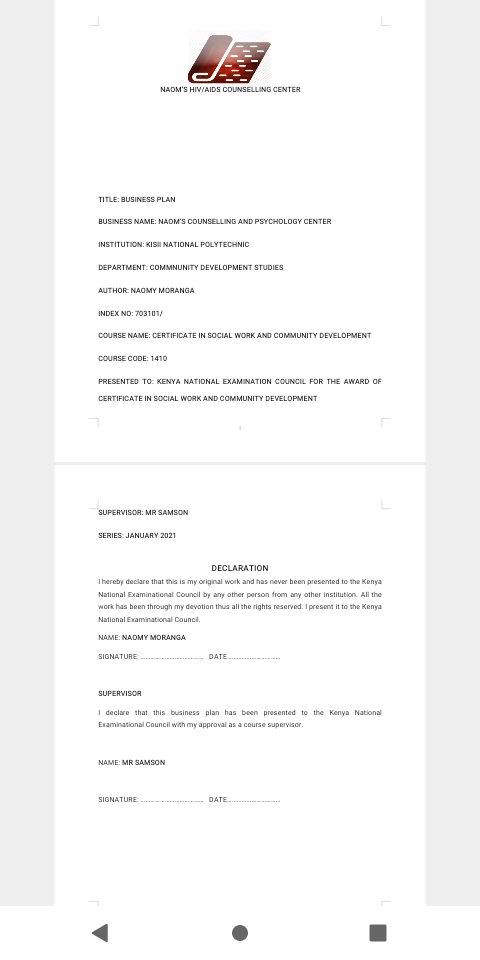
HIV testing and counselling center business plan
| Institution | Rift Valley Institute of Science and Technology |
| Course | Diploma in social wo... |
| Year | 3rd Year |
| Semester | Unknown |
| Posted By | MAKORI KERECHA |
| File Type | docx |
| Pages | |
| File Size | 102.76 KB |
| Views | 1733 |
| Downloads | 0 |
| Price: |
Buy Now
 Buy via
whatsapp Buy via
whatsapp
|


Description
This is a business plan of running a HIV testing and counselling center.
EXECUTIVE SUMMARY
CHAPTER ONE
Chapter one contains the business describes whereby you describe the nature and management structure of the business, the owners background, the business name, the business location and address, form of ownership, type of business, products and services offered, justification of opportunity, the industry, primary and secondary objectives of the business and the entry and growth strategy.
CHAPTER TWO
Chapter two contains the following; marketing plan and it holds the type of customers, the market share or size, the competition level with others carrying out the same business, a swot analysis table, promotion and advertisement, methods of advertisement, the pricing strategy, the sales tactics and the distribution strategy.
CHAPTER THREEE
Chapter three contains the organization plan whereby you describe the management team and draw the organization chart, describe the qualities of the manager and the assistant manager, recruitment, training and promotion, you describe the remuneration policy and the incentives, the license, permit and by-laws and the support services offered.
CHAPTER FOUR
Chapter four contains the product operation plan that holds the production facilities and capacity, business layout, production strategy, production process, the regulations affecting the operation- health regulations, safety regulations and environmental regulation process.
CHAPTER FIVEChapter five contains the financial plan, pre-operational costs working capital, cash flow statement for the two years, the preform income statement, the balance sheets, the break-even analysis for the business, the desired business financing, proposed business organization and the profitability ratios.
Below is the document preview.

ASSESSENT OF CREDIT MGT CPRACTICE IN CASE OF LION BANK- BUSINESS RESEARCH PROJECT
purpose of the study was to assess the credit management practice of Lion International S.C. The data were gathered from all staff of the head office Credit Management Department and twenty branch managers and customers’ relationship officer found in Nairobionly on the credit management practices of the bank in areas of securing credit facilities against collateral, credit management analysis/evaluation practice of the bank, concentration risk management practice of the bank and the practice of the bank’s credit follow-up and recovery. The questionnaire survey was undertaken among 65 employees of the bank and all were collected to assess the perception of credit management practices of the bank in relation to the above practices. Closed ended questions were used, particularly to reflect the views of the employees with regard to four practices.Descriptive research design with 5 levels Likert scale was used to measure variables of study. Data was analyzed through descriptive statistics, percentage and frequency using SPSS Version 20.0 software. The result from the survey shows that majority of the bank staff were explained their concern on weak collateral coverage of the bank loans, high concentration risk on export loan out of the total loan volume of the bank, weak credit analysis during approval and at same time poor follow-up and recovery activities. According to the survey the bank can reverse the potential risk by providing reasonable attention for collateral holding , developing moderate loan concentration between credit products, improving the competency of the credit follow-up and recovery division for quality loan management
1225 Views
0 Downloads
105.11 KB
challenges and opportunities of adopting alternative channel banking for private commercial banks of kenya- accounting, Banking and finance research project
This study has taken one of the current issues in the Kenyan banking industry: alternative channel banking. The objective of the study was to identify the challenges and opportunities of adopting electronic channel banking. The study was conducted on six private commercial banks. The banks were selected using stratified sampling technique. Data was collected by distributing questionnaire on a survey basis to the staff of the respected departments/divisions of the selected banks. Out of the distributed 92 questionnaires 87 of them were used in the study. The study used descriptive analysis to analyze the collected data. The results of the study showedthat; perceived ease of use, perceived usefulness, the fact that the Kenyan banking sector is adopting alternative channel banking late compared to developed countries and the fact that the 65 % of the population is between the age 15 and 54 (CSA, 2015) are opportunities for Kenyan private commercial banks to adopt alternative channel banking.It is also concluded that lack of awareness of the society about alternative channel banking; the security risk associated with using alternative channel banking; the constant interruption of power; absence of network between commercial banks; the underdevelopment of the telecommunication infrastructure of the country and the level of illiteracy of the society are challenges of adopting alternative channel banking for the Kenyan private commercial banks. Based on the findings commercial banks are recommended to create customer awareness; work with other commercial banks and government; enhance their infrastructure; develop customer customized system and associate motivating factors with the usage of alternative channel banking.
1327 Views
0 Downloads
89.62 KB
Challenges and Opportunities of Electronic Banking in Equity Bank Banking Industry In Case of Commercial Bank of Equity Bank- accounting, Banking and finance research project
Abstract
This study is conducted with Assessment of Opportunities and Challenges of E-Banking Service in CBE. The objective of this paper to assess adoption of E-banking in the Equity Bank banking services with respect to the challenges which can taking advantage of Ebanking system and expected opportunity derived by adopting the system. To acquire the intended information the researcher use different data collection instruments like distributing close-ended questionnaire, conducting interview. The collected data was analyzed by using descriptive analysis such as tables and percentages. Among the different opportunity that initiate banks to adopt e-banking services: Improving customer services, Facilitating the work to be done fast, helping to facilitate work with minimum error, Simplifying the activity of employees of the bank in the delivery of services to customers, Enhancing the image of the bank, improving efficiency, reducing paper work, reduces queues in the banking hall, Increasing Revenues of the bank, reduction of cost, and improves relationship with customers. It also investigated the major challenges for the electronic banking services in commercial bank of Equity Bank as of infrastructural, legal and regulatory, socio-cultural, and illiteracy related challenges. To address various challenges identified on the study, the study suggests a series of measures which could be taken by government as well as Equity Bank.
1222 Views
0 Downloads
179.38 KB
CHALLENGES AND PRACTICES OF ANTI-MONEY LAUNDERING AND COMBATING OF TERRORISM FINANCING-THE CASE OF THE KENYAN COMMERCIAL BANKS- ACCOUNTING, BANKING AND FINANCE RESEARCH PROJECT
Over the last decade, there has been an increase in the number of money laundering and terrorist financing crimes across the globe. In a bid for authorities to control these criminal activities both locally and internationally, the Financial Action Task Force (FATF) 40+9 recommendations were established as a mechanism for identifying, combating and controlling money laundering activities. Kenya recently endeavored to combat money laundering and terrorist financing by criminalizing money laundering and financing of terrorism through proclamation no. 780/2013. In this regard, banks play a leading role as the main objective of the law is to ensure the integrity of the Kenyan financial system. Therefore, the purpose of this research is to assess the Anti-Money Laundering (AML) and Counter Financing of Terrorism (CFT) practice and challenges of commercial banks in Kenya in accordance with international standards and applicable laws. This study employed exploratory and descriptive research design in the form of close ended questionnaires completed by 69 employees of Kenyan commercial banks. To assess the practice and challenges 48 questions were provided to the respondents to acquire quantitative data and eight close ended interview questions were also provided to accommodate opinions of FIC officials. Based on the respondents among the commercial banks' the study found that commercial banks in Kenya have been discharging their responsibilities by implementing and practicing AML/CTF. However, ML/TF preventive measures revealed that commercial banks do not have automatic electronic customer/transaction screening and the finding confirmed that absence of national ID and lack of list of Political Exposed Persons, lack of technology to enhance AML/CFT activities and lower awareness in the country are serious challenges for banks. Therefore EFIC and NBE and other responsible organs of the country have to focus their efforts on the most fundamental tasks and main challenges, and need to give utmost priorities about AML/CFT. Finally, as this study focuses on commercial banks, further research is needed on the other financial and nonfinancial sectors which are vulnerable to money laundering and terrorist financing.
1517 Views
0 Downloads
121.94 KB
SOIL SCIENCE
SOIL GENESIS AND CLASSIFICATION
Definition; Soil is a dynamic natural body composed of mineral matter, organic materials, living forms of life and air in which plants grow.
ELEMENTARY GEOLOGY
Geology is the scientific study of the earth’s crust and formation of rocks and minerals in relation to the sphere factors e.g. climatic factors and volcanic eruptions.
The sphere is divided into four regions ;
Atmosphere (gases)
Hydrosphere
Bari sphere
lithosphere
65 Pages
388 Views
0 Downloads
2.21 MB
SOIL & WATER CONSERVATION
INTRODUCTION TO SOIL AND WATER CONSERVATION
Soil and Water conservation refers to those practices involved in the maintaining and preventing the loss of top soil and water . Soil and water are the major resources in agricultural production.
111 Pages
1306 Views
0 Downloads
2.56 MB
IRRIGATION AND DRAINAGE
Irrigation and drainage, artificial application of water to land and artificial removal of excess water from land, respectively. Some land requires irrigation or drainage before it is possible to use it for any agricultural production; other land profits from either practice to increase production. Some land, of course, does not need either. Although either practice may be, and both often are, used for nonagricultural purposes to improve the environment, this article is limited to their application to agriculture
161 Pages
371 Views
0 Downloads
2.5 MB
DOMESTIC WATER SUPPLY
Water supply service quality has many dimensions: continuity; water quality; pressure; and the degree of responsiveness of service providers to customer complaints.
68 Pages
1200 Views
0 Downloads
1.07 MB
STRUCTURAL AND ARCHITECTURAL DESIGN OF THREE STOREY HOSPITAL BUILDING BLOCK
Trending!
Research project on building hospitalABSTRACT
The main objective of this research was to conduct a technical detailed study on the implementation of a four stored building in Nyacheki Hospital at Nyamache Sub-County due to the capacity of existing hospital based on the number of patients received on Hospital. It is the reason why this research has been conducted to solve that problem. Different methods have been used for well conducting this study such as analytical method for designing different structural members like slab, beam, column, stairs and ramp, different software’s has been used like ArchCAD 23, for providing architectural drawing of the Building such including all plan views, sections, elevation and perspectives, Manual calculation have been used for the structural design of beam, stair and ramp by computing beam detailing and reinforcements
2276 Views
0 Downloads
2.28 MB
STRUCTURAL AND ARCHITECTURAL DESIGN OF FIVE STOREY RESIDENTIAL APARTMENT BUILDING PROJECT REPORT
Trending!
This project work “structural design of G+2 commercial building at Nyamache Sub County_ Kisii County sector is a part of fulfillment of advanced diploma as awarded of Kisii National polytechnic (KNP). It contains with conception, structural design which provides proper communication to all of users, this project gives more information about the design and analysis of commercial building. The final project report contains five chapters that are: General Introduction, Literature review, research methodology, system design, analysis and implementation and then Conclusion and Recommendation.
This project report also has been compiled referred to books of different authors and by using equation provided in codes of practice like; British standard used in design of the commercial building. The analysis of each structure members starts with evaluation of all loads that are expected to be carried by structure including self-weight. The structure design of this project detail, beam, slab, stair, column, and foundation by BS8110.
2106 Views
0 Downloads
6.28 MB