ADVANCED FINANCIAL REPORTING THEORY REVISION
| Institution | University |
| Course | CERTIFIED PUBLIC ACC... |
| Year | 1st Year |
| Semester | Unknown |
| Posted By | stephen |
| File Type | |
| Pages | 17 Pages |
| File Size | 785.01 KB |
| Views | 4873 |
| Downloads | 0 |
| Price: |
Buy Now
 Buy via
whatsapp Buy via
whatsapp
|


Description
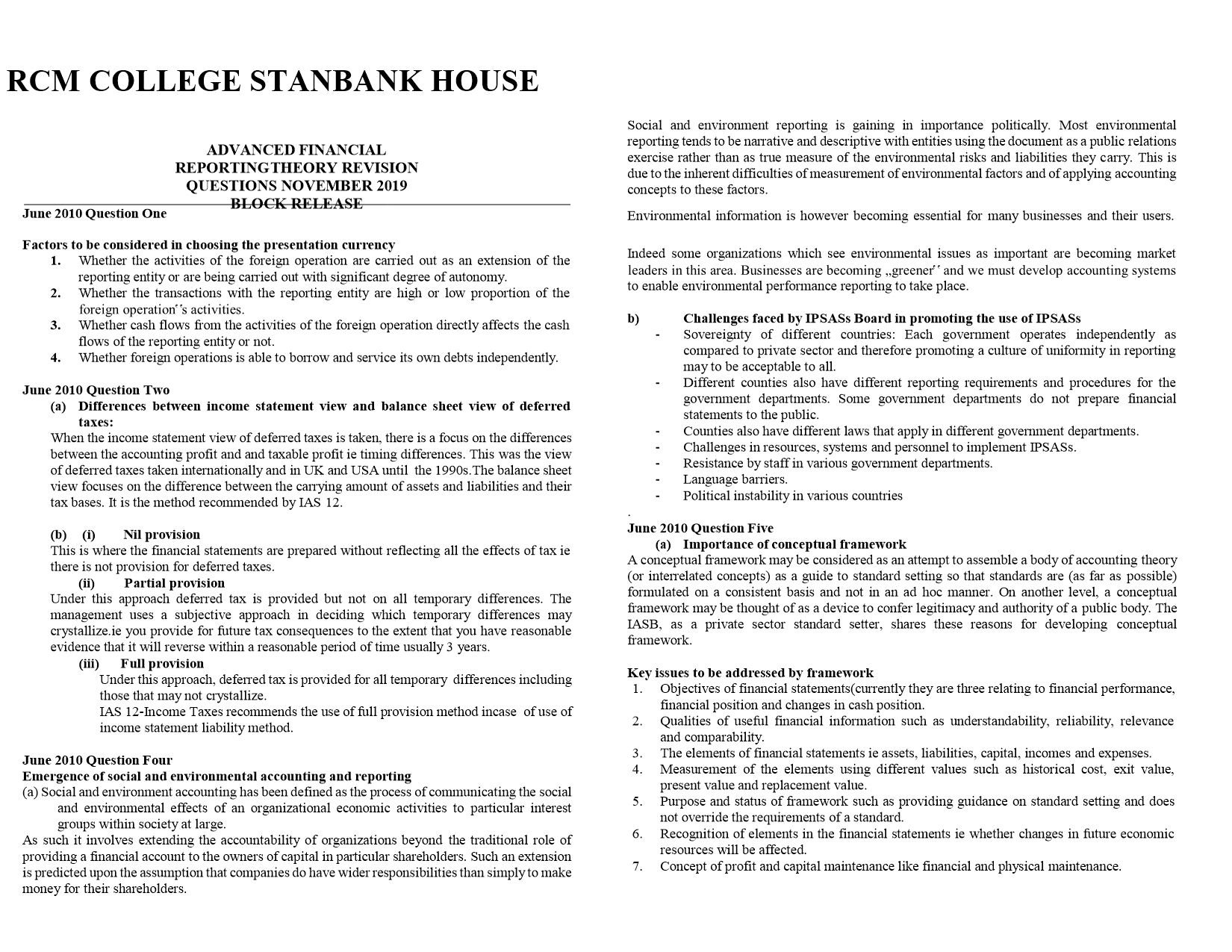
Factors to be considered in choosing the presentation currency
1. Whether the activities of the foreign operation are carried out as an extension of the
reporting entity or are being carried out with significant degree of autonomy.
2. Whether the transactions with the reporting entity are high or low proportion of the
foreign operations activities.
3. Whether cash flows from the activities of the foreign operation directly affects the cash
flows of the reporting entity or not.
4. Whether foreign operations is able to borrow and service its own debts independently.
June 2010 Question Two
(a) Differences between income statement view and balance sheet view of deferred
taxes:
When the income statement view of deferred taxes is taken, there is a focus on the differences
between the accounting profit and and taxable profit ie timing differences. This was the view
of deferred taxes taken internationally and in UK and USA until the 1990s.The balance sheet
view focuses on the difference between the carrying amount of assets and liabilities and their tax bases. It is the method recommended by IAS 12.
(b) (i) Nil provision
This is where the financial statements are prepared without reflecting all the effects of tax iethere is not provision for deferred taxes.
(ii) Partial provision
Under this approach deferred tax is provided but not on all temporary differences. The
management uses a subjective approach in deciding which temporary differences may
crystallize.ie you provide for future tax consequences to the extent that you have reasonable
evidence that it will reverse within a reasonable period of time usually 3 years.
Below is the document preview.

ELEMENTS OF MARKETING NOTES
Trending!
This document provides an overview of key marketing concepts and the differences between marketing and selling. It defines marketing as identifying consumer wants and needs and finding profitable ways to satisfy them. The key elements of marketing are the marketing mix of product, price, place and promotion. Marketing takes a long term, customer-focused approach to meeting needs, while selling has a short term product focus. The goal of marketing is customer satisfaction and long term profits, not just sales.
17 Pages
3892 Views
0 Downloads
644.77 KB
PRINCIPLES OF MARKETING NOTES
The marketing mix is one of the key concept in modern marketing. It is the set of controllable tools that the firm blend to influence the sale of their products. It is a conceptual framework that helps to structure the approach to each marketing challenge.
20 Pages
487 Views
0 Downloads
695.67 KB
SMA 2433: QUALITY CONTROL METHODS LECTURE NOTES
Trending!
The document discusses quality control methods, specifically control charts. It defines control charts as tools used to study and control repetitive manufacturing processes.
37 Pages
3828 Views
1 Downloads
552.5 KB
LECTURE NOTE ON STATISTICAL QUALITY CONTROL
Trending!
Statistical methods are analytical tools used to evaluate men, materials, Machines, or processes. Evaluations obtained by these methods assist in maintaining desired result by using past history to predict capabilities or trends. Such analytical methods are management tools which furnish data to all levels supervision for appropriate action.
24 Pages
4344 Views
0 Downloads
666.75 KB
BOT 102: GENERAL BOTANY SHORT NOTES
Trending!
This document provides an overview of general botany. It begins by defining botany as the study of plants and describes the main groups of plants: Thallophyta, Bryophyta, Pteridophyta, Gymnosperms and Angiosperms. It then discusses key aspects of plant cells, including their structures like the cell wall and plasma membrane. The document outlines the cell theory and types of cells, specifically prokaryotic and eukaryotic cells. It also briefly discusses viruses.
24 Pages
4074 Views
0 Downloads
471.46 KB
LECTURE NOTES ON TESTING OF HYPOTHESIS
Trending!
The document defines key terms related to testing hypotheses such as population, sampling, statistic, statistical inference, and types of hypotheses. 2. It outlines the steps to test a hypothesis which include identifying the parameter of interest, stating the null and alternative hypotheses, determining the test statistic formula and rejection region, computing sample quantities, and deciding whether to reject or accept the null hypothesis.
36 Pages
4094 Views
2 Downloads
477.68 KB
STA 2305: STOCHASTIC PROCESSES LECTURE NOTES
Trending!
A stochastic process is a collection of random variables, typically representing the state of a system over time, where the evolution of the system is governed by chance. These processes are used to model dynamic, unpredictable systems where exact rules are unknown or too complex to calculate precisely, allowing for the calculation of expected behaviors and probabilities over time.
133 Pages
4315 Views
0 Downloads
22.15 MB
AKS 300: MORPHOLOGY AND SYNTAX NOTES IN KISWAHILI
Trending!
Shabaha za Kijumla za Kozi hii: Kueleza dhana mbali mbali za mofolojia, Kueleza mbinu tofauti za uundaji wa maneno, Kuchunguza nadharia mbali mbali za kisintaksia na maendeleo yake katika uchanganuzi wa lugha.
207 Pages
4218 Views
1 Downloads
397.45 KB
QUANTITATIVE METHODS FOR BUSINESS II NOTES
Trending!
The document provides an introduction to statistics including definitions, concepts, uses, and limitations. It defines statistics as the science of collecting, organizing, summarizing, analyzing, and interpreting numerical data. Some key uses of statistics include helping businesses, governments, researchers, and more to make data-driven decisions. However, statistics has limitations as it only applies to aggregates rather than individuals and may be misused if not applied carefully.
65 Pages
3852 Views
0 Downloads
1.47 MB
Quantitative Techniques For Business
Trending!
Quantitative techniques may be defined as those techniques which provide the decision makes a systematic and powerful means of analysis, based on quantitative data. It is a scientific method employed for problem solving and decision making by the management. With the help of quantitative techniques, the decision maker is able to explore policies for attaining the predetermined objectives. In short, quantitative techniques are inevitable in decision-making process.
142 Pages
3892 Views
0 Downloads
1.79 MB