VB.NET TUTORIAL
| Institution | University |
| Course | BACHELOR OF COMPUTER... |
| Year | 1st Year |
| Semester | Unknown |
| Posted By | stephen oyake rabilo |
| File Type | |
| Pages | 243 Pages |
| File Size | 3.46 MB |
| Views | 3749 |
| Downloads | 0 |
| Price: |
Buy Now
 Buy via
whatsapp Buy via
whatsapp
|


Description
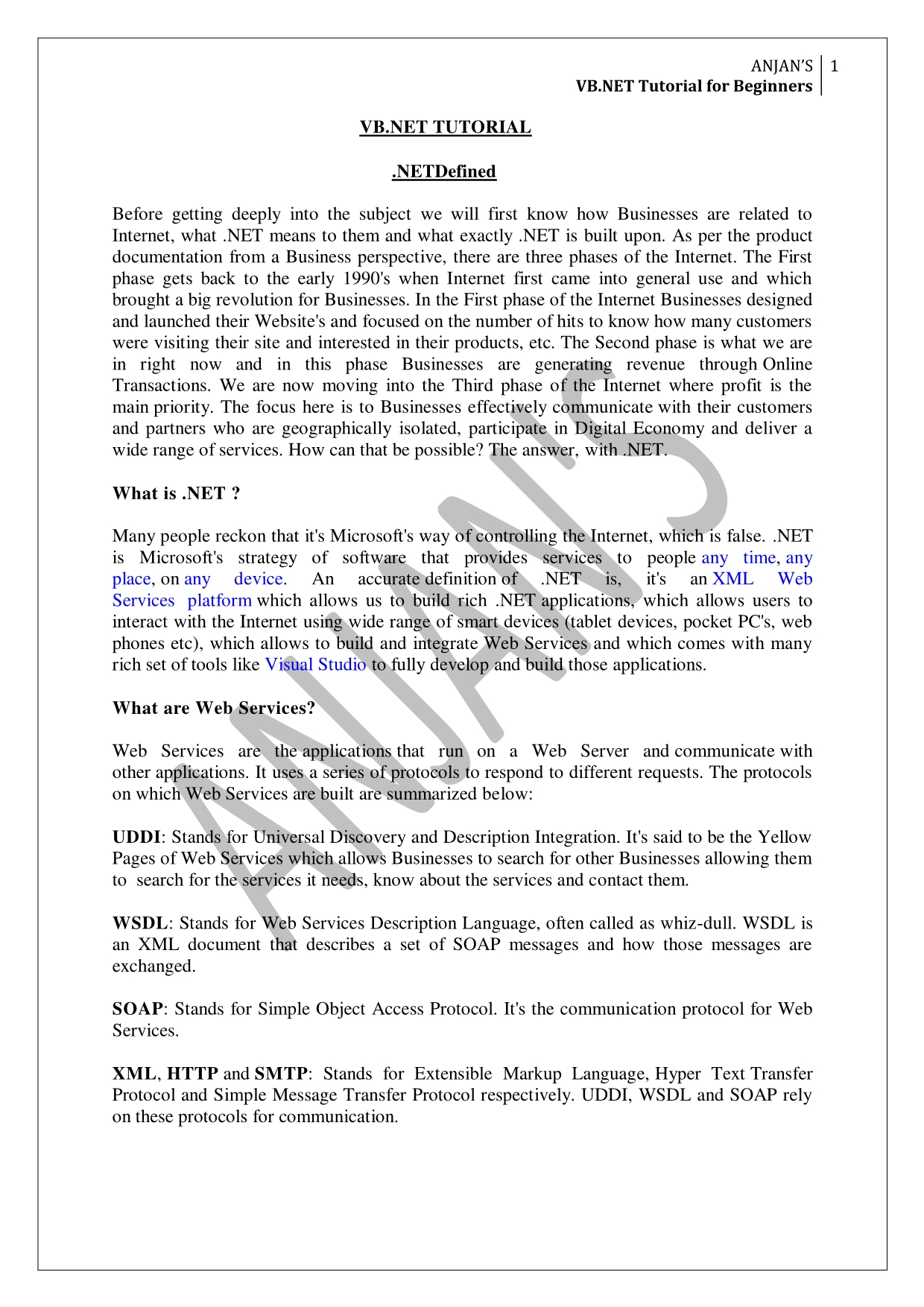
Before getting deeply into the subject we will first know how Businesses are related to
Internet, what .NET means to them and what exactly .NET is built upon. As per the product
documentation from a Business perspective, there are three phases of the Internet. The First
phase gets back to the early 1990's when Internet first came into general use and which
brought a big revolution for Businesses. In the First phase of the Internet Businesses designed
and launched their Website's and focused on the number of hits to know how many customers
were visiting their site and interested in their products, etc. The Second phase is what we are
in right now and in this phase Businesses are generating revenue through Online
Transactions. We are now moving into the Third phase of the Internet where profit is the
main priority. The focus here is to Businesses effectively communicate with their customers
and partners who are geographically isolated, participate in Digital Economy and deliver a
wide range of services. How can that be possible? The answer, with .NET
Below is the document preview.

ALGORITHMS, FLOWCHARTS, DATA TYPES AND PSEUDOCODE
An algorithm is a representation of a solution to a problem. If a problem can be defined
as a difference between a desired situation and the current situation in which one is, then
a problem solution is a procedure, or method, for transforming the current situation to the
desired one. We solve many such trivial problems every day without even thinking about it, for example making breakfast, travelling to the workplace etc. But the solution to such problems requires little intellectual effort and is relatively unimportant. However, the solution of a more interesting problem of more importance usually involves stating the problem in an understandable form and communicating the solution to others. In the case where a computer is part of the means of solving the problem, a procedure, explicitly stating the steps leading to the solution, must be transmitted to the computer. This concept of problem solution and communication makes the study of algorithms important to computer science.
22 Pages
418 Views
0 Downloads
86.08 KB
Introduction to Data Structures
Trending!
Computer System=Software+Hardware
Computer Software
Set of instructions that tells the hardware what to do, how to do it, and even when.
160 Pages
3933 Views
0 Downloads
693.46 KB
Data Structures and Algorithms in Java
Trending!
Building data structures and algorithms requires that we communicate detailed instructions to a computer. An excellent way to perform such communication is
using a high-level computer language, such as Java. In this chapter, we provide an
overview of the Java programming language, and we continue this discussion in the
next chapter, focusing on object-oriented design principles. We assume that readers
are somewhat familiar with an existing high-level language, although not necessarily Java. This book does not provide a complete description of the Java language
(there are numerous language references for that purpose), but it does introduce all
aspects of the language that are used in code fragments later in this book.
3868 Views
0 Downloads
1.13 MB
CMT 211: Object Oriented Programming II
Trending!
Java is an object-oriented, class-based, concurrent, secured and general-purpose
computer-programming language which is a widely used and a robust technology.
What is Java-Java is a programming language and a platform.
• It is a high level, robust, secured and object-oriented programming language.
• It is also a Platform: A platform is any hardware or software environment in which a program runs. Remember Operating Systems are softwares that runs on hardware platforms, But Os also acts as platforms on which applications runs.
3661 Views
0 Downloads
566.18 KB
Data Structures Singly and Doubly Linked Lists
Trending!
Introduction
– Remember Linear List
• Array ( Done)
– Search, Modification,Insertion, Deletion
– Flow chart and Pseudo-codes
– Implementation
– Any Question
• Linked List ( Today)
• Stacks
• Queues
73 Pages
3751 Views
0 Downloads
173.23 KB
The BinaryTree ADT
Trending!
A tree is a nonlinear data structure used to
represent entities that are in some hierarchical relationship
• Examples in real life:
• Family tree
• Table of contents of a book
• Class inheritance hierarchy in Java
• Computer file system (folders and
subfolders)
• Decision trees
• Top-down design
149 Pages
4037 Views
0 Downloads
1.03 MB
Introduction To Graph Data Structure
Trending!
A set is a collection of non repeating objects.
• The objects in a set are called its elements or members.
• The elements in a set can be any types, including sets(set of sets)! The
members of a set do not even have to be of the same type. Fo
• forr example, a set can consist of numbers and names
37 Pages
4167 Views
0 Downloads
4.59 MB
Data Structure MCQ (Multiple Choice Questions)
Trending!
Data Structure MCQ
1) How can we describe an array in the best possible way?
a. The Array shows a hierarchical structure.
b. Arrays are immutable.
c. Container that stores the elements of similar types
d. The Array is not a data structure
Hide Answer Workspace
Answer: c
Explanation: The answer is c because array stores the elements in a contiguous
block of memory of similar types. Therefore, we can say that array is a container
that stores the elements of similar types
58 Pages
3813 Views
0 Downloads
1.43 MB
MAT 111 :DISCRETE MATHEMATICS
Trending!
A set is a collection of distinct objects
44 Pages
3798 Views
0 Downloads
5.09 MB
Communication in Distributed System
Trending!
In distributed systems, nodes communicate by sending messages, invoking remote procedures, sharing memory, or using sockets. These methods allow nodes to exchange data and coordinate actions, enabling effective collaboration towards common goals.
327 Pages
4116 Views
0 Downloads
5.03 MB