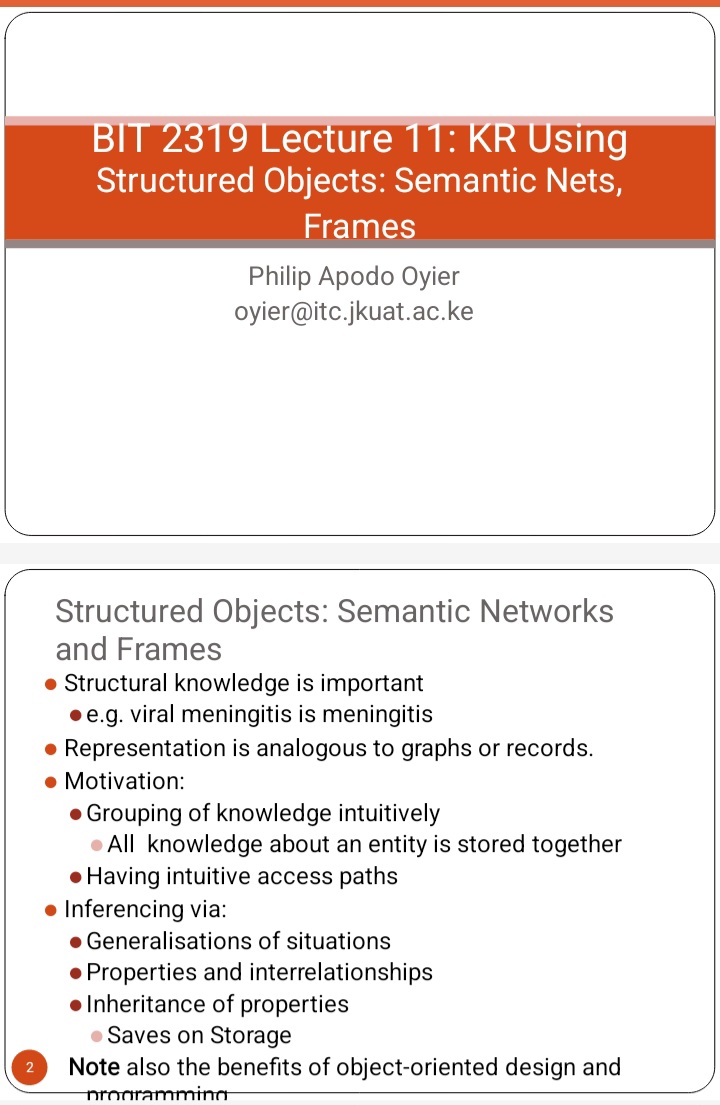
KR Using structured objects: Semantic nets, frames
| Institution | Jomo Kenyatta University of Science and Technology |
| Course | Information Technol... |
| Year | 3rd Year |
| Semester | Unknown |
| Posted By | Jeff Odhiambo |
| File Type | ppt |
| Pages | |
| File Size | 2.07 MB |
| Views | 3550 |
| Downloads | 0 |
| Price: |
Buy Now
 Buy via
whatsapp Buy via
whatsapp
|


Description
Knowledge Representation (KR) using structured objects, such as semantic nets and frames, involves organizing and representing knowledge in a way that mimics human understanding. A semantic net is a graph-based structure where concepts are represented as nodes, and relationships between them are represented as edges. This approach enables the modeling of associative relationships and hierarchies between concepts, providing a way to represent facts and the context in which they hold true. Frames, on the other hand, are data structures that contain slots or attributes, each of which holds values or pointers to other frames. Frames are useful for representing stereotypical situations, allowing the encoding of more complex, object-oriented knowledge. Both structures help capture knowledge in a way that is understandable and manipulable by machines, facilitating reasoning and inference in artificial intelligence applications.
Below is the document preview.

Database Architecture
Trending!
Database architecture refers to the structure and organization of a database system, defining how data is stored, processed, and accessed within a database management system (DBMS). It provides a blueprint for both the physical and logical aspects of a database, ensuring that data is stored efficiently and can be retrieved, updated, and managed effectively. The architecture typically involves several layers and components, each playing a specific role in the overall functioning of the system.
4106 Views
0 Downloads
333.32 KB
Database Design
Trending!
Database design is the process of creating a detailed blueprint for a database, focusing on its structure, relationships, and constraints. The goal of database design is to ensure that the database efficiently stores, organizes, and retrieves data while maintaining data integrity, security, and performance. A well-designed database is crucial for meeting the needs of its users and applications, ensuring scalability, and providing a reliable system for managing data.
4053 Views
0 Downloads
3.12 MB
The ANSI-SPARCArchitectureDBMS
Trending!
The architecture of most commercial DBMSs is based on the ANSI-SPARC architecture (1975). Itwasdevised by American National Standards Institute (ANSI) and Standards Planning AndRequirementsCommittee (SPARC). The ANSI-SPARC model of a database identifies three distinct levels atwhichdata items can be described. These levels form a three-level architecture comprising of an external level,aconceptual level, and an internallevel
4101 Views
0 Downloads
136.03 KB
Data models
Trending!
Data models describe how data is structured, organized, and managed in a database or system. They define the relationships, constraints, and operations on the data.
12 Pages
3831 Views
0 Downloads
256.68 KB
Query Processing and Optimization
Trending!
Query Processing and Optimization are critical components in database management systems (DBMS) to ensure efficient data retrieval, transformation, and storage. They focus on translating, executing, and improving the performance of user queries.
3882 Views
0 Downloads
1.49 MB
Introduction to Database systems.
Trending!
A database system is an organized collection of data and a set of programs used to manage and access that data efficiently. It serves as a foundation for storing, retrieving, and manipulating information in a structured manner. Database systems are integral to applications ranging from simple inventory tracking to complex enterprise resource planning.
3821 Views
0 Downloads
107.94 KB
Transaction Management & concurrency control 1
Trending!
Transaction Management and Concurrency Control are essential components of a database management system (DBMS) that ensure data consistency, integrity, and performance when multiple users or processes access the database simultaneously.
3634 Views
0 Downloads
2.05 MB
Database Management System
A Database Management System (DBMS) is software designed to store, manage, and retrieve data efficiently in a structured manner. It serves as an interface between users and databases, allowing for data organization, retrieval, modification, and management without requiring users to understand the complexities of database structures.
834 Views
0 Downloads
183.97 KB
Database Recovery Techniques
Trending!
Database recovery techniques are methods used to restore a database to a consistent state after a failure. Failures can be caused by hardware issues, software bugs, or user errors. The primary goal of these techniques is to ensure data integrity and minimize data loss.
3586 Views
0 Downloads
559.49 KB
Distributed Database System
Trending!
Distributed Database System (DDBS) is a collection of databases distributed across multiple locations, interconnected by a network, and managed in such a way that they function as a single logical database. This system allows data to be stored, processed, and accessed from multiple sites, enhancing performance, reliability, and scalability.
3785 Views
0 Downloads
253 KB