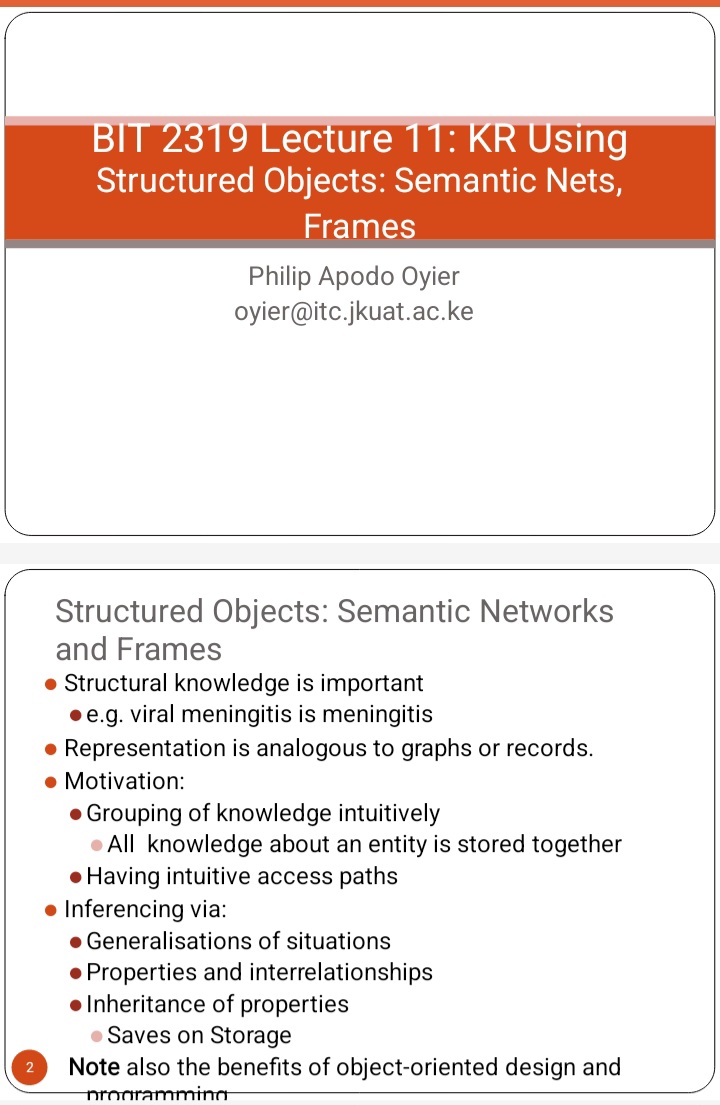
KR Using structured objects: Semantic nets, frames
| Institution | Jomo Kenyatta University of Science and Technology |
| Course | Information Technol... |
| Year | 3rd Year |
| Semester | Unknown |
| Posted By | Jeff Odhiambo |
| File Type | ppt |
| Pages | |
| File Size | 2.07 MB |
| Views | 3538 |
| Downloads | 0 |
| Price: |
Buy Now
 Buy via
whatsapp Buy via
whatsapp
|


Description
Knowledge Representation (KR) using structured objects, such as semantic nets and frames, involves organizing and representing knowledge in a way that mimics human understanding. A semantic net is a graph-based structure where concepts are represented as nodes, and relationships between them are represented as edges. This approach enables the modeling of associative relationships and hierarchies between concepts, providing a way to represent facts and the context in which they hold true. Frames, on the other hand, are data structures that contain slots or attributes, each of which holds values or pointers to other frames. Frames are useful for representing stereotypical situations, allowing the encoding of more complex, object-oriented knowledge. Both structures help capture knowledge in a way that is understandable and manipulable by machines, facilitating reasoning and inference in artificial intelligence applications.
Below is the document preview.

BIT 2112: Lesson 5 System Modeling
Trending!
System modeling is the process of creating a mathematical, computational, or conceptual representation of a system to analyze its behavior, performance, and other properties. This can be done in various fields, including engineering, computer science, biology, economics, and more. The purpose of system modeling is to understand, predict, and optimize the behavior of a system, often before it is physically implemented or experimented with.
79 Pages
4075 Views
0 Downloads
546.98 KB
BIT 2112: Software Development
Trending!
Software development is the process of designing, creating, testing, and maintaining software applications. It involves several stages.
4116 Views
0 Downloads
49 KB
BIT 2112: Stuctured system Analysis and Design
Trending!
Structured System Analysis and Design (SSAD) is a methodology used to develop information systems in a systematic, organized manner. It focuses on a clear, step-by-step approach to understanding the needs of the business or organization and then creating a system that fulfills those needs.
54 Pages
3989 Views
0 Downloads
1.95 MB
ICS 2201: HTML and CSS design and build website
Trending!
HTML and CSS are the foundational technologies for designing and building websites.
HTML is the standard language for structuring and presenting content on the web. It forms the skeleton of a website by defining elements like headings, paragraphs, images, and links.
CSS is used to style and layout the HTML content. It controls colors, fonts, spacing, and positioning.
514 Pages
4045 Views
1 Downloads
18.78 MB
ICS 2201: Lab work HTML introduction
Trending!
Lab work HTML introduction
1 Pages
3963 Views
0 Downloads
65.54 KB
ICS 2201: HTML tags
Trending!
HTML (Hypertext Markup Language) tags are the building blocks of web pages. They define the structure, content, and layout of a webpage.
4038 Views
0 Downloads
24.66 KB
HBC 2305: INTERNATIONAL BUSINESS MANAGEMENT
Trending!
International business is a term used to collectively describe all commercial trans- actions and logistics that take place between two or more countries beyond their political boundary. For example, private companies undertake such undertake them for profit and for political.
96 Pages
4016 Views
0 Downloads
855.21 KB
HBF 2304: INVESTMENT ANALYSIS AND PORTFOLIO MANAGEMENT
Trending!
The purpose of this course is to enable students to undertake critical evaluation and appraisal of the key concepts, theories, innovations and applications of investing theory for risk minimization and return maximization in the financial and real markets.
75 Pages
4006 Views
0 Downloads
1.05 MB
HBF 2404: CONTEMPORARY ISSUES IN FINANCIAL MANAGEMENT
Trending!
Course aims; Help students build onto the principles and concepts acquired in Financial Management, Advanced Financial Management and Research Methodology to evaluate emerging and new issues in Financial Management and corporate finance and financial innovations.
124 Pages
4202 Views
4 Downloads
1.05 MB
ACC 2101: Intermediate Accounting Notes
Trending!
A single entry and incomplete records refer to a situation where business transactions are not analyzed and recorded following the accounting process. The double entry system is not followed whereby only one side of the transaction is recorded and or the records are completely omitted.
50 Pages
4355 Views
1 Downloads
521.42 KB