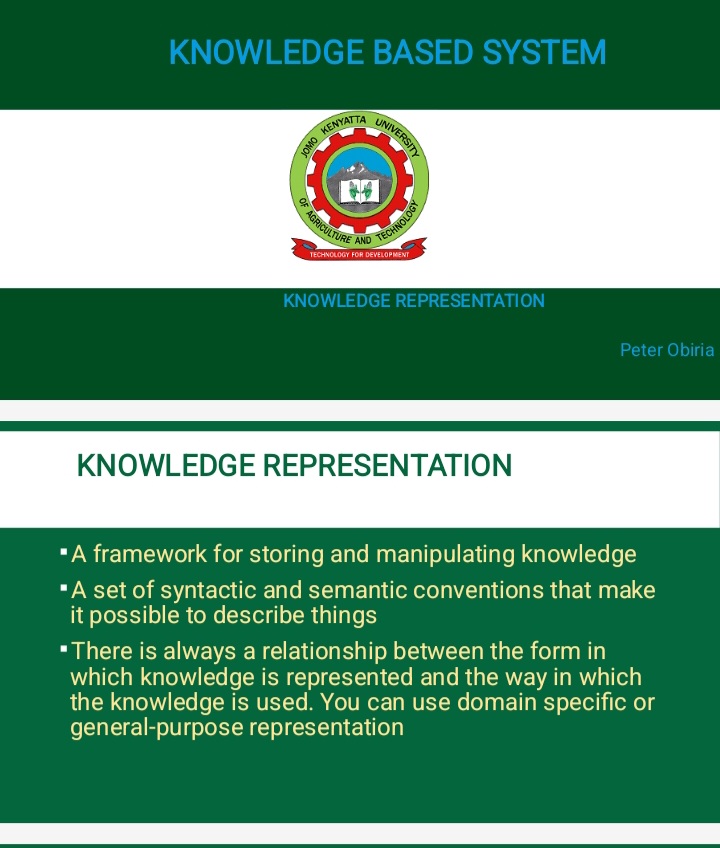
Knowledge Representation
| Institution | Jomo Kenyatta University of Science and Technology |
| Course | Information Technol... |
| Year | 3rd Year |
| Semester | Unknown |
| Posted By | Jeff Odhiambo |
| File Type | pptx |
| Pages | |
| File Size | 1.98 MB |
| Views | 459 |
| Downloads | 0 |
| Price: |
Buy Now
 Buy via
whatsapp Buy via
whatsapp
|


Description
Knowledge representation (KR) is a field of artificial intelligence that focuses on how to formally model information about the world in a way that a computer system can understand, reason, and use to make decisions. It involves the creation of structures, such as graphs, rules, or ontologies, that capture relationships, concepts, and properties of objects in a domain. KR allows machines to simulate human-like reasoning and problem-solving by encoding knowledge in a structured form, facilitating tasks like natural language understanding, expert systems, and machine learning. The goal is to enable intelligent systems to process, infer, and act upon knowledge efficiently and accurately.
Below is the document preview.

Knowledge Representation: Logic
Trending!
Knowledge representation using logic is a formal approach to encoding information about the world in a structured and interpretable way. It employs logical systems, such as propositional logic and first-order logic, to represent facts, rules, and relationships between entities. Logic-based knowledge representation enables reasoning by applying inference rules to derive new facts from existing ones, ensuring consistency and transparency. This approach is widely used in artificial intelligence, expert systems, and automated reasoning, allowing machines to make informed decisions based on logical deductions.
3688 Views
0 Downloads
1.91 MB
Knowledge Representation
Knowledge representation in Artificial Intelligence (AI) refers to the methods used to encode information about the world in a format that a computer can process and reason with. It enables AI systems to store, retrieve, and manipulate knowledge to make informed decisions. Common techniques include semantic networks, frames, production rules, and ontologies, each suited for different problem domains. Effective knowledge representation allows AI to perform reasoning, understand natural language, and interact intelligently with humans. It is fundamental to expert systems, natural language processing, and automated decision-making, making AI systems more efficient and capable of solving complex problems.
8 Pages
516 Views
0 Downloads
303.99 KB
Techniques of knowledge representation
Trending!
Techniques of knowledge representation in Artificial Intelligence (AI) define how information is structured and processed for reasoning and decision-making. The main techniques include logical representation, which uses formal logic to express facts and rules; semantic networks, which represent knowledge as interconnected nodes and relationships; frames, which organize knowledge into structured templates with attributes and values; and production rules, which use "if-then" statements for decision-making. Ontologies provide a hierarchical structure of concepts and their relationships, enabling AI to understand context. These techniques help AI systems efficiently store, retrieve, and apply knowledge, making them crucial for expert systems, natural language processing, and intelligent decision-making.
7 Pages
3505 Views
0 Downloads
1.11 MB
ICS 2405: Chapter 3 - KNOWLEDGE REPRESENTATION(KBS)
Trending!
Buy Chapter 3 - Knowledge Representation (ICS 2305) and learn more about the techniques and frameworks for structuring knowledge in Knowledge Based Systems (KBS), including semantic networks, frames, ontologies, and logic-based representations for reasoning and problem-solving.
72 Pages
4074 Views
0 Downloads
882.59 KB