CMT 212: CLOUD COMPUTING ESSENTIALS
| Institution | University |
| Course | BACHELOR OF COMPUTER... |
| Year | 1st Year |
| Semester | Unknown |
| Posted By | stephen oyake rabilo |
| File Type | |
| Pages | 35 Pages |
| File Size | 1.47 MB |
| Views | 3962 |
| Downloads | 0 |
| Price: |
Buy Now
 Buy via
whatsapp Buy via
whatsapp
|


Description
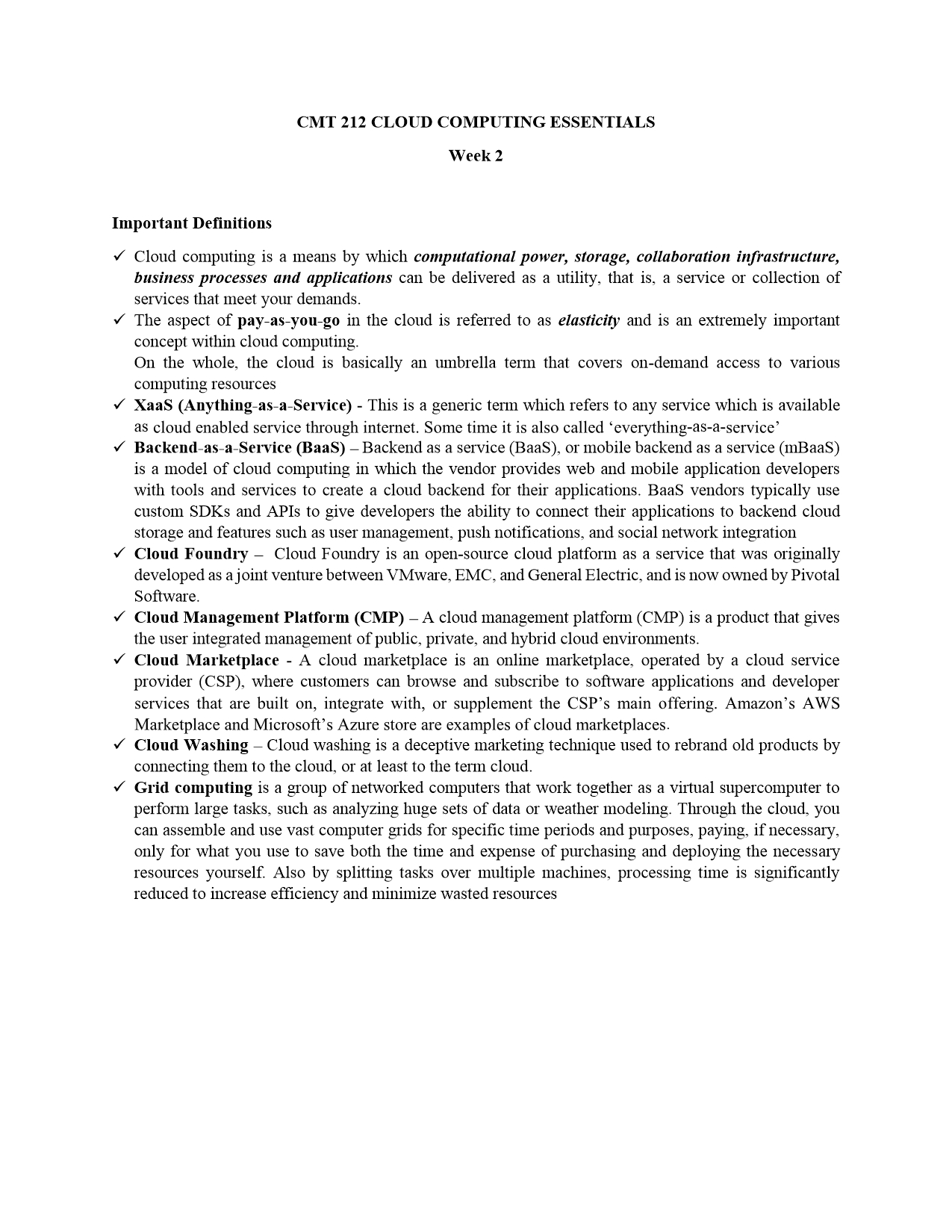
Cloud computing is a means by which computational power, storage, collaboration infrastructure, business processes and applications can be delivered as a utility, that is, a service or collection of services that meet your demands. The aspect of pay-as-you-go in the cloud is referred to as elasticity and is an extremely important concept within cloud computing.
On the whole, the cloud is basically an umbrella term that covers on-demand access to various computing resources. XaaS (Anything-as-a-Service) - This is a generic term which refers to any service which is available as cloud enabled service through internet. Some time it is also called ‘everything-as-a-service Backend-as-a-Service (BaaS) – Backend as a service (BaaS), or mobile backend as a service (mBaaS) is a model of cloud computing in which the vendor provides web and mobile application developers with tools and services to create a cloud backend for their applications. BaaS vendors typically use custom SDKs and APIs to give developers the ability to connect their applications to backend cloud storage and features such as user management, push notifications, and social network integration. Cloud Foundry – Cloud Foundry is an open-source cloud platform as a service that was originally developed as a joint venture between VMware, EMC, and General Electric, and is now owned by Pivotal Software. Cloud Management Platform (CMP) – A cloud management platform (CMP) is a product that gives the user integrated management of public, private, and hybrid cloud environments.
Cloud Marketplace - A cloud marketplace is an online marketplace, operated by a cloud service provider (CSP), where customers can browse and subscribe to software applications and developer services that are built on, integrate with, or supplement the CSP’s main offering. Amazon’s AWS . Marketplace and Microsoft’s Azure store are examples of cloud marketplaces. Cloud Washing – Cloud washing is a deceptive marketing technique used to rebrand old products by connecting them to the cloud, or at least to the term cloud. Grid computing is a group of networked computers that work together as a virtual supercomputer to perform large tasks, such as analyzing huge sets of data or weather modeling. Through the cloud, you can assemble and use vast computer grids for specific time periods and purposes, paying, if necessary, only for what you use to save both the time and expense of purchasing and deploying the necessary resources yourself. Also by splitting tasks over multiple mac
Below is the document preview.

DEVELOPMENT OF AXIAL SKELETON
Trending!
The Skeleton
• Consists of–Bones, cartilage, joints, and ligaments
• Composed of 206 named bones: two
divisions–Axial skeleton (80 bones)–Appendicular skeleton (126 bones)
80 Pages
4365 Views
0 Downloads
6.09 MB
Head and Neck development I: Pharyngeal apparatus and their derivatives
Trending!
Pharyngeal Apparatus 1
•Pharyngeal arches are rod-like thickenings of
mesoderm present in the wall of the foregut.
•The ventral ends of the arches of the right and left sides meet in the middle line in the floor of the pharynx.
•In the interval between any two arches, the endoderm (lining the pharynx) is pushed outwards to form a series of pouches - endodermal, or pharyngeal, pouches.
•They are evident in the head and neck region by 4th week
•Resemble fish gills (branchia) thus their earlier name .Branchial apparatus - derived from the Greek word
branchia or gill
•They are derived from neural crest cells
97 Pages
4564 Views
0 Downloads
4.7 MB
DEVELOPMENT OF THE DIGESTIVE SYSTEM
Trending!
The digestive system consists of the hollow GIT and the extrinsic glands
•Name the components of the hollow GIT in order
•Name the extrinsic glands of the digestive system
•The hollow GIT develops from the primordial gut, that forms during embryonic folding
•Extrinsic glands of the digestive system develop as diverticula from the developing
gut, hence retain their connections with the GIT via their ducts
26 Pages
4549 Views
0 Downloads
1.45 MB
Biostatistics Lecture Notes
Trending!
This document provides an overview of key concepts in biostatistics and statistical methods used in health studies. It defines statistics as techniques used to draw conclusions from empirical data and introduces common statistical terms like population, sample, bias, and primary and secondary data.
84 Pages
4744 Views
0 Downloads
408.82 KB
ANATOMY PRACTICAL
Trending!
Grab yourself a copy practical anatomy questions and answers for your revision and study purposes. Be ahead of the rest with your study with this copy , grab the copy today.
46 Pages
4540 Views
0 Downloads
2.01 MB
BLA 1111: CRITICAL READING AND RESPONSE LECTURE NOTES
Trending!
This document provides an introduction to a course on critical reading and response. It discusses how the course will introduce students to concepts in literature and give them the foundational skills for literary appreciation and analysis. Key topics that will be covered include literary genres, theory and criticism, and how to interpret texts. The goal is for students to understand the language of literary studies and be able to do basic interpretations of works from different genres.
53 Pages
4785 Views
5 Downloads
423.6 KB
LIT 2101: EAST AFRICAN POETRY AND DRAMA COMPLETE NOTES
Trending!
This course exposes students to a vast dramatic literary world, while orienting
them with the concept and ideology of each playwright with intent to inspire and
emancipate them to mitigate the challenges of contemporary society through writing and art performance.
134 Pages
4237 Views
0 Downloads
648.16 KB
AFRICAN DRAMA HANDWRITEN NOTES
Trending!
This is for those studying literature in their third years in the university, especially in Africa.
33 Pages
3984 Views
0 Downloads
9.96 MB
SURVEY OF THE PLANT KINGDOM NOTES
Trending!
This document provides an overview of plant taxonomy and classification. It discusses the hierarchical taxonomic system used to classify organisms, from domain to species. It then details the classification of major plant divisions, from algae to flowering plants. Key information on each division is given, such as distinguishing characteristics, examples of families and economically important plants. The document aims to present plant taxonomy and classification in an organized, informative manner.
28 Pages
4350 Views
0 Downloads
1.97 MB
MBA PSYCHOLOGY NOTES
Trending!
Psychology is the scientific study of the mind, how it works, and how it influences behavior. It has many branches that study specific areas. Some of the major branches described in the document are clinical psychology, which focuses on mental health diagnosis and treatment; cognitive psychology, which studies thinking, memory, and learning; developmental psychology, which focuses on lifespan development; and social psychology, which examines how people influence each other and interact in groups.
66 Pages
4101 Views
0 Downloads
494.24 KB