CMT 212: CLOUD COMPUTING ESSENTIALS
| Institution | University |
| Course | BACHELOR OF COMPUTER... |
| Year | 1st Year |
| Semester | Unknown |
| Posted By | stephen oyake rabilo |
| File Type | |
| Pages | 35 Pages |
| File Size | 1.47 MB |
| Views | 3985 |
| Downloads | 0 |
| Price: |
Buy Now
 Buy via
whatsapp Buy via
whatsapp
|


Description
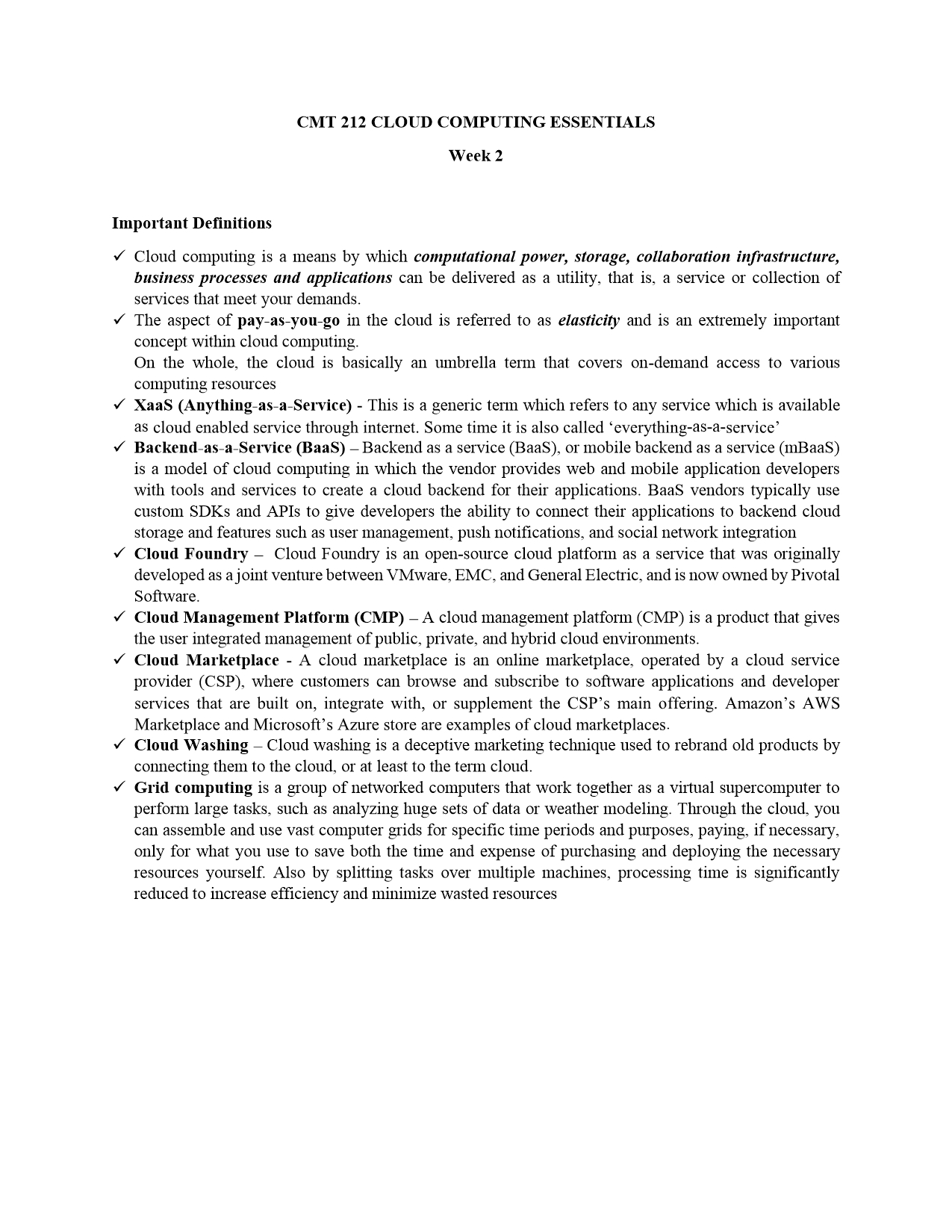
Cloud computing is a means by which computational power, storage, collaboration infrastructure, business processes and applications can be delivered as a utility, that is, a service or collection of services that meet your demands. The aspect of pay-as-you-go in the cloud is referred to as elasticity and is an extremely important concept within cloud computing.
On the whole, the cloud is basically an umbrella term that covers on-demand access to various computing resources. XaaS (Anything-as-a-Service) - This is a generic term which refers to any service which is available as cloud enabled service through internet. Some time it is also called ‘everything-as-a-service Backend-as-a-Service (BaaS) – Backend as a service (BaaS), or mobile backend as a service (mBaaS) is a model of cloud computing in which the vendor provides web and mobile application developers with tools and services to create a cloud backend for their applications. BaaS vendors typically use custom SDKs and APIs to give developers the ability to connect their applications to backend cloud storage and features such as user management, push notifications, and social network integration. Cloud Foundry – Cloud Foundry is an open-source cloud platform as a service that was originally developed as a joint venture between VMware, EMC, and General Electric, and is now owned by Pivotal Software. Cloud Management Platform (CMP) – A cloud management platform (CMP) is a product that gives the user integrated management of public, private, and hybrid cloud environments.
Cloud Marketplace - A cloud marketplace is an online marketplace, operated by a cloud service provider (CSP), where customers can browse and subscribe to software applications and developer services that are built on, integrate with, or supplement the CSP’s main offering. Amazon’s AWS . Marketplace and Microsoft’s Azure store are examples of cloud marketplaces. Cloud Washing – Cloud washing is a deceptive marketing technique used to rebrand old products by connecting them to the cloud, or at least to the term cloud. Grid computing is a group of networked computers that work together as a virtual supercomputer to perform large tasks, such as analyzing huge sets of data or weather modeling. Through the cloud, you can assemble and use vast computer grids for specific time periods and purposes, paying, if necessary, only for what you use to save both the time and expense of purchasing and deploying the necessary resources yourself. Also by splitting tasks over multiple mac
Below is the document preview.

Linear Model Regression
Trending!
Comprehensive resource for linear model regression concepts.
29 Pages
3827 Views
0 Downloads
11.43 MB
Introduction To Artificial/ Machine Intelligence
Trending!
Comprehensive introduction to machine intelligence ,commonly, artificial intelligence.
71 Pages
3887 Views
0 Downloads
2.5 MB
Python Libraries
Trending!
Expand your knowledge in python with this compilation to a far reaching depth.
74 Pages
3767 Views
0 Downloads
4.13 MB
Pyhton CheatSheet
Trending!
Detailed exam cheat sheet for python
26 Pages
4378 Views
0 Downloads
3.02 MB
Python, AI, data science machine learning Cheat Sheet
Trending!
Comprehensive Python, AI, data science machine learning exams Cheat Sheet
15 Pages
4240 Views
0 Downloads
2.13 MB
PySpark Python Cheat sheet
Trending!
Comprehensive PySpark Python exams Cheat sheet
21 Pages
3873 Views
0 Downloads
5.14 MB
ADVANCED FINANCIAL REPORTING THEORY REVISION
Trending!
Factors to be considered in choosing the presentation currency
1. Whether the activities of the foreign operation are carried out as an extension of the
reporting entity or are being carried out with significant degree of autonomy.
2. Whether the transactions with the reporting entity are high or low proportion of the
foreign operations activities.
3. Whether cash flows from the activities of the foreign operation directly affects the cash
flows of the reporting entity or not.
4. Whether foreign operations is able to borrow and service its own debts independently.
June 2010 Question Two
(a) Differences between income statement view and balance sheet view of deferred
taxes:
When the income statement view of deferred taxes is taken, there is a focus on the differences
between the accounting profit and and taxable profit ie timing differences. This was the view
of deferred taxes taken internationally and in UK and USA until the 1990s.The balance sheet
view focuses on the difference between the carrying amount of assets and liabilities and their tax bases. It is the method recommended by IAS 12.
(b) (i) Nil provision
This is where the financial statements are prepared without reflecting all the effects of tax iethere is not provision for deferred taxes.
(ii) Partial provision
Under this approach deferred tax is provided but not on all temporary differences. The
management uses a subjective approach in deciding which temporary differences may
crystallize.ie you provide for future tax consequences to the extent that you have reasonable
evidence that it will reverse within a reasonable period of time usually 3 years.
17 Pages
4855 Views
0 Downloads
785.01 KB
ADVANCED FINANCIAL MANAGEMENT Revision kit
Trending!
Download full revision kit for Advanced Financial Management Paper. This kit has a number questions that will boost your understanding and knowledge in matters AFM.
230 Pages
4784 Views
0 Downloads
7.39 MB
2002-2019-Advanced Financial Management Past Papers
Trending!
This documents contains past papers from the year 2002 to 2019 for Advanced Financial Management . Get equipped with possible question in the next paper of Advanced Financial Management .
288 Pages
5036 Views
0 Downloads
3.43 MB
CPA; Advanced Taxation
Trending!
In the first taxation paper you were introduced with aspects of taxation of business income. In this chapter, you will be introduced with concepts on advanced aspects of the taxation of business income. Some of the issues to be discussed in this chapter are tax implications of various sources of income for partnerships, and taxation of group of companies. In the next chapter you will cover the taxation of specialized institutions.
286 Pages
4686 Views
0 Downloads
1.22 MB