HOW TO PASS KCSE MATHS
| Institution | Secondary |
| Course | K.C.S.E |
| Year | 4th Year |
| Semester | Unknown |
| Posted By | Liz Ochola |
| File Type | |
| Pages | 11 Pages |
| File Size | 102.61 KB |
| Views | 8455 |
| Downloads | 1 |
| Price: |
Buy Now
 Buy via
whatsapp Buy via
whatsapp
|


Description
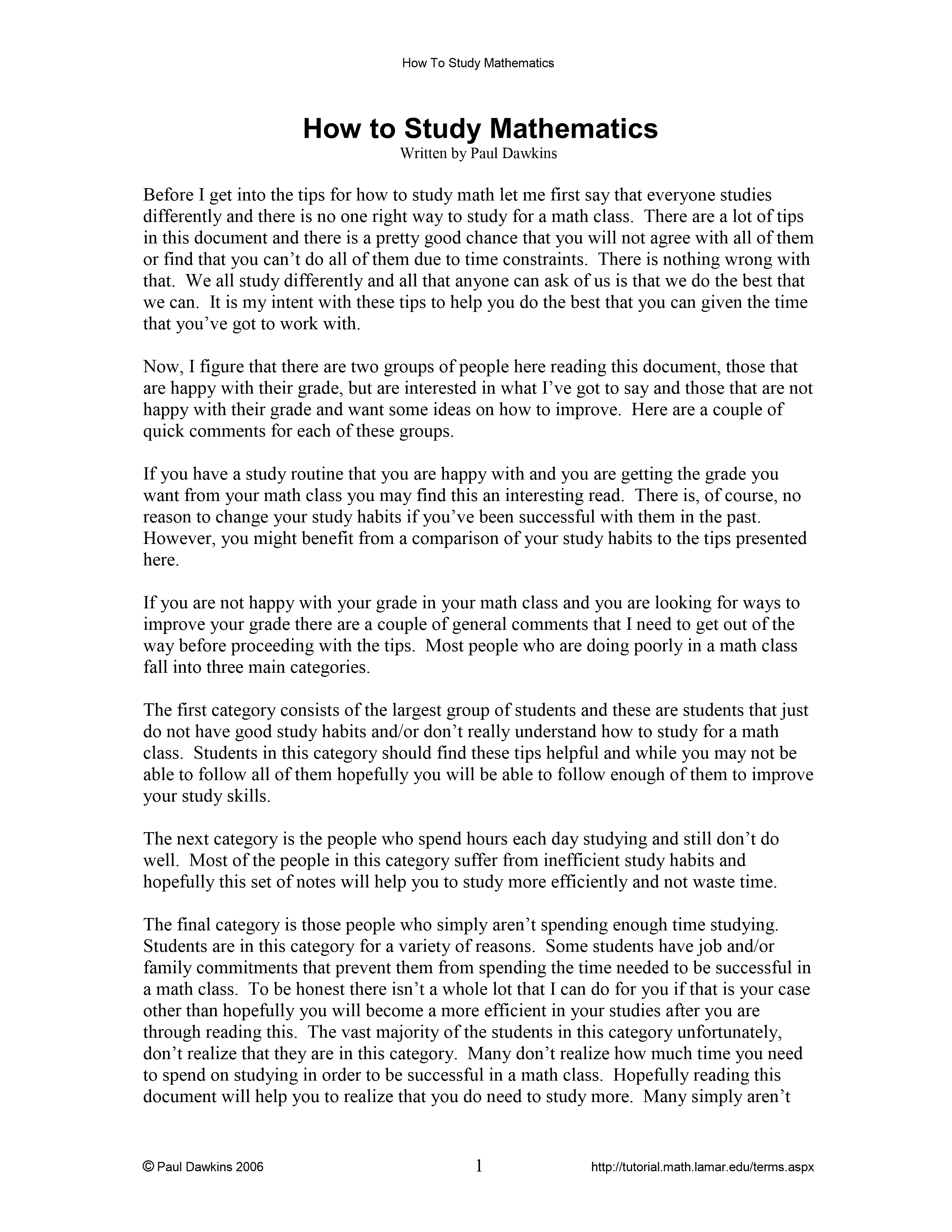
Before I get into the tips for how to study math let me first say that everyone studies
differently and there is no one right way to study for a math class. There are a lot of tips
in this document and there is a pretty good chance that you will not agree with all of them or find that you can’t do all of them due to time constraints.
Below is the document preview.

Operating Systems
An operating system is a software that manages the computer hardware. The hardware must provide appropriate mechanisms to ensure the correct operation of the computer system and to prevent user programs from interfering with the proper operation of the system.
159 Pages
1696 Views
0 Downloads
1.18 MB
BMA 1207: INTRODUCTION TO BUSINESS MATHEMATICS
Trending!
The purpose of this module: the learner to acquire Basic mathematical concepts in order to prepare for the advanced courses and acquiring positive attitude, knowledge and skills which will be relevant to her/his life in the university.
107 Pages
10615 Views
4 Downloads
1.36 MB
BBM 312: BUSINESS STATISTICS
Trending!
A Statistician collects information for variables, which describe the situation. A variable is a characteristics or attribute that can assume different values. That is Data are values, measurements or observations that the variables can assume. Variables whose values are determined by chance are called random variable.
71 Pages
8700 Views
2 Downloads
932.96 KB
BASIC COMPUTER KNOWLEDGE
Trending!
The first computing machine was known as ABACUS which was used in ancient China and Japan thousands of years before Christ for simple and small volumes arithmetics. John Napier invented Logarithms which was an aid to calculations, he also published log tables in 1614 and later in 1620s it was used by William Oughtred to develop the slide rule.
56 Pages
6573 Views
0 Downloads
1.2 MB
CMCC 2401: Introduction to Project Management
Trending!
A project is a series of activities aimed at producing a good or a service. According to the project management institute, a project is defined as a temporary endeavor undertaken to create a unique product/ service. Temporary means that every project has a definite end. Unique means that the product or service is different in some distinguishing way from all similar products or services.
91 Pages
7142 Views
1 Downloads
889.24 KB
FOOD SCIENCE AND TECHNOLOGY
Food science is the study of nature, composition and the chemical and physical changes that occur under valid conditions of storage, processing and use of food components.
49 Pages
264 Views
0 Downloads
338.69 KB
Computer Application II
Trending!
Accounting is a systematic process of identifying, recording, measuring, classifying, verifying, summarizing, interpreting and communicating financial information. It reveals profit or loss for a given period, and the value and nature of a firm's assets, liabilities and owners' equity. Accounting provides information on the.
129 Pages
6896 Views
1 Downloads
3.31 MB
Computational Mathematics
Mathematical statement of equality between algebraic expressions. An expression is algebraic if it involves a finite combination of numbers and variables and algebraic operations (addition, subtraction, multiplication, division, raising to a power, and extracting a root).
199 Pages
743 Views
1 Downloads
3.32 MB
PUBLIC RELATIONS
Public Relations is the deliberate, planned and sustained effort to establish and maintain mutual understanding between on organization and its publics. Public Relations is distinctive management function which helps establish and maintain mutual lines of communication, understanding, acceptance and cooperation between an organization and its publics.
130 Pages
577 Views
0 Downloads
438.28 KB
SCH 211/311: COMPARATIVE STUDY OF D BLOCK ELEMENTS
The d–block occupies the large middle section flanked by s– and p– blocks in the periodic table. The very name
‘transition’ given to the elements of d-block is only because of their position between s– and p– block elements. The d–orbitals of the penultimate energy level in their atoms receive electrons giving rise to the three rows of the transition
metals, i.e., 3d, 4d and 5d. The fourth row of 6d is still incomplete.
66 Pages
127 Views
0 Downloads
3.37 MB