Expectation and Variance
| Institution | Jomo Kenyatta University of Science and Technology |
| Course | Information Technol... |
| Year | 2nd Year |
| Semester | Unknown |
| Posted By | Jeff Odhiambo |
| File Type | |
| Pages | 30 Pages |
| File Size | 233.95 KB |
| Views | 3547 |
| Downloads | 0 |
| Price: |
Buy Now
 Buy via
whatsapp Buy via
whatsapp
|


Description
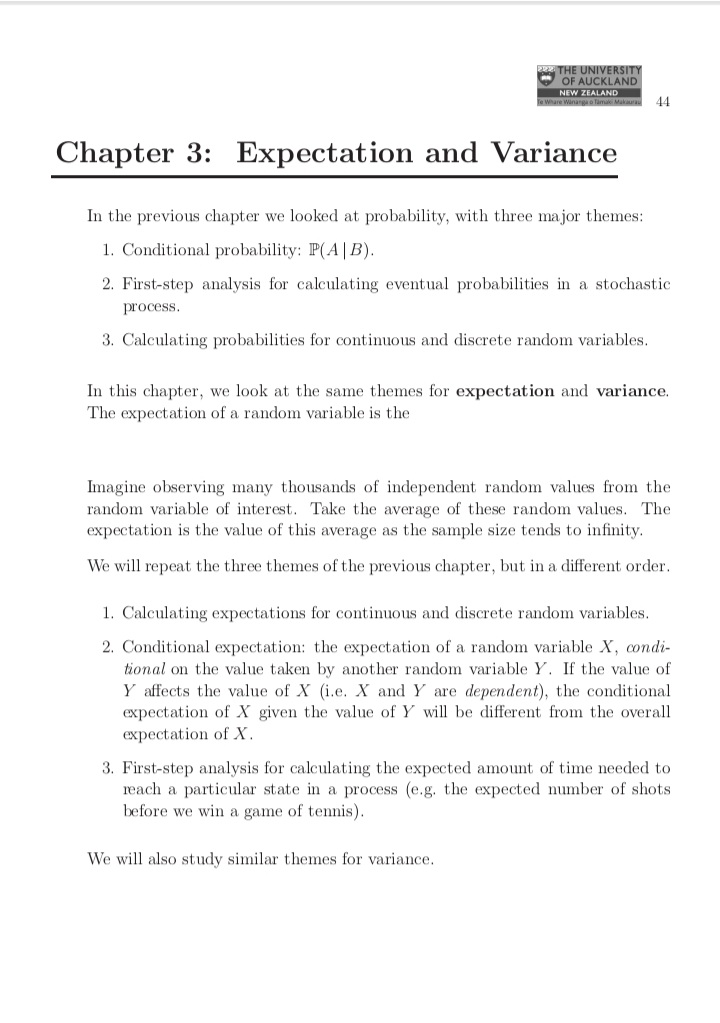
Expectation and Variance are fundamental concepts in probability and statistics. The expectation (or expected value) of a random variable represents its theoretical average over an infinite number of trials, essentially summarizing the central tendency of its probability distribution. It is calculated as the weighted sum of all possible values of the variable, where the weights are their respective probabilities. Variance, on the other hand, measures the dispersion or spread of the random variable around its expectation. It quantifies how much the values deviate, on average, from the mean, and is calculated as the expected value of the squared differences between the variable and its mean. Together, expectation and variance provide a comprehensive understanding of a random variable’s behavior, highlighting both its central value and the variability around it.
Below is the document preview.

Network Layer Protocols and IP Addressing
on completion of this course, you will be able to:
Describe main protocols at the network layer.
Describe the concepts and classification of IPv4 addresses and special IPv4 addresses.
Calculate IP networks and subnets.
Use the IP network address planning method.
25 Pages
370 Views
0 Downloads
744.84 KB
IP Routing Basics
On completion of this course, you will be able to:
Understand the basic principles of routers.
Know how routers select optimal routes.
Understand the contents of routing tables.
Master advanced routing features.
23 Pages
353 Views
0 Downloads
1018.85 KB
OSPF Basics
On completion of this course, you will be able to:
Describe the advantages and classification of dynamic routing protocols.
Describe basic OSPF concepts and usage scenarios.
Describe the working mechanism of OSPF.
Implement basic OSPF configurations.
24 Pages
359 Views
0 Downloads
1.22 MB
IPv6 Basics
On completion of this course, you will be able to:
Summarize the advantages of IPv6 over IPv4.
Describe the basic concepts of IPv6.
Describe the formats and functions of IPv6 packet headers.
Describe the IPv6 address format and address types.
Describe the method and basic procedure for configuring IPv6 addresses.
Configure IPv6 addresses and IPv6 static routes
26 Pages
339 Views
0 Downloads
2.31 MB
Inter-VLAN Communication
On completion of this course, you will be able to:
Methods of implementing inter-VLAN communication.
How to use routers (physical interfaces or sub-interfaces) to implement inter-VLAN
communication.
How to use Layer 3 switches to implement inter-VLAN communication.
How Layer 3 packets are forwarded
17 Pages
275 Views
0 Downloads
1.42 MB
WLAN Overview
On completion of this course, you will be able to:
Understand basic concepts of WLAN and the history of the 802.11 protocol family.
Learn about different WLAN devices.
Distinguish between different WLAN networking architectures.
Understand the WLAN working process.
Complete basic WLAN configurations.
57 Pages
319 Views
0 Downloads
2.71 MB
ACL Principles and Configuration
On completion of this course, you will be able to:
Describe the basic principles and functions of ACLs.
Understand the types and characteristics of ACLs.
Describe the basic composition of ACLs and ACL rule ID matching order.
Understand how to use wildcards in ACLs.
Complete the basic configurations of ACLs.
20 Pages
291 Views
0 Downloads
972.72 KB
AAA Principles and Configuration
On completion of this course, you will be able to:
Understand the fundamentals of AAA.
Describe the application scenarios of AAA.
Understand the fundamentals of RADIUS.
Get familiar with the basic configurations of AAA.
13 Pages
295 Views
0 Downloads
574.08 KB
Network Address Translation
On completion of this course, you will be able to:
Understand the motivation behind NAT.
Master NAT classification and implementations.
Master NAT selection in different scenarios.
15 Pages
330 Views
0 Downloads
1.26 MB
Network Services and Applications
On completion of this course, you will be able to:
Understand FTP fundamentals.
Understand TFTP fundamentals.
Understand DHCP fundamentals.
Understand Telnet fundamentals.
Understand HTTP fundamentals.
Understand DNS fundamentals.
Understand NTP fundamentals.
23 Pages
339 Views
0 Downloads
811.5 KB