Object Oriented Software Analysis and Design methodology
| Institution | Jomo Kenyatta University of Science and Technology |
| Course | Information Technol... |
| Year | 2nd Year |
| Semester | Unknown |
| Posted By | Jeff Odhiambo |
| File Type | |
| Pages | 44 Pages |
| File Size | 477.13 KB |
| Views | 331 |
| Downloads | 0 |
| Price: |
Buy Now
 Buy via
whatsapp Buy via
whatsapp
|


Description
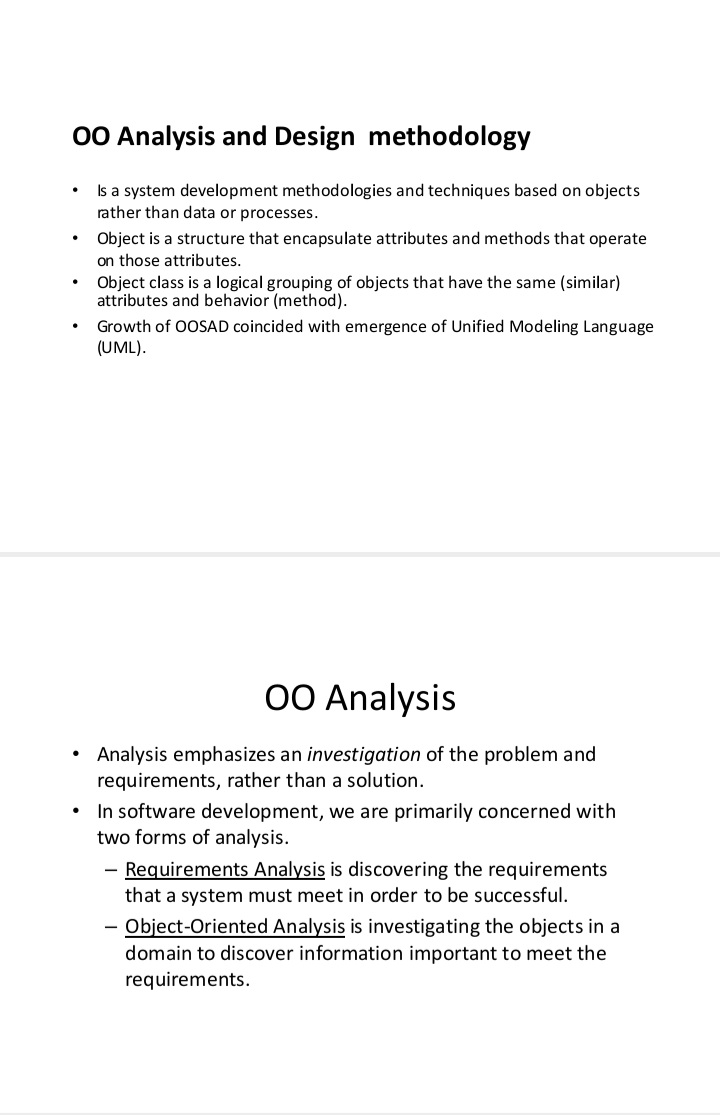
Object-Oriented Software Analysis and Design (OOSAD) is a methodology used to design and develop software systems by modeling them as a collection of interacting objects. These objects represent real-world entities, encapsulating data (attributes) and behavior (methods). The approach emphasizes principles like abstraction, inheritance, polymorphism, and encapsulation to enhance modularity, reusability, and maintainability. OOSAD typically follows a lifecycle that includes requirements gathering, analysis, design, implementation, and testing. It employs visual modeling tools like Unified Modeling Language (UML) to create diagrams that illustrate system structure and behavior, such as class diagrams, sequence diagrams, and use case diagrams. This methodology is widely used in complex, large-scale projects due to its ability to simplify system complexity by focusing on the relationships and interactions among objects.
Below is the document preview.

Object Oriented Software Analysis and Design methodology
Object-Oriented Software Analysis and Design (OOSAD) is a methodology that emphasizes modeling software systems based on real-world entities, encapsulating data and behavior within objects. It utilizes object-oriented principles such as encapsulation, inheritance, and polymorphism to create modular and reusable systems. The process typically involves analyzing user requirements to identify key objects, defining their attributes and behaviors, and designing interactions among them to achieve the desired functionality. OOSAD promotes iterative development, enabling teams to refine designs through feedback and testing, resulting in scalable and maintainable software solutions. It is widely used due to its ability to closely align system designs with user needs and real-world scenarios.
378 Views
0 Downloads
553 KB