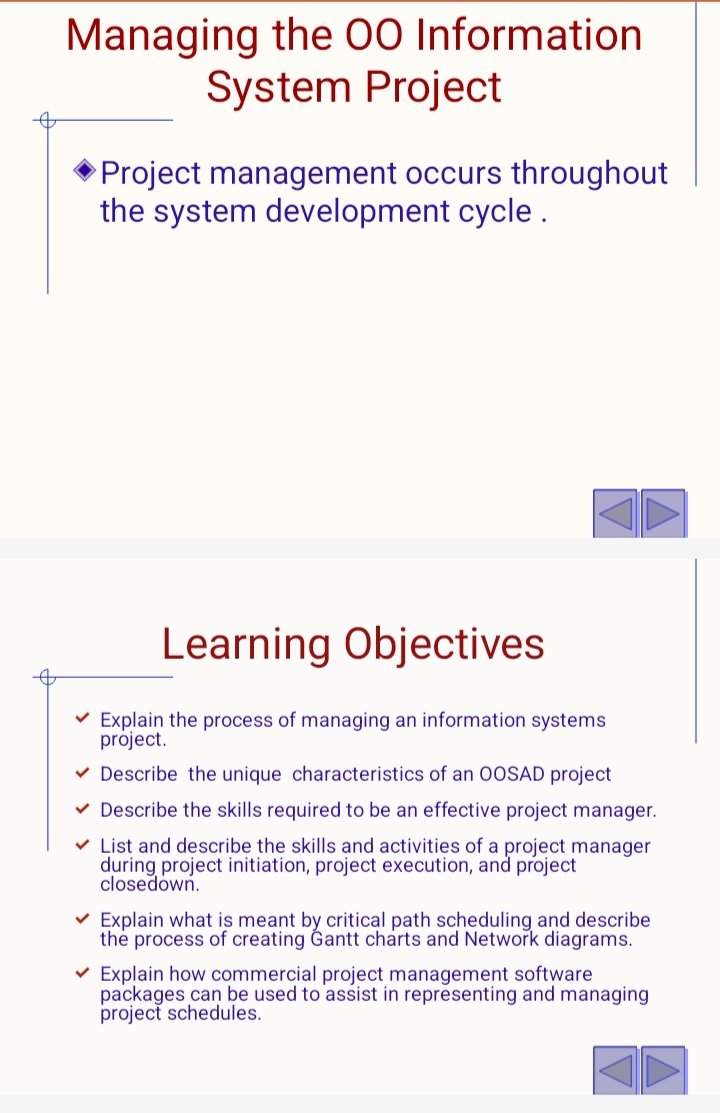
Managing the Object Oriented Information System Project
| Institution | Jomo Kenyatta University of Science and Technology |
| Course | Information Technol... |
| Year | 2nd Year |
| Semester | Unknown |
| Posted By | Jeff Odhiambo |
| File Type | ppt |
| Pages | |
| File Size | 402.5 KB |
| Views | 3780 |
| Downloads | 0 |
| Price: |
Buy Now
 Buy via
whatsapp Buy via
whatsapp
|


Description
Managing an Object-Oriented Information System (OOIS) project involves the application of structured methodologies and principles to ensure efficient design, development, and deployment. It includes defining clear objectives, gathering system requirements, and breaking down the project into manageable modules using object-oriented concepts like encapsulation, inheritance, and polymorphism. Effective management ensures seamless collaboration among team members, proper allocation of resources, adherence to timelines, and ongoing communication with stakeholders. The use of modeling tools such as Unified Modeling Language (UML) helps visualize and structure the system’s components, while iterative development methodologies ensure continuous testing and refinement. A strong focus on quality assurance, scalability, and adaptability ensures the project meets current needs while accommodating future expansions.
Below is the document preview.

SOIL AND WATER ENGEENERING NOTES
Trending!
This thesis examines the relationship between soil hydro-physical properties and the persistence of soil water repellency in agricultural soils in Murang'a and Makueni counties, Kenya. It aims to determine how soil properties like texture, organic matter content, and moisture levels impact the severity and duration of water repellency. The study will collect soil samples from different agricultural sites and test them for repellency over time. It seeks to improve understanding of this problem and help develop strategies to remedy repellency issues that affect crop growth.
147 Pages
4534 Views
0 Downloads
2.32 MB
DOCTOR OF PHILOSOPHY: HUMAN RESOURCE
Trending!
The purpose of this study was to establish determinants of academic staff retention in
Kenyan public universities. Universities in Kenya are operating in a highly competitive
environment and one of the challenges they face is employee retention. This has been
occasioned by globalisation which has intensified competition and increased the mobility
of highly skilled employees yet the universities depend on these staff for success and
sustainability. Specifically, the objectives of the study were to establish whether the
extrinsic factors (leadership style, remuneration) and intrinsic factors (training,
promotion) influenced retention of academic staff, and the moderating effect of personal
characteristics (age and education level) on academic staff retention.
227 Pages
4332 Views
0 Downloads
941.52 KB
REGIONAL ECONOMICS CLASS NOTES
Trending!
) The document discusses regional income estimation and employment determination using two main models: the Keynesian income-expenditure model and input-output model. 2) It explains how the Keynesian model can be used to estimate a region's equilibrium income based on factors like consumption, investment, exports and imports. It also introduces the concept of the regional multiplier which magnifies changes in income. 3) The document analyzes how characteristics of a region like industry mix and location can impact the size of the regional multiplier and therefore the region's economy. It provides an example of how universities can boost a local economy through jobs and skilled graduates.
21 Pages
4079 Views
0 Downloads
878.5 KB
HSC 0206 : INTRODUCTION TO PRINT MEDIA LAYOUT AND DESIGN TECHNIQUES
Trending!
Institution: Jomo Kenyatta University of Science and Technology
Year: 2018/2019
Semester: 2nd Year, 2nd Semester (2.2)
HSC 0207: FEATURE AND COMMENTARY WRITING
Trending!
Institution: Jomo Kenyatta University of Science and Technology
Year: 2019/2020
Semester: 2nd Year, 2nd Semester (2.2)
HSC 0209: ONLINE JOURNALISM
Trending!
Institution: Jomo Kenyatta University of Science and Technology
Year: 2018/2019
Semester: 2nd Year, 2nd Semester (2.2)
HSD 0103: EDUCATION, HEALTH AND DEVELOPMENT
Trending!
Institution: Jomo Kenyatta University of Science and Technology
Year: 2019/2020
Semester: 1st Year, 1st Semester (1.1)
HSD 0201 : ISSUES IN COMMUNITY DEVELOPMENT
Trending!
Institution: Jomo Kenyatta University of Science and Technology
Year: 2019/2020
Semester: 2nd Year, 2nd Semester (2.2)
HSD 0205: THE PROCESS OF DIFFUSSION AND EXTENSTION SERVICES
Trending!
Institution: Jomo Kenyatta University of Science and Technology
Year: 2019/2020
Semester: 2nd Year, 2nd Semester (2.2)
SMA 2242: METHODS OF APPLIED MATHEMATICS I NOTES
Trending!
Download a copy METHODS OF APPLIED MATHEMATICS I NOTES for purposes of your revision and exam preparation reference. This document is handwritten and very legible with the details on it. Get your copy today!
97 Pages
4167 Views
0 Downloads
19.76 MB