Stacks and Queues
| Institution | Jomo Kenyatta University of Science and Technology |
| Course | Information Technol... |
| Year | 2nd Year |
| Semester | Unknown |
| Posted By | Jeff Odhiambo |
| File Type | docx |
| Pages | |
| File Size | 91.93 KB |
| Views | 3796 |
| Downloads | 0 |
| Price: |
Buy Now
 Buy via
whatsapp Buy via
whatsapp
|


Description
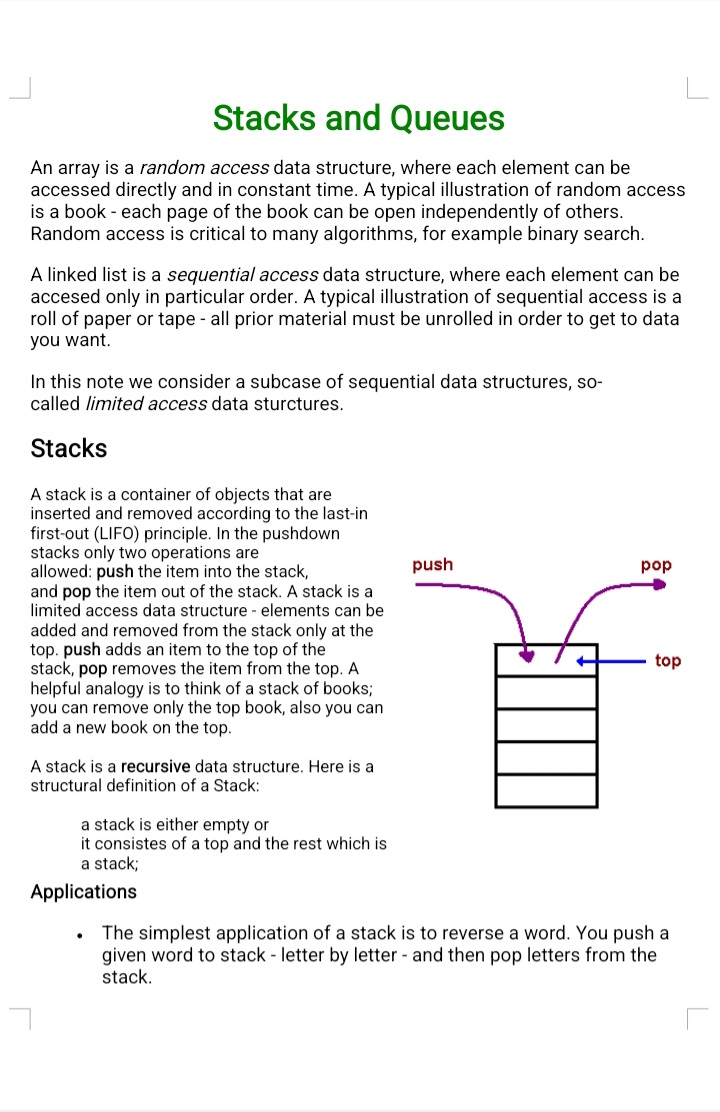
Stacks and queues are fundamental data structures used to manage collections of elements. A stack follows the Last In, First Out (LIFO) principle, meaning the last element added is the first one to be removed. It is often used for tasks such as reversing data, function calls, and undo operations. A queue, on the other hand, follows the First In, First Out (FIFO) principle, where the first element added is the first one to be removed. Queues are commonly used in scenarios like task scheduling, data buffering, and handling requests in a system. Both structures enable efficient element access and manipulation through specific operations like push and pop for stacks, and enqueue and dequeue for queues.
Below is the document preview.

ICS2403: Distributed Systems
Buy this note now to learn more about distributed systems
Buy this note now to learn more about distributed systems
Buy this note now to learn more about distributed systems
No pages found
672 Views
4 Downloads
4.47 MB
BIT 2305: Human Computer Interaction - Outline(HCI)
Trending!
Buy Human Computer Interaction (BIT 2305) and learn more about the interaction between humans and computers, including usability principles, interface design, cognitive psychology, accessibility, and evaluation techniques.
3 Pages
4113 Views
0 Downloads
150.94 KB
BIT 2305: Evaluation Techniques & Analysis(HCI)
Trending!
Buy Evaluation Techniques & Analysis (BIT 2305) and learn more about methods for assessing human-computer interaction, including usability testing, heuristic evaluation, cognitive walkthroughs, data analysis, and user feedback interpretation.
62 Pages
4305 Views
2 Downloads
380.44 KB
BIT 2305: Understanding and Conceptualizing Interaction Design(HCI)
Trending!
Buy Understanding and Conceptualizing Interaction Design (BIT 2305) and learn more about the principles of designing interactive systems, user experience (UX) frameworks, conceptual models, prototyping, and the role of human cognition in interaction design.
27 Pages
4368 Views
0 Downloads
600.62 KB
BIT 2305: Introduction to Evaluation Methods(HCI)
Trending!
Buy Introduction to Evaluation Methods (BIT 2305) and learn more about the foundational techniques for evaluating software systems, including usability metrics, formative and summative evaluation, task analysis, and how to interpret results to improve user interfaces.
22 Pages
4383 Views
0 Downloads
125.09 KB
BIT 2305: Evaluation -Field Evaluation Methods(HCI)
Trending!
Buy Evaluation - Field Evaluation Methods (BIT 2305) and learn more about real-world testing and evaluation techniques for assessing user interaction, including contextual inquiry, field studies, ethnographic methods, and how to gather and analyze user data in natural settings.
15 Pages
4210 Views
0 Downloads
93.81 KB
BIT 2305: User Support(HCI)
Trending!
Buy User Support (BIT 2305) and learn more about strategies and tools for assisting users in interacting with systems, including helpdesk support, online documentation, troubleshooting techniques, user training, and the role of feedback in improving user experiences.
20 Pages
4426 Views
0 Downloads
133.96 KB
ICS 2405: Chapter 1- Introduction to Knowledge Based Systems(KBS)
Trending!
Buy Chapter 1 - Introduction to Knowledge Based Systems (ICS 2405) and learn more about the fundamentals of Knowledge Based Systems (KBS), including their components, architecture, and the role of knowledge representation in solving problems using AI and expert systems.
36 Pages
3986 Views
0 Downloads
575.56 KB
ICS 2405: Chapter 2: KNOWLEDGE ENGINEERING(KBS)
Trending!
Buy Chapter 2 - Knowledge Engineering (ICS 2305) and learn more about the process of designing, building, and maintaining Knowledge Based Systems (KBS), including knowledge acquisition, representation, and the methods used to extract and structure knowledge for system development.
58 Pages
4244 Views
0 Downloads
408 KB
ICS 2405: Chapter 3 - KNOWLEDGE REPRESENTATION(KBS)
Trending!
Buy Chapter 3 - Knowledge Representation (ICS 2305) and learn more about the techniques and frameworks for structuring knowledge in Knowledge Based Systems (KBS), including semantic networks, frames, ontologies, and logic-based representations for reasoning and problem-solving.
72 Pages
4076 Views
0 Downloads
882.59 KB