Organic Chemistry (Chem 231)
| Institution | Egerton University |
| Course | Bsc.Biomedical Scien... |
| Year | 2nd Year |
| Semester | Unknown |
| Posted By | Duncan Akatch |
| File Type | docx |
| Pages | |
| File Size | 14.47 MB |
| Views | 1475 |
| Downloads | 0 |
| Price: |
Buy Now
 Buy via
whatsapp Buy via
whatsapp
|


Description
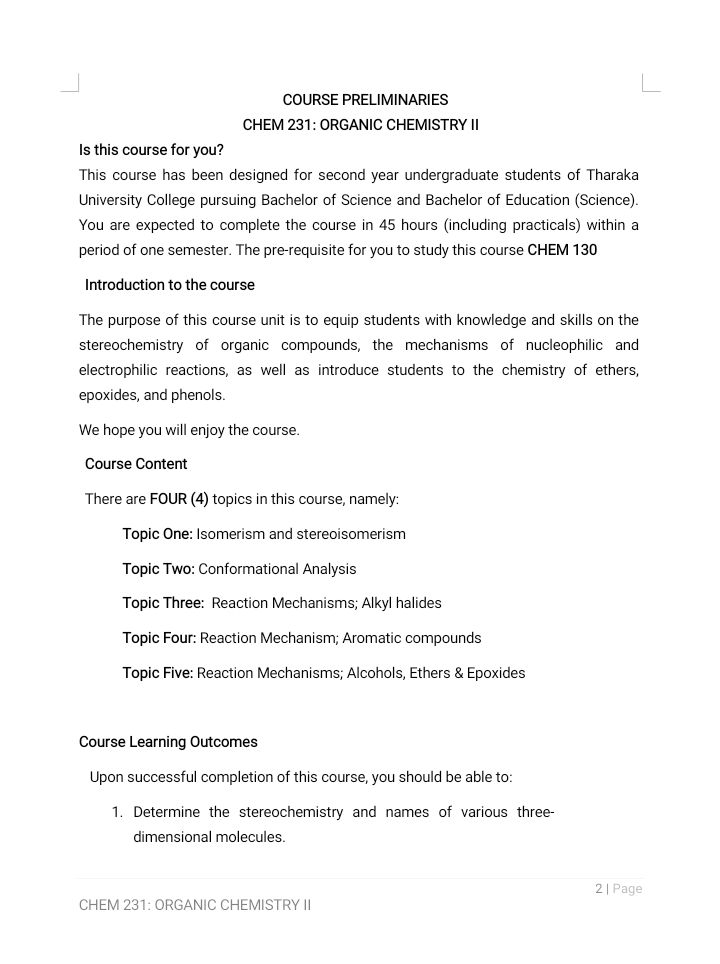
Useful notes for students taking biological related courses. They are very elaborate and much more detailed.
Below is the document preview.

TOHM 106: INTRODUCTION TO HOSPITALITY MANAGEMENT LECTURE NOTES
This course has been designed for first year undergraduate students pursuing a career in ecotourism and hospitality. This course will introduce you to the core units which will furnish you with knowledge in hospitality industry.
271 Pages
1499 Views
2 Downloads
768.93 KB
PHIL 106: LAW AND SOCIETY LECTURE NOTES
Constitutional law consists of rules which regulate the relationship between various organs of the state. Administrative law relates to public administration e.g. Chief D.O etc while criminal law consists of wrongs committed against the state. (Crime=the intentional commission of an act deemed socially harmful or dangerous.
47 Pages
1242 Views
1 Downloads
212.42 KB
INTRODUCTION TO NURSING SURVEILLANCE
1: INTRODUCTION TO NUTRITION SURVEILLANCE
1.1: Meaning of terms
DEFINITION OF KEY TERMS AND TERMINOLOGIES
Surveillance: It refers to the act of carefully watching someone or something especially in order to prevent or detect an occurrence of a given situation. It can also be defined as a continuous observation of a place, person, group, or ongoing activity in order to gather information:
201 Pages
1398 Views
0 Downloads
1.24 MB
Actuarial mathematics
These are actuarial mathematics notes for students taking actuarial science.
It contains topics like life assurance, select and non-select life select tables, annuities and premiums calculation.
343 Pages
522 Views
0 Downloads
1.36 MB
FARM BUSINESS MANAGEMENT
The meaning and importance of Farm Management
One of the most striking things that have emerged out from Farm Management surveys is the wide variation of farm incomes among any group of farms. No doubt some of these variations can be explained by such factors as:
1. Climate
2. Soil fertility
3. Size
4. Type of enterprises etc.
117 Pages
1010 Views
0 Downloads
743.33 KB
CHEM 130: INTRODUCTION TO ORGANIC CHEMISTRY
Introduction into the major families of organic compounds:
Alkanes, alkenes and alkynes, alkyl halides, aldehydes and ketones, carboxylic
acids, aliphatic amines, phenols, ethers (nomenclature, preparation, reactions and qualitative analysis
105 Pages
505 Views
0 Downloads
1.52 MB
AGEN 172: INTRODUCTION TO WORKSHOP TECHNOLOGY
The unit covers the competencies required to perform workshop process. Competenciesinclude
electrical installation, Storage of Electrical tools and materials, troubleshoot and repair/replace
applying workshop Safety, use of workshop tools and instruments, preparation of workshop for
workshop tools and equipment
84 Pages
1580 Views
0 Downloads
2.13 MB
BOTA 121: PLANT ANATOMY AND MORPHOLOGY
This is a course that deals with plants anatomy and morphology and other terms used in classification of plant . It also deals with types of leaves and how they can be classified
140 Pages
1044 Views
0 Downloads
2.39 MB
Aged 112:communication skills notes
This is a well explained past papers for first year where you can access your past papers questions easily and revise them consequently .Differently you can access this post paper via your library
1200 Views
0 Downloads
41.61 MB
BOTA 111: GENERAL GENETICS By
This is a foundation course for all first year students taking biology-related
(biology), and veterinary sciences. It’s a convergence discipline in biological
sciences. As captured by the title, its general in scope, because it introduces
well grounded in biological heredity but can confidently apply this knowledge
qualitative or Mendelian genetics, quantitative genetics, molecular genetics,
and populations genetics. At the conclusion ofthis course you will not only be
and skills gained in related subsequent courses like plant/animal breeding,
disciplines, agricultural sciences, natural resources, biochemistry, science
students to the major sub-disciplines of genetics, namely cytogenetics,
molecular genetics, and recombinant DNA technology, among others.
213 Pages
1191 Views
0 Downloads
1.69 MB