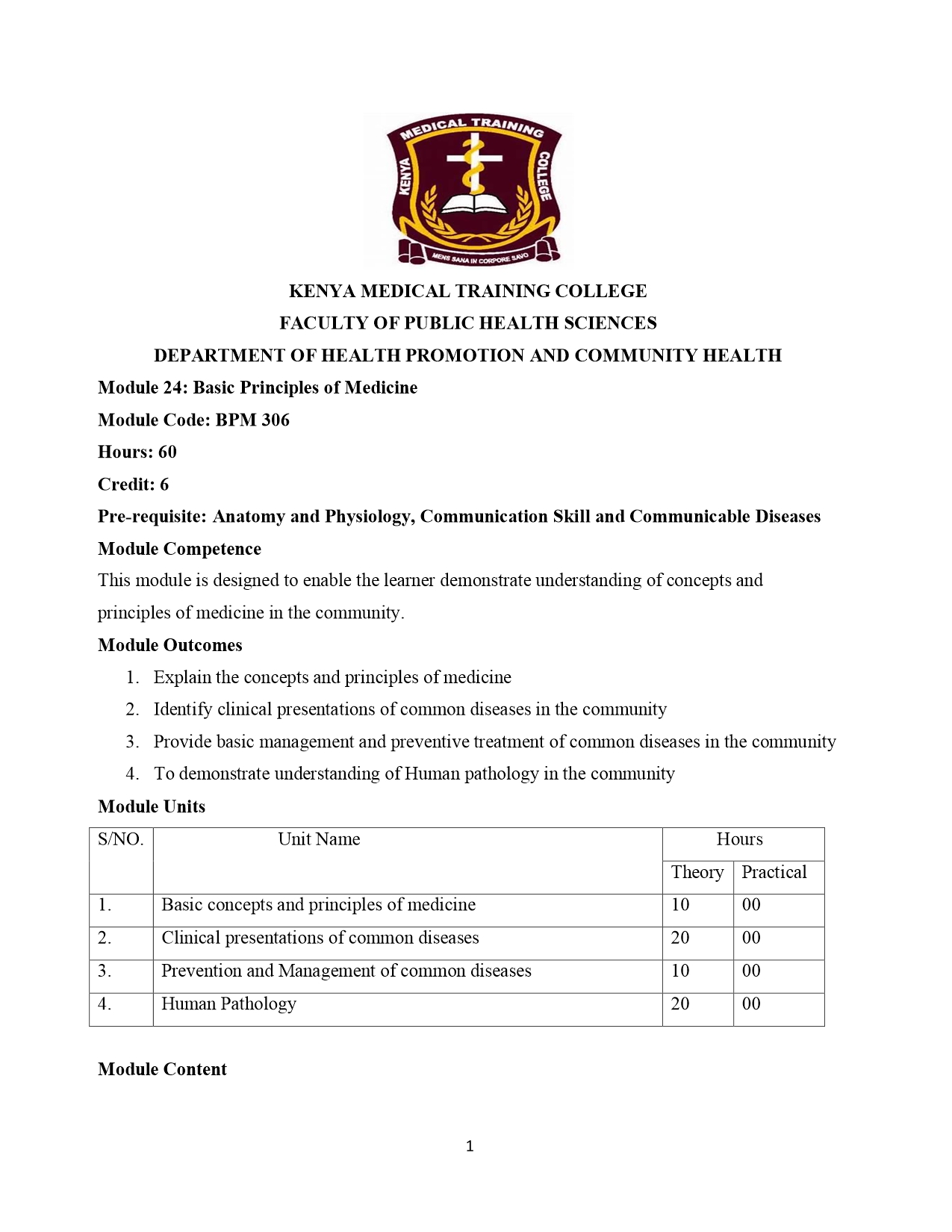
BPM 306: BASIC PRINCIPLES OF MEDICINE
| Institution | TVET |
| Course | DIPLOMA IN NURSING |
| Year | 1st Year |
| Semester | Unknown |
| Posted By | stephen oyake rabilo |
| File Type | |
| Pages | 43 Pages |
| File Size | 1.02 MB |
| Views | 8931 |
| Downloads | 0 |
| Price: |
Buy Now
 Buy via
whatsapp Buy via
whatsapp
|


Description
Basic concepts and principles of medicine; Medicine, Pathogenesis, Cardiomyopathy, intravenous, Osteoarthritis, Dysphasia, Dysphagia, Superior, Inferior, Superior, Medial, Lateral Proximal, Distal, Anterior, Ventral, Posterior, Dorsal, Supine, Prone, Lateral. Clinical Presentation of Diseases; Clinical Features, Diagnostic approach, Signs and Symptoms, Differential Diagnosis of common diseases in the community, Traditional disease presentation, Typical disease presentation, Provincial diagnosis of atypical disease presentations. Prevention and Management of common diseases; Population identification, Collaborative practice involvement, Multidisciplinary teams, Risk identification and matching of interventions to need, Patient self-management education behaviour modification, support groups, and primary
prevention; Human Pathology; Terminologies, Branches of pathology, cell division, causes of diseases, mechanism of disease process, cell adaption mechanism, cell injury and death.
Inflammatory process; Body response to injury, Inflammation, wound healing; Major Disease conditions related to specific body system and basic diagnostic tests; Cardiovascular and
circulatory system, Respiratory system, Male and Female reproductive system including those occurring during pregnancy, Urinary system, Gastrointestinal system, Endocrine system, Nervous system, Musculoskeletal system.
Below is the document preview.

CONDITIONS FOR THE UPPER RESPIRATORY TRACT
Trending!
Hemorrhage from the nose
Attributed to rupture of distended tiny blood vessels in the mucous membrane of the nasal cavity
Commonly occur at the anterior nasal septum, where 3 blood vessels meet at the nasal cavity;
Anterior ethmoidal artery on the anterosuperior of the roof
Sphenopalatine artery in the posterosuperior region
Internal maxillary branches
Causes:
Trauma
Infections
Inhalation of illicit drugs
Cardiovascular diseases
Nasal tumors
Low humidity
Foreign body in the nose
38 Pages
8864 Views
2 Downloads
630.09 KB
CARDIOVASCULAR SYSTEM PHARMACOLOGY
Trending!
An Inotrope is an agent which increases or decreases the
force of muscular contraction of the heart and Cardiac output.
Inotropes act on the alpha, beta1 and beta2 receptors.
Physiologically:
a. Alpha receptors causes peripheral vasoconstriction and
increased vascular resistance
43 Pages
10295 Views
0 Downloads
870.41 KB
KMTC COMMUNITY HEALTH Notes
Trending!
The purpose of this unit or module is to equip the student or trainee with knowledge and skills to enable him or her understand the concepts of community health in their local regions deeply
99 Pages
12544 Views
12 Downloads
2.71 MB
APS 215: PSYCHOLOGY OF GENDER
Trending!
The purpose of this module is to equip students with knowledge on how Gender issues affect Human behavior and Society. It examines various theories of gender, stereotypes and the impact of gender prejudices on society.
102 Pages
7315 Views
2 Downloads
1.3 MB
APH 202: EPISTEMOLOGY
Trending!
This unit introduces you to the discipline of philosophy which is an activity of life. At the end of this unit you will realize that most people like philosophy if they understand it, and that most understand it if it is presented to them exhaustively. In this course, I have tried to make it simpler for you to understand philosophy as a service discipline.
26 Pages
5995 Views
0 Downloads
942.19 KB
APS 409: LIFESTYLE DISEASES AND REHABILITATION
Trending!
The purpose of this module is to help you (the learner) to gain requisite knowledge and skills in the area of lifestyle diseases and rehabilitation.
111 Pages
6806 Views
1 Downloads
1.65 MB
APS 321: ENVIRONMENTAL PSYCHOLOGY
Environmental psychology is an interdisciplinary field focused on the interplay between human’s actions or behaviors and their surroundings. The field defines the term environment broadly, encompassing natural environments, social settings, built environments, learning environments and informational environment.
30 Pages
551 Views
0 Downloads
1.21 MB
APS 323: BEHAVIOUR MODIFICATION
Trending!
Kazdin (2001) defines behavior modification as an approach to assessment, evaluation and alteration of behavior. Miltenberger (2012) on the other hand describes behavior modification as the field of psychology concerned with analyzing and modifying human behavior.
134 Pages
4613 Views
1 Downloads
1.03 MB
LEADERSHIP NOTES
Trending!
Leadership is similar to management in various ways as both involve influencing and working with people and are concerned with effective goal accomplishment.
However, leadership is also different from management. The primary function of management in an organization is to provide order and consistency whereas leadership is to produce change and growth.
68 Pages
9058 Views
1 Downloads
1.14 MB
INTRODUCTION TO PHILOSOPHY
Trending!
This sub- topic is intended to equip the learner with knowledge, skills and positive attitudes towards the understanding and appreciating the role of philosophy in human life and endeavors. It covers the definition, meaning, branches and uses of philosophy in the cultivation of better thinking and meaningful living.
8 Pages
2153 Views
0 Downloads
888.5 KB