The Samaritan excerpts and answers
| Institution | Secondary |
| Course | English Setbooks |
| Year | 4th Year |
| Semester | Unknown |
| Posted By | Amos |
| File Type | |
| Pages | 43 Pages |
| File Size | 8.68 MB |
| Views | 26284 |
| Downloads | 94 |
| Price: |
Buy Now
 Buy via
whatsapp Buy via
whatsapp
|


Description
Get The Samaritan excerpts questions and answers.
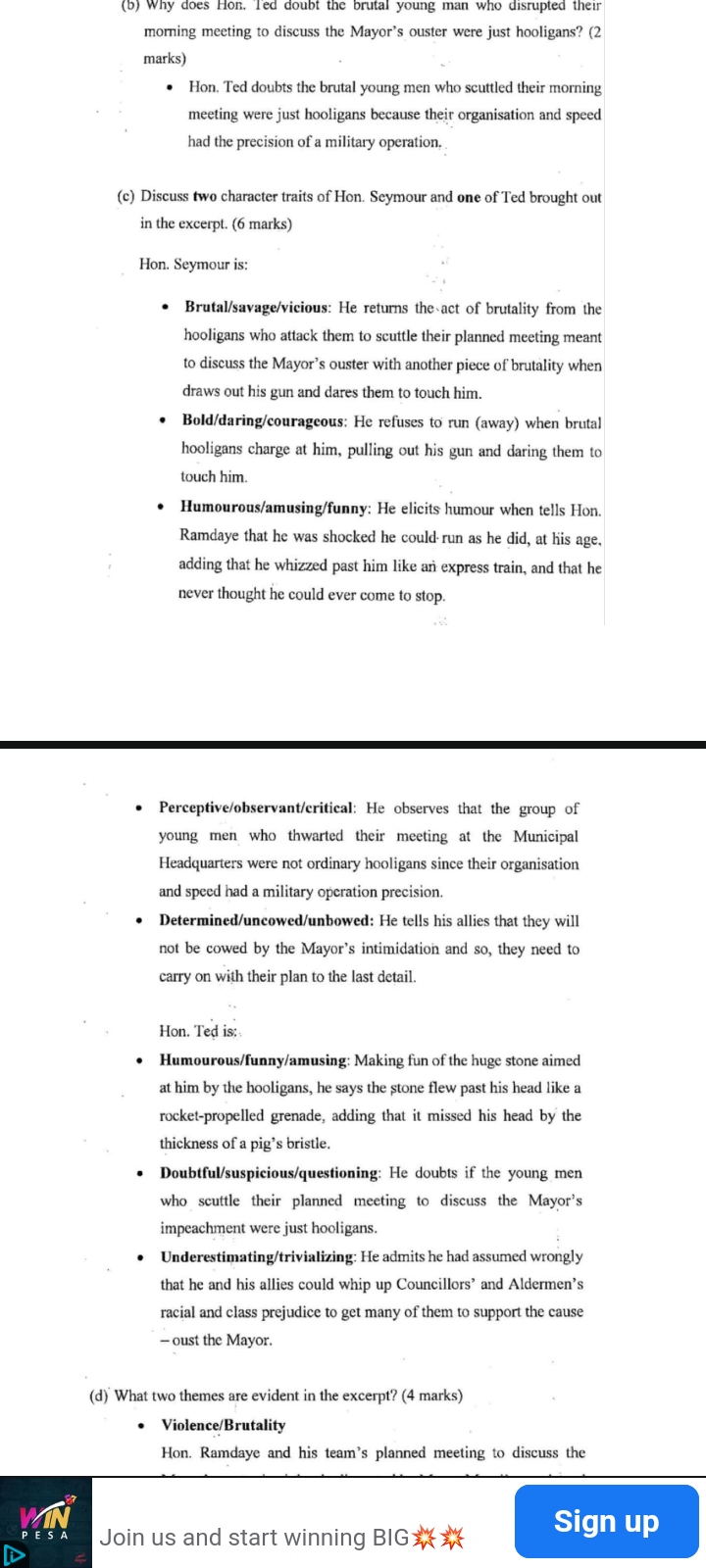
Below is the document preview.

Estimating and Costing I
It is a bill of quantities that is organized according to trades in the order in which they appear in the building and a sum of it given. It is also called sectional bills of quantities because work is divided into sections in which they appear in the construction project such as excavation works, roofing, concreting, etc.
19 Pages
515 Views
0 Downloads
380.5 KB
ESTIMATING AND COSTING II NOTES
Trending!
Cost incurred on site, factors, situations, and items that affect the cost of a project and are temporary in nature but assist in the smooth running of the project. They include hoarding, security, power, and water. They affect the overall cost of the works but cannot be attributed to any particular section of the works.
87 Pages
11085 Views
2 Downloads
9.4 MB
FORM 3 BIOLOGY NOTES
Trending!
For the preparation of national and local exams, get the entire biology Form 3 notes. These biology form 3 notes are aggregated from the various high school approved text books, including KLB biology form 3, Finder biology form 3, etc.
82 Pages
11949 Views
2 Downloads
1.93 MB
FORM 3 KISWAHILI MUFTI NOTES
Trending!
Ngeli ni vikundi vya majina ya Kiswahili. Ngeli za nomino ni utaratibu unaotumika kuweka nomino katika matabaka au makundi yanayofanana.
31 Pages
9625 Views
1 Downloads
455.8 KB
COMMUNICATION PATHWAYS
Trending!
Communication pathways refer to the guidelines
used to ensure a common understanding of the
expectations for communication.
• Pathways of communication are established to
meet requirement of organization and
workforce.
Developing Character, Skills and Competence 7/20/2024 5:33 PM 2
• Communication pathways involve ways of better
engagement with colleagues and clients in an
organization.
• Through communication pathways, a more inclusive and
diverse workplace is realized.
• It is therefore important to establish internal
communication arrangements on communication
channels like messages, telephone calls and meetings
among others.
• Such arrangements create structured connections
between the organizations and the employees.
48 Pages
9941 Views
0 Downloads
378.45 KB
COMPUTER CRIMES
Trending!
TYPES OF COMPUTER CRIMES
The following are some of various types of computer crimes:
• Data Interception: This type is exclusive to network environment
with teleprocessing activities in which the criminal may tap the signal
sent to a computer from remote source.
• Data Modification: Alteration, destruction, or erasing of data in the
computer, usually done with desire to misallocate money or to cover
up management incompetence.
• Theft of Software/piracy: Taking or copying data, regardless of
whether it is protected by other laws, e.g., copyright, privacy, etc.
The cause of this may be for profit purpose or for private use
9 Pages
10208 Views
0 Downloads
582.09 KB
ENERGY SOURCES
Trending!
ENERGY SOURCES
All of these different sources of energy are used to produce electricity.
Types of Sources of Energy
These can be broken down into renewable and non-renewable energy sources.
Renewable Energy Source
Renewable energy sources are natural resources that can be harnessed to generate energy in an
environmentally sustainable way. These sources are replenished by natural processes and are
considered a clean and green alternative to fossil fuels. Some of the most common renewable energy
sources include:
The major types or sources of renewable energy are:
i) Solar Energy: Solar energy is harnessed from the sun's radiation using photovoltaic (PV) cells to
generate electricity or solar thermal systems to produce heat for various applications. Solar panels
are commonly used to capture sunlight and convert it into electricity for residential, commercial,
and industrial use.
ii) Wind Energy: Wind turbines capture the kinetic energy of moving air and convert it into
electricity. Wind farms consist of multiple turbines and are often located in areas with consistent
wind patterns. Wind energy is a significant source of electricity generation in many regions.
iii) Hydroelectric Power: Hydroelectric power is generated by capturing the energy of flowing or
falling water, typically in dams and reservoirs. The movement of water turns turbines, which
produce electricity. Hydropower is a well-established and widely used renewable energy source.
iv) Geothermal Energy: Geothermal energy is derived from the heat within the Earth's core. It is
typically harnessed by tapping into underground reservoirs of hot water or steam, which can be
used for heating buildings, generating electricity, or providing direct-use applications like
greenhouse heating.
v) Biomass Energy: Biomass energy is produced from organic materials, such as wood, agricultural
residues, and organic waste. These materials can be burned directly for heat or converted into
biofuels like bioethanol and biodiesel for transportation and electricity generation.
vi) Ocean Energy: Ocean energy includes various forms of energy generated from the movement of
tides, waves, and ocean currents. It is an emerging and still-evolving source of renewable energy
with the potential for sustainable power generation near coastlines.
vii)Tidal Energy: Tidal energy is generated by the rise and fall of tides in coastal areas. Turbines
placed in tidal streams can capture the kinetic energy of the moving water and convert it into
electricity.
viii)Wave Energy: Wave energy is harnessed from the up and down movement of ocean waves.
Various technologies, including oscillating water columns and point absorbers, can capture wave
energy and convert it into electricity.
ix) Algal Biofuel: Algae can be cultivated and converted into biofuels, such as biodiesel and
bioethanol, offering a sustainable alternative to fossil fuels.
11 Pages
9489 Views
0 Downloads
165.13 KB
CAPACITORS
Trending!
Capacitors are passive electronic components that store and release electrical energy. They consist of two conductive plates separated by an insulating material called the dielectric.
When a voltage is applied across the capacitor's plates, an electric field develops across the dielectric, causing positive charge to accumulate on one plate and negative charge on the other. This stored energy can be released when the circuit requires it, maintaining current flow and stabilizing voltage
19 Pages
8896 Views
0 Downloads
385.26 KB
RESISTORS
Trending!
What is an electronic component?
• Electronic components are the building blocks of electronic
circuits, each serving a specific function.
• There are two types:
a) Passive components: Passive components are electronic
components that do not require an external power source to
operate and cannot introduce power into a circuit. Instead, they
can only consume, store, or dissipate electrical energy. Passive
components typically influence the voltage, current, or signal flow
in an electronic circuit without amplifying or controlling it.
Examples: Resistors, Capacitors, Diodes, Inductors.
b) Active components: An active component is an electronic
component that relies on a source of energy and can inject power
into a circuit. Active components are capable of controlling the
flow of electricity in a circuit and typically require an external
power source to operate. They can amplify signals, process data,
and perform other complex functions. Example: Transistors,
Integrated Circuits or ICs, Logic Gates.
13 Pages
9830 Views
0 Downloads
406.28 KB
DAH 3304: ANTE-MORTEM INSPECTION OF FOOD ANIMALS
Trending!
Ante-mortem Inspection
• This is the comprehensive examination of food animals
destined to slaughter
• Conducted in the Lairage within 24 hours of slaughter and
repeated if slaughter has been delayed over a day
• Done by an official veterinarian in the slaughter house
• In some cases it can be done on the farm if legislation
allows. E.g., pigs and poultry
• The slaughterhouse layout and conditions must facilitate
the ante-mortem inspections, so that each animal can be
readily checked and identified.
• Adequate lighting and separate pens for sick or suspect
animals are necessary
10 Pages
7042 Views
0 Downloads
83.06 KB