INTRODUCTION TO HEALTH STATISTICS
| Institution | KMTC |
| Course | DIPLOMA IN HEALTH RE... |
| Year | 1st Year |
| Semester | Unknown |
| Posted By | stephen oyake rabilo |
| File Type | |
| Pages | 23 Pages |
| File Size | 896.42 KB |
| Views | 11644 |
| Downloads | 3 |
| Price: |
Buy Now
 Buy via
whatsapp Buy via
whatsapp
|


Description
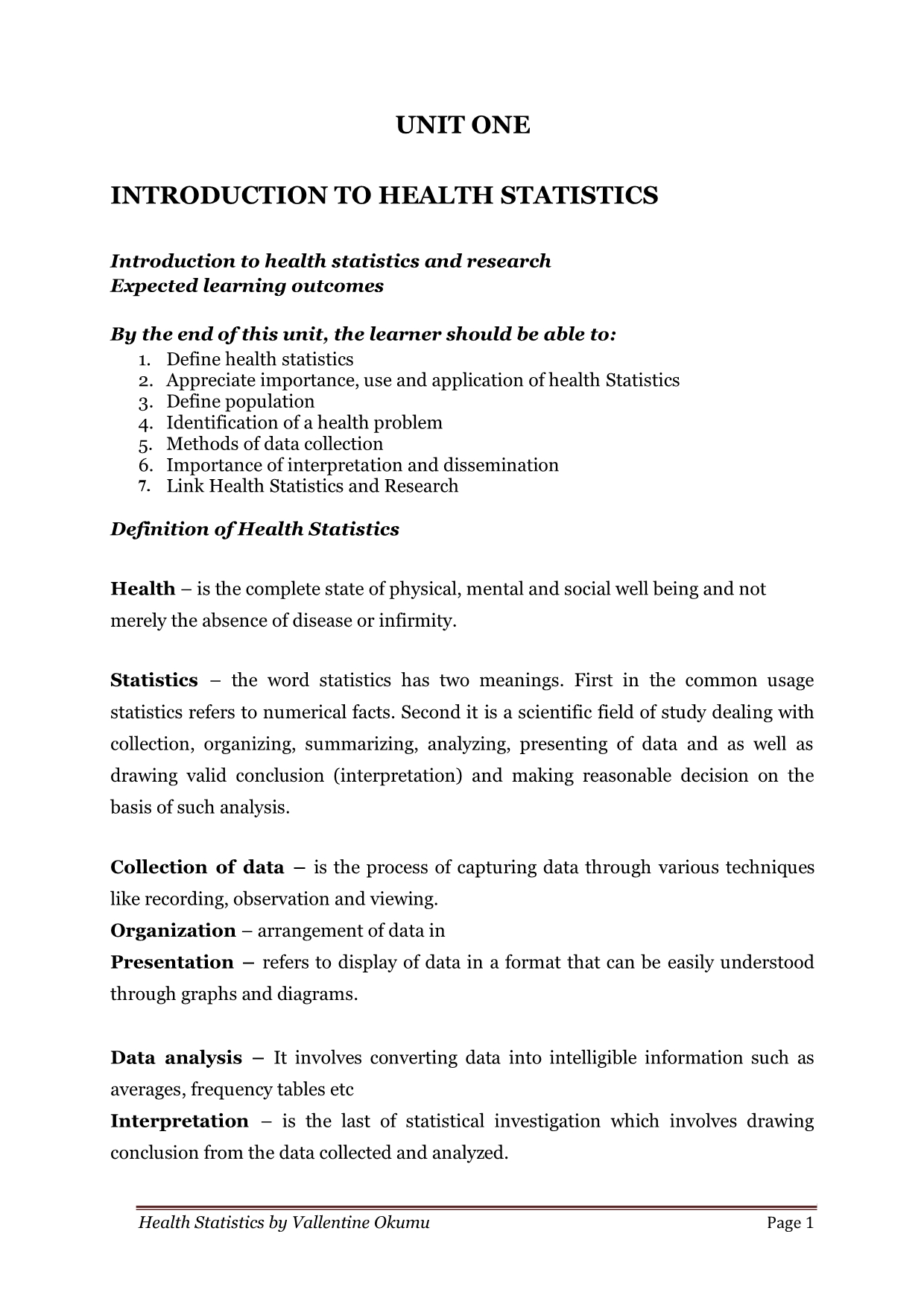
Health – is the complete state of physical, mental and social well being and not merely the absence of disease or infirmity. Statistics – the word statistics has two meanings. First in the common usage statistics refers to numerical facts. Second it is a scientific field of study dealing with collection, organizing, summarizing, analyzing, presenting of data and as well as drawing valid conclusion (interpretation) and making reasonable decision on the basis of such analysis.
Below is the document preview.

ABA 404 TOPIC 3: COST CLASSIFICATIONS
Trending!
Cost classification may be defined as ‘the arrangement of cost items in a logical sequence having regard to their nature and purpose to be fulfilled’. The term cost must be qualified when in use in order that it’s precise meaning is established in a particular situation; however, cost refers to the amount of resources that have been diverted from other uses or sacrificed so as to achieve the desired objective. But the term is used to refer to various aspects of cost; depending on the base of argument that one is approaching the issue from.
12 Pages
6668 Views
0 Downloads
401.81 KB
ABA 404 TOPIC 4: COST ESTIMATION AND FORECASTING
Trending!
In this topic, you will learn to use cost estimating relationships to estimate and forecast costs. As the name implies, a cost estimating relationship (CER) is a technique used to estimate a particular cost or price by using an established relationship with an independent variable.
18 Pages
5139 Views
0 Downloads
419.4 KB
COMPUTER HARDWARE MAINTENANCE
Trending!
Computer is an electronic and digital device, it take data as input, process it and gives information as output and save it. Computer is used because it is more efficient and effective. Computer hardware is accessed through Software (operating System) computer is Extensible: means we can add any number of application software to this and extend its functionality. Versatile : means it is used in almost all places like hospitals, business, education, Research etc. Computer is not similar to any other electronic and digital machine but its Versatile and Extensible.
104 Pages
7260 Views
0 Downloads
7.62 MB
Financial ManagementRevision Kit
Trending!
Essential notes in having you navigate in your course and gain practical knowledge on financial management skills
244 Pages
8461 Views
2 Downloads
1.95 MB
APS 107: BIOLOGICAL PSYCHOLOGY
Trending!
Biopsychology, the scientific study of the biology of behavior and mental processes. People also refer to this field as biological psychology, psychobiology, behavioral biology, or behavioral neuroscience.
93 Pages
7623 Views
0 Downloads
1.6 MB
AKS 203: AN INTRODUCTION TO THE THEORY AND PRACTICE OF TRANSLATION
Trending!
Hamna shaka kuwa tafsiri ni nguzo muhimu ya, mahusiano, mawasiliano na maelewano ya jamii bayana na jamii ya kimataifa. Mitaala ya lugha, kwa hivyo, yawajibika kuandaa kozi za tafsiri. Kozi hii itakuwa ya kitangulizi. Madhumuni yake ni kuweka msingi wa masomo zamilifu zaidi, kinadharia, kitendaji, kitumikizi, kwa eneo pana zaidi la tafsiri.
71 Pages
8191 Views
4 Downloads
1.13 MB
AKS 318: RESEARCH METHODS (MBINU ZA UTAFITI)
Trending!
Kozi hii ya mbinu za utafiti inajadili mbinu za kufanyia utafiti katika nyanja za lugha na
fasihi. Ni kozi inayokusudiwa kumtayarisha mwanafunzi kufanya kazi yoyote ya utafiti na
kujua jinsi ya kukabiliana na changamoto zinazomkumba mtafiti.
8 Pages
10757 Views
18 Downloads
384.25 KB
APP 401: INTERNATIONAL ORGANISATIONS
Trending!
This course surveys in historically and theoretically informed fashion the role of various international institutions in international relations. It addresses the fundamental question of the contribution of international institutions to world order. The course first traces the historical evolution of international organizations before turning to international institutions since World War II.
42 Pages
6026 Views
0 Downloads
547.62 KB
COMPANY LAW REVISION KIT
Trending!
The main purpose of this booklet is to help candidates preparing for the KASNEB
examination to make the best use of the last few weeks before the examination.
246 Pages
10425 Views
0 Downloads
1.63 MB
EES 100: MATHEMATICS FOR ECONOMISTS I
Trending!
Statistics which is a branch of mathematics is used by economists to transform
raw data from the real world into numerical generalizations. Such generalizations
are used by economists to construct a network of interlocking relationships which
enable them to draw conclusions about economic variables that are related to each
other only directly.
97 Pages
9790 Views
1 Downloads
901.83 KB