 Join Our WhatsApp Channel for Updates!
SOCIOLOGY OF EDUCATION QUESTIONS & ANSWERS
| Institution | TVET |
| Course | DIPLOMA IN SOCIAL WO... |
| Year | 1st Year |
| Semester | Unknown |
| Posted By | stephen |
| File Type | |
| Pages | 15 Pages |
| File Size | 703.6 KB |
| Views | 5809 |
| Downloads | 1 |
| Price: |
Buy Now
 Buy via
whatsapp Buy via
whatsapp
|


Description
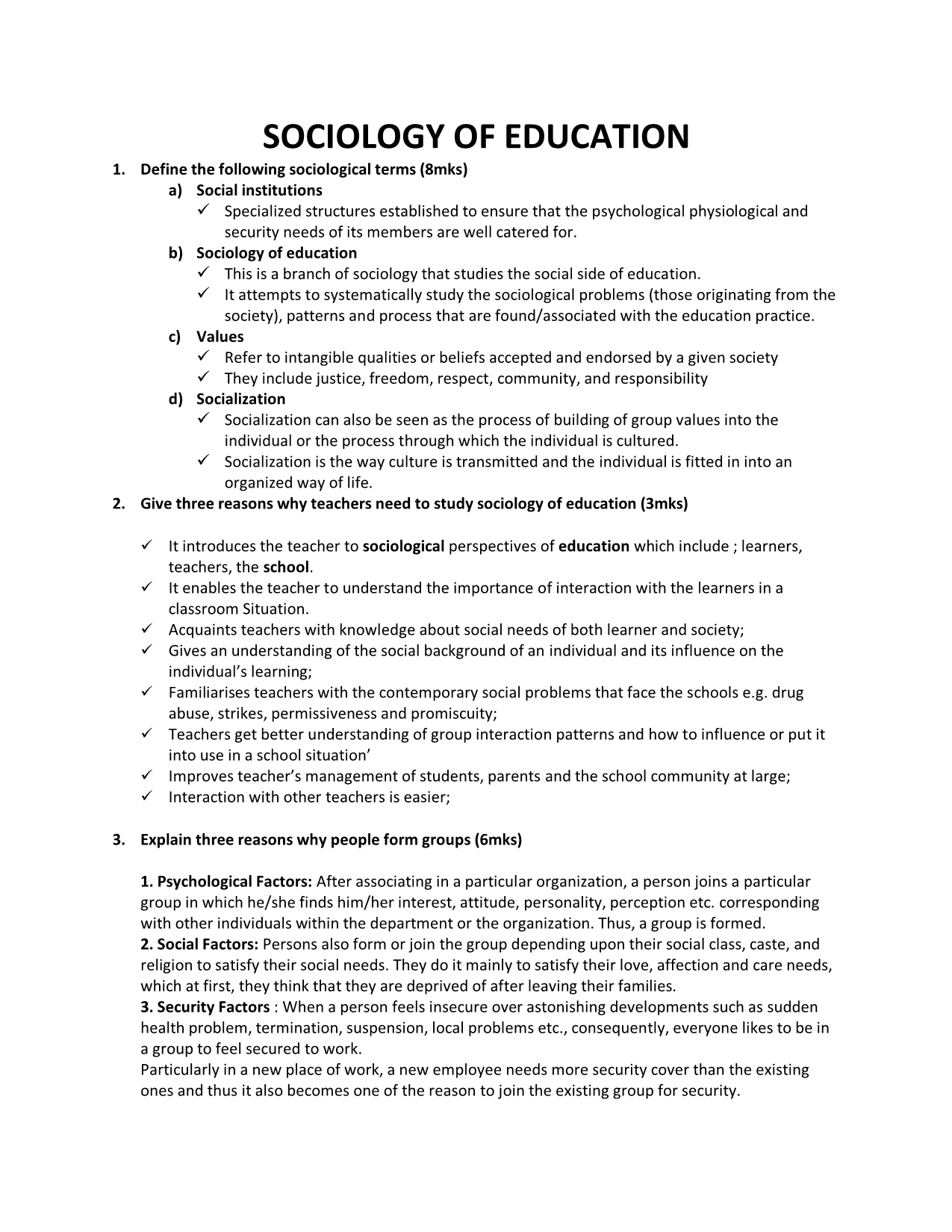
SOCIOLOGY OF EDUCATION
1.Define the following sociological terms (8mks)
a)Social institutions
Specialized structures established to ensure that the psychological physiological and security needs of its members are well catered for.
b)Sociology of education
This is a branch of sociology that studies the social side of education.
It attempts to systematically study the sociological problems (those originating from the society), patterns and process that are found/associated with the education practice.
c)Values
Refer to intangible qualities or beliefs accepted and endorsed by a given society
They include justice, freedom, respect, community, and responsibility
d)Socialization
Socialization can also be seen as the process of building of group values into the individual or the process through which the individual is cultured. Socialization is the way culture is transmitted and the individual is fitted in into an organized way of life.
Below is the document preview.

SMA 2104: Mathematics for Sciences - Lesson 5 Permutations and Combination
Trending!
Permutations and Combination
Permutations - This is defined as the number of different ways of arranging different objects in order.
No pages found
4150 Views
0 Downloads
273.38 KB
SMA 2104: Mathematics for Sciences - Lesson 6 Binomial expansion
Trending!
Upon completing this topic you should be able to understand the binomial theorem and it’s application in the expansion of expressions and in approximations.
No pages found
4046 Views
0 Downloads
282.79 KB
SMA 2104: Mathematics for Sciences - Lesson 7 Probability
Trending!
Upon completing this topic,you should be able to;- Apply the principles of probability to solve problems in real-world contexts. Understand and use the language of probability and to compute the probabilities of composite events using the basic rules of probability.
No pages found
4494 Views
0 Downloads
395.57 KB
SBC100: STRUCTURE OF BIOMOLECULES
Trending!
They are well descritive
30 Pages
5789 Views
0 Downloads
2.65 MB
SMA 2104: Mathematics for Sciences - Lesson 8 Statistics
Trending!
Upon completing this topic,you should be able to Collect, organize, and represent data, and be able to recognize and describe relationships. Apply the principles of statistics to solve problems in real world contexts. Demonstrate knowledge of statistical terms. Differentiate between the two branches of statistics. Identify types of data. Understand and use the basic measure of central tendency
No pages found
3886 Views
0 Downloads
282.84 KB
SMA 2104: Mathematics for Sciences - Lesson 9 TRIGONOMETRY
Trending!
Upon completing this topic, you should be able to Define, manipulate and apply trigonometric functions. Define the basic trigonometric ratios, sine, cosine and tangent of an angle and derive the other trigonometric ratios; cosecant, secant and cotangent using the basic trigonometric ratios. Derive identities involving the trigonometric ratios
11 Pages
5209 Views
0 Downloads
635.34 KB
SMA 2104: Quadratic Equations Practice Problems
Trending!
Quadratic Equations Practice Problems, Solving Quadratic Equations When the Product of Two Numbers is Zero
12 Pages
4732 Views
0 Downloads
602.99 KB
SMA 2104: Factorisation Practice Questions
Get a copy Factorisation Practice Questions, this is suitable for your revision
2 Pages
422 Views
0 Downloads
38.59 KB
SMA 2104: Factorisation Practice Questions Answers
Trending!
Factorisation Practice Questions Answers
2 Pages
4763 Views
0 Downloads
38.59 KB
EEE 2202: ANALOGUE ELECTRONICS I
Trending!
Electronics is the study of conduction current in solids, gases, vacuum and liquids.
It is a branch of engineering that comes from the 2 words Electrons - negatively charged particle in an atom, Mechanics - Study of motion of an electron. Electronics is also study of electrons and how they can be used to perform different functions.
The ability to control movement of electrons or electron flow is the basic of electronics it specializes in digital computers, audio systems, communication systems, and automatic control.
99 Pages
4435 Views
0 Downloads
1.43 MB