SOCIOLOGY OF EDUCATION QUESTIONS & ANSWERS
| Institution | TVET |
| Course | DIPLOMA IN SOCIAL WO... |
| Year | 1st Year |
| Semester | Unknown |
| Posted By | stephen |
| File Type | |
| Pages | 15 Pages |
| File Size | 703.6 KB |
| Views | 10431 |
| Downloads | 2 |
| Price: |
Buy Now
 Buy via
whatsapp Buy via
whatsapp
|


Description
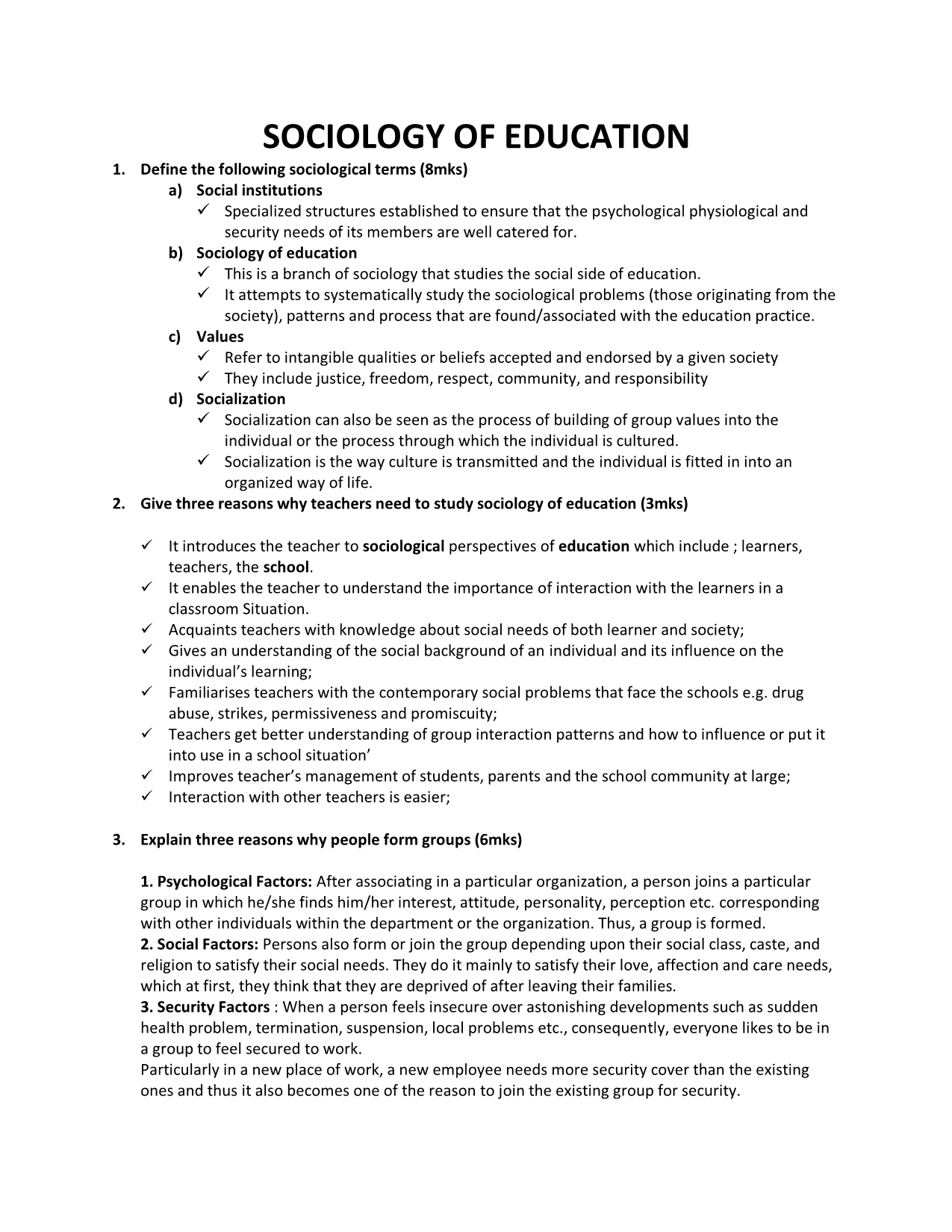
SOCIOLOGY OF EDUCATION
1.Define the following sociological terms (8mks)
a)Social institutions
Specialized structures established to ensure that the psychological physiological and security needs of its members are well catered for.
b)Sociology of education
This is a branch of sociology that studies the social side of education.
It attempts to systematically study the sociological problems (those originating from the society), patterns and process that are found/associated with the education practice.
c)Values
Refer to intangible qualities or beliefs accepted and endorsed by a given society
They include justice, freedom, respect, community, and responsibility
d)Socialization
Socialization can also be seen as the process of building of group values into the individual or the process through which the individual is cultured. Socialization is the way culture is transmitted and the individual is fitted in into an organized way of life.
Below is the document preview.

COMMERCE KNEC NOTES
Trending!
Commerce looks after the smooth distribution of goods and services made available by the industry. Without commerce, industry will find it difficult to keep the pace of production. It helps to increase demand for goods on one hand and on the other hand it helps industries by getting them the necessary raw materials and other services. Hence, commerce helps in attaining better division of labour and industrial progress.
117 Pages
12362 Views
12 Downloads
1.31 MB
Tour Package Development Notes 2nd Module
Trending!
The notes covers all competencies being assessed on learning about Tours and Travel Operations.
It's weighs all critical aspects that are assessed.
8 Pages
9213 Views
1 Downloads
471.18 KB
Acquire Tour Resources
Trending!
Acquire Tour Resources notes aids in shaping all competencies that trainees and Trainers need to have while conducting Tour operations.
42 Pages
8998 Views
0 Downloads
336.05 KB
Entrepreneurship Notes 1st Year
Trending!
Entrepreneurship Notes blends on different competencies assessed and mainly cuts across various critical aspects on Entrepreneurial skills.
50 Pages
9417 Views
1 Downloads
771.89 KB
Tour operations
Trending!
Tour operations notes have indepth dispatch of knowledge concerning various skills and trainings required to undertake Tourism operations.
2 Pages
8994 Views
0 Downloads
409.58 KB
Communication Skills Notes 1st Year
Trending!
Communication Skills Notes aims to impart knowledge on competencies assessed. Trainees need to equip themselves with the knowledge and skills sourced here during their day to day workplace ethics.
263 Pages
2632 Views
0 Downloads
1.89 MB
DEVELOPING A PROPOSAL FOR FUNDING
Trending!
A well-formed proposal funding is one that is carefully prepared, thoughtfully planned, and concisely packaged. The potential applicant should first become familiar with all of the pertinent program eligibility criteria of the funding institution.
Before developing a proposal, the potential applicant may refer to the information contact listed in the agency or foundation program description to learn whether funding is available, when applicable deadlines occur, and the process used by the grantor agency or foundation for accepting and reviewing applications
15 Pages
7928 Views
0 Downloads
643.95 KB
SSW 412/414: INDUSTRIAL SOCIAL WORK
Trending!
Social work is a profession for those with a strong desire to help improve people's lives. Social workers help people function the best way they can in their environment, deal with their
relationships, and solve personal and professional problems. Social workers practice in a variety of settings. Hospitals and psychiatric facilities they provide or arrange for a range of support
services. In mental health, community centers, and private practice they provide counseling services on marriage, family, and adoption matters, and they help people through personal or
community emergencies, such as dealing with loss or grief or arranging for disaster assistance.
24 Pages
7721 Views
0 Downloads
699.46 KB
HISTORICAL BACKGROUND OF KENYA'S LEGAL SYSTEM
Trending!
The history of Kenya’s Judiciary can be traced to the East African Order in Council of 1897 and the Crown regulations made there under which marked the beginning of a legal system in Kenya. It was based on a tripartite division of subordinate courts; that is,
Native courts, Muslim courts and those staffed by Administrative officers and Magistrates. A dual system of superior courts was also established, one court for Europeans and the other for Africans. This system only lasted for 5 years. Upon the realization by the colonial authorities of the need to have dispute resolution organs, village elders, headmen and chiefs were empowered to settle disputes as they had done in the pre-colonial period.
45 Pages
8042 Views
0 Downloads
252.76 KB
SCR 310: SOCIAL STATISTICS
Trending!
Social statistics is the use of statistical measurement systems to study human behavior in a social environment. This is mainly done through sampling a particular group of people, evaluating a particular subset of data obtained about a group of people, or by observation and statistical analysis of a set of data that relates to people and their behaviors.
53 Pages
8838 Views
0 Downloads
1.04 MB