LEGAL ASPECTS IN SOCIAL DEVELOPMENT
| Institution | TVET |
| Course | DIPLOMA IN SOCIAL WO... |
| Year | 1st Year |
| Semester | Unknown |
| Posted By | stephen |
| File Type | |
| Pages | 48 Pages |
| File Size | 871.3 KB |
| Views | 9819 |
| Downloads | 0 |
| Price: |
Buy Now
 Buy via
whatsapp Buy via
whatsapp
|


Description
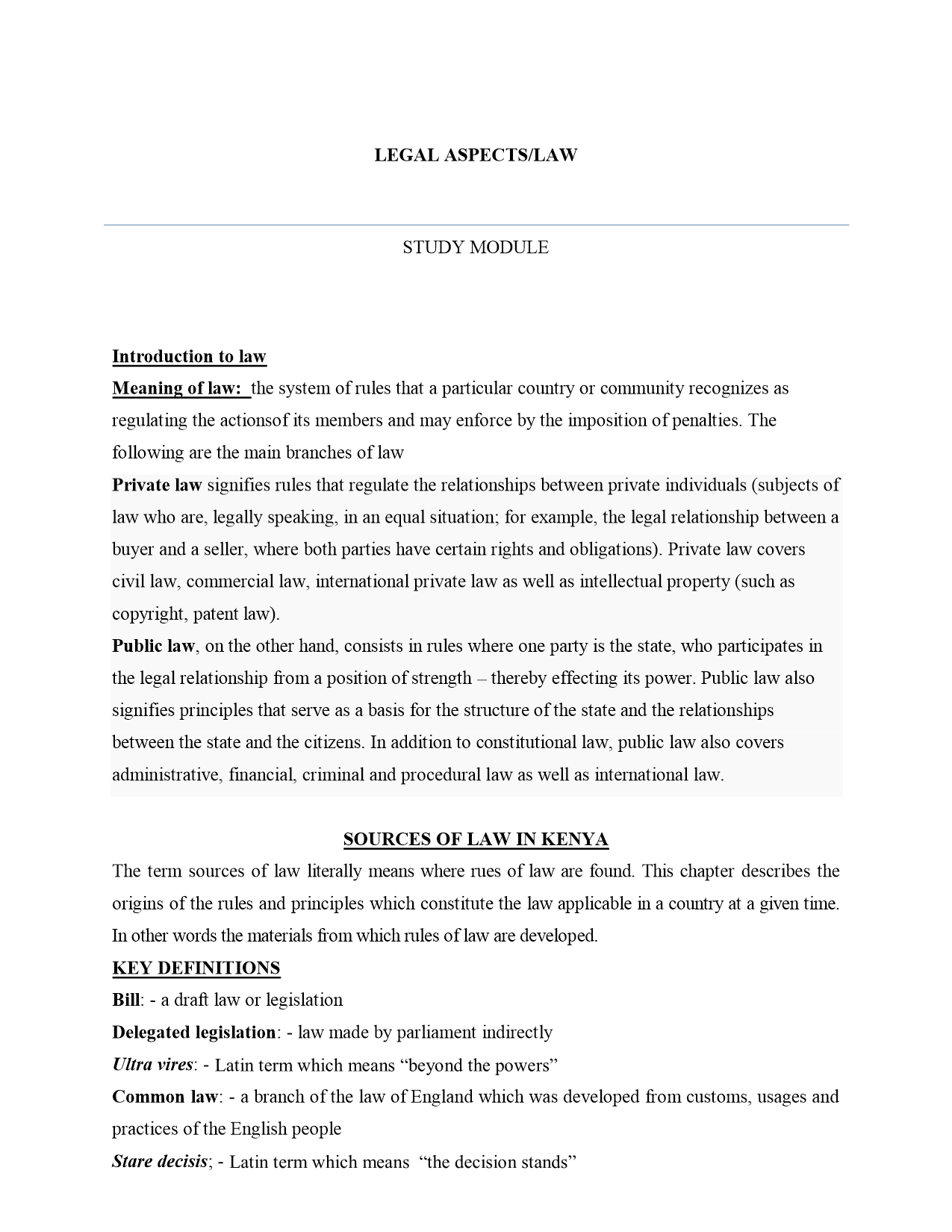
Meaning of law: the system of rules that a particular country or community recognizes as regulating the actionsof its members and may enforce by the imposition of penalties. The following are the main branches of law
Private law signifies rules that regulate the relationships between private individuals (subjects of law who are, legally speaking, in an equal situation; for example, the legal relationship between a buyer and a seller, where both parties have certain rights and obligations). Private law covers civil law, commercial law, international private law as well as intellectual property (such as copyright, patent law).
Public law, on the other hand, consists in rules where one party is the state, who participates in the legal relationship from a position of strength – thereby effecting its power. Public law also signifies principles that serve as a basis for the structure of the state and the relationships between the state and the citizens. In addition to constitutional law, public law also covers administrative, financial, criminal and procedural law as well as international law.
Below is the document preview.

LABOUR & INDUSTRIAL RELATIONS
Trending!
Industrial relations is the relationship between employers and employees or trade union. It has been defined also as that part of management which is concerned with the man power of the enterprise i.e. skilled, semi-skilled and unskilled.
7569 Views
1 Downloads
112.28 KB
Individualized Education Programme (IEP) Report
Trending!
Individualized Education Programme (IEP) Report
2 Pages
7753 Views
0 Downloads
58.83 KB
Record Of Work
Trending!
Download your copy of Record Of Work covered!
2 Pages
5733 Views
6 Downloads
36.13 KB
BBM 335: Introduction to Financial Markets
Trending!
A market is not necessarily a physical and geographically identifiable place, and goods traded are not necessarily physical goods. Trading might take place over the telephone, and goods traded might be knowledge, etc.
6570 Views
0 Downloads
509 KB
KCSE CHEMISTRY TIPS (THEORY AND PRACTICALS)
Trending!
Test for solubility of organic compound where you add ethanol is sometimes confused by students with esterification but in esterification addition of ethanol is followed by addition of few drops of concentrated sulphuric (VI) acid with gentle warming e.g...
25 Pages
11980 Views
10 Downloads
1.52 MB
BIOLOGY KCSE REVISION BOOKLET
Trending!
The booklet contains a variety of papers from different counties that contains paper 1,2 &3,with complete and comprehensive marking schemes. This resource is ideal for preparing students for the national exams.
35 Pages
11621 Views
3 Downloads
1000.45 KB
CHEMISTRY FORMULARS HANDBOOK
Trending!
This booklet contains all the relevant formulaes arranged topicwise from form one to form four.
9575 Views
3 Downloads
171 KB
TOP STUDENT HOMESCIENCE REVISION KIT
Trending!
Top student homescience revision kit.
9394 Views
0 Downloads
140.5 KB
BIOLOGY PP2 REVISION ESSAYS QUESTIONS & EXPECTED RESPONSES
Explain the various ways in which a typical cell is adapted to its functions. Explain how the various specialized cells are modified to carry out their functions in plants and animals.
278 Views
0 Downloads
143.5 KB
History form 2 exams paper 1 and 2 (with marking schemes)
Trending!
This entails form 2 exams for term two.Besides,it has both paper 1 and 2.Therefore it is very useful for your students
16496 Views
10 Downloads
40.47 KB