COMMUNITY BASED ORGANIZATION
| Institution | TVET |
| Course | DIPLOMA IN SOCIAL WO... |
| Year | 1st Year |
| Semester | Unknown |
| Posted By | stephen oyake rabilo |
| File Type | |
| Pages | 67 Pages |
| File Size | 977.64 KB |
| Views | 4065 |
| Downloads | 0 |
| Price: |
Buy Now
 Buy via
whatsapp Buy via
whatsapp
|


Description
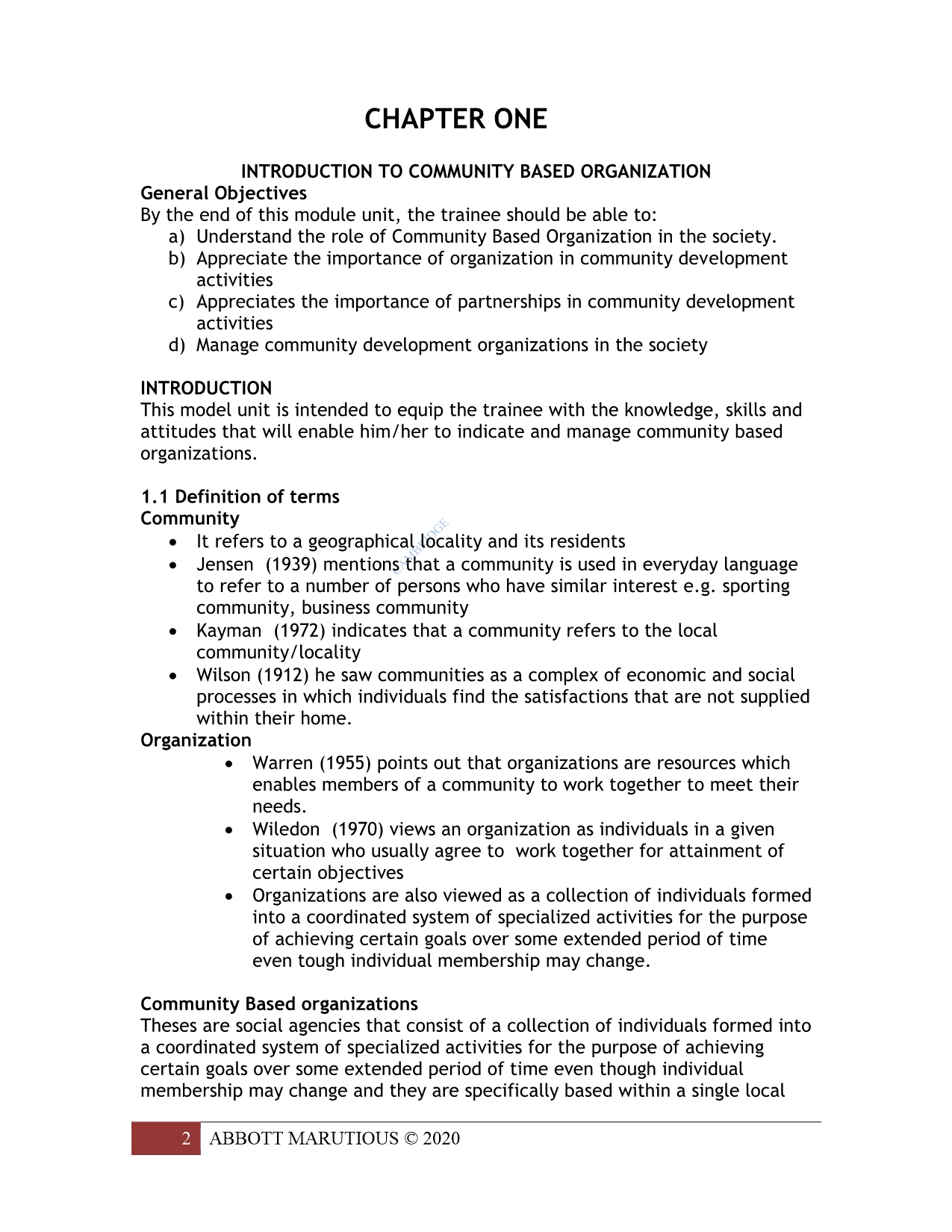
Community
It refers to a geographical locality and its residents
Jensen (1939) mentions that a community is used in everyday language to refer to a number of persons who have similar interest e.g. sporting community, business community
Kayman (1972) indicates that a community refers to the local community/locality
Wilson (1912) he saw communities as a complex of economic and social processes in which individuals find the satisfactions that are not supplied within their home.
Organization
Warren (1955) points out that organizations are resources which enables members of a community to work together to meet their needs.
Wiledon (1970) views an organization as individuals in a given situation who usually agree to work together for attainment of certain objectives
Organizations are also viewed as a collection of individuals formed into a coordinated system of specialized activities for the purpose of achieving certain goals over some extended period of time even tough individual membership may change.
Community Based organizations
Theses are social agencies that consist of a collection of individuals formed into a coordinated system of specialized activities for the purpose of achieving certain goals over some extended period of time even though individual membership may change and they are specifically based within a single local community. Like other non- profits, they are often run on a voluntary basis and are self funded.
Below is the document preview.

EFFECT OF SKILLS DEVELOPMENT ON POST COVID-19 PANDEMIC EMPLOYEE PERFORMANCE IN COMMUNITY BASED ORGANIZATIONS IN LAIKIPIA COUNTY, KENYA- HRM RESEARCH PROJECT
Employee performance is a critical component of the success and effectiveness of community-based organizations in Laikipia County, Kenya. However, there are several challenges that hinder optimal performance in these organizations. One significant issue affecting employee performance is the limited access to training and development opportunities. Hence the need to conduct a study on the effect of skills development on post covid-19 pandemic employee performance in community based non-governmental organizations in Laikipia County, Kenya. Specifically, the study sought to assess the effect of upskilling, cross skilling, reskilling and retooling on employee performance in community based organizations in Laikipia County, Kenya. This study was informed by human capital theory, cognitive theory of multimedia learning and technology acceptance model. This study adopted an exploratory research design. The unit of analysis was six community-based organizations in Laikipia County. The unit of observation was 151 employees working with the six community-based organizations in Laikipia County. The sample size was 110 respondents drawn from the six organizations calculated using the formula developed by Taro Yamane. Data was collected using questionnaires. A pilot study was conducted to test the data collection instruments for their reliability while validity was tested through subjecting it to subject matter experts. From the findings the Cronbach Alpha was between 0.706 and 0.838 implying that the research instrument was reliable. The collected data was analyzed using descriptive statistics including frequencies, percentages and means, and inferential statistics including correlation and regression analysis using SPSS. The findings revealed that there is a moderate positive and statistically significant correlation between upskilling and employee performance in community-based organizations in Laikipia County, (r = 0.543; p < 0.05). In addition, the findings revealed that there is a moderate positive and statistically significant correlation between cross skilling and employee performance in community-based organizations in Laikipia County, (r = 0.643; p < 0.05). Furthermore, the findings revealed that there is a moderate positive and statistically significant correlation between reskilling and employee performance in community-based organizations in Laikipia County, (r = 0.443; p < 0.05). Finally, the findings indicated that there was a moderate positive and statistically significant correlation between retooling and employee performance in community-based organizations in Laikipia County, (r = 0.654; p < 0.05). The study also concluded that as a result of being provided with an opportunity for retraining employees are more committed to the organization. The study also concluded that as a result of being provided with an opportunity for reskilling employees are more committed to the organization. The study also concluded that new technologies and working processes reduced errors at work. From the findings, the study recommended that training programs should address specific challenges faced by these organizations. Moreover, community-based organizations should design comprehensive training programs that expose employees to various aspects of community-based work. Finally, the study recommended that organizations should emphasize digital literacy and technology-driven skills to align with the evolving landscape of community development. The findings are significant to policy makers, practitioners and stakeholders in adjusting workforce development and capacity building initiatives.
1429 Views
0 Downloads
136.05 KB
KNEC COMMUNITY BASED ORGANIZATIONS LECTURE NOTES
Trending!
A CBO is an organization that provides social services at the local level. It is a non-profit
organization whose activities are based primarily on volunteer efforts. This means that CBOs depend heavily on voluntary contributions for labour, material and financial support.
212 Pages
2442 Views
0 Downloads
1.52 MB