ELEMENTS OF COMPANY LAW
| Institution | UNIVERSITY |
| Course | Diploma in Cooperati... |
| Year | 1st Year |
| Semester | Unknown |
| Posted By | stephen |
| File Type | |
| Pages | 13 Pages |
| File Size | 580.56 KB |
| Views | 11494 |
| Downloads | 0 |
| Price: |
Buy Now
 Buy via
whatsapp Buy via
whatsapp
|


Description
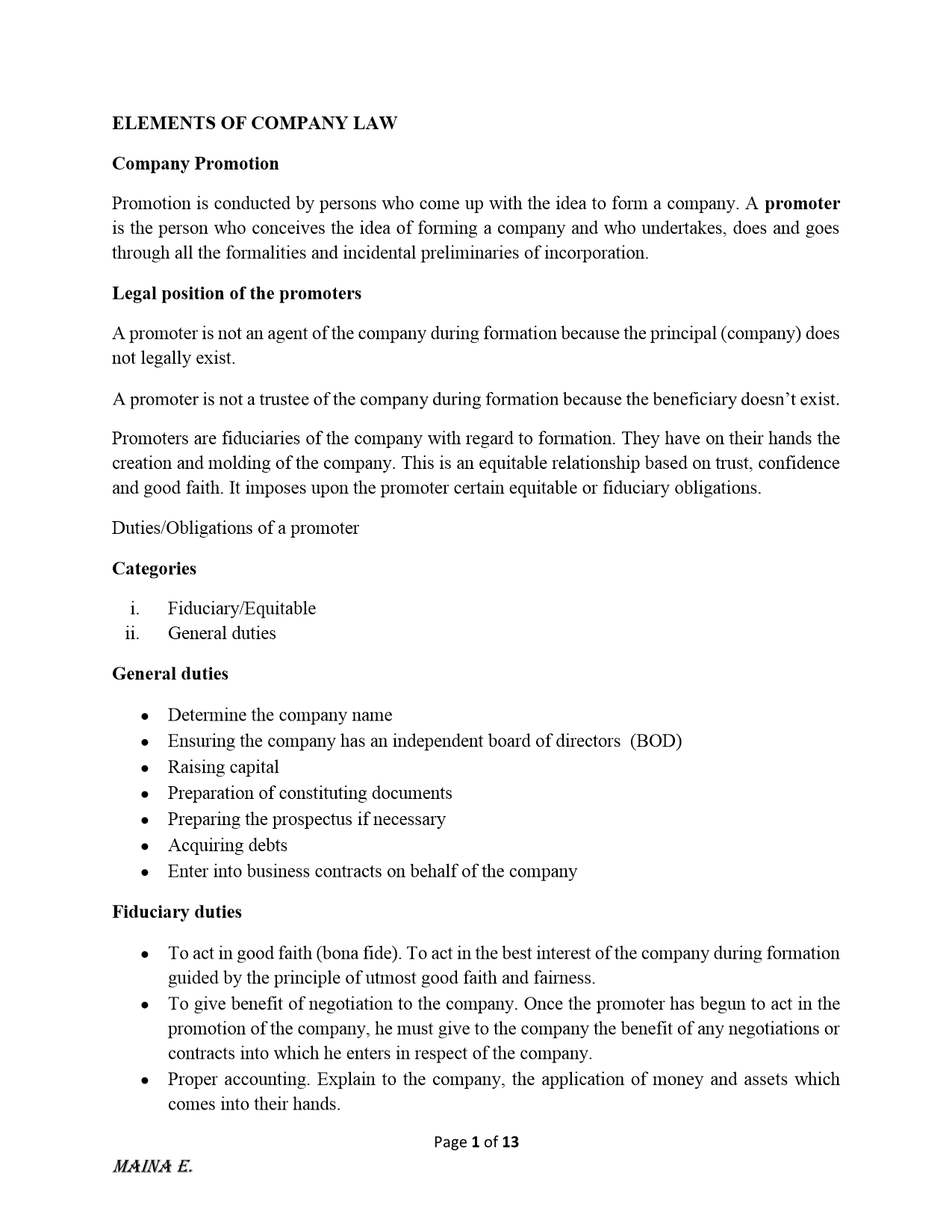
Promotion is conducted by persons who come up with the idea to form a company. A promoter is the person who conceives the idea of forming a company and who undertakes, does and goes through all the formalities and incidental preliminaries of incorporation. Legal position of the promoters A promoter is not an agent of the company during formation because the principal (company) does not legally exist. A promoter is not a trustee of the company during formation because the beneficiary doesn’t exist. Promoters are fiduciaries of the company with regard to formation. They have on their hands the creation and molding of the company. This is an equitable relationship based on trust, confidence and good faith. It imposes upon the promoter certain equitable or fiduciary obligations.
Below is the document preview.

PUBLIC FINANCE
Public finance management in kenya is covered in the constitution of kenya 2010, chapter 12 and public finance management act, 2012. this act of parliament provides effective manage ment of public finances by the national and county government; the oversight responsibility of parliament and county assemblies; the different responsibilities of government entities and other bodies and for connected purposes
1 Pages
413 Views
0 Downloads
2.6 MB
AGD 100: INTRODUCTION TO GENDER DEVELOPMENT STUDIES
Trending!
The differences between women and men within the same households and between cultures that are socially and culturally constructed and change over time. The differences are reflected in: roles, responsibilities, access to and control over resources, constraints, opportunities, needs, perceptions, views etc, held by men and women.
46 Pages
6944 Views
0 Downloads
934.91 KB
DATA MINING TECHNIQUES
Trending!
The paper presents application of data mining techniques to fraud analysis. We
present some classification and prediction data mining techniques which we
consider important to handle fraud detection. There exist a number of data
mining algorithms and we present statistics-based algorithm, decision treebased algorithm and rule-based algorithm. We present Bayesian classification model to detect fraud in automobile insurance. Naïve Bayesian visualization is selected to analyze and interpret the classifier predictions. We illustrate how ROC curves can be deployed for model assessment in order to provide a more intuitive analysis of the models
21 Pages
6704 Views
0 Downloads
545.18 KB
AGD 303: GENDER AND ENVIRONMENTAL MANAGEMENT
Trending!
The purpose of the course is to discuss the concepts that are essential to the subject of natural resource and environmental management and relate them to gendered understanding of environmental challenges and solutions. We hope that you will find this module exciting, educative, and engaging.
61 Pages
9268 Views
0 Downloads
2.37 MB
AGD 101: EVOLUTION OF GENDER AND DEVELOPMENT
In this lesson we shall learn about gender, sex, sex roles, and gender roles. This shall strengthen our perception of the concepts in the area where these concepts have been taken as synonymous.
38 Pages
365 Views
1 Downloads
1.68 MB
AGD 304: GENDER ASPECTS IN REGIONAL COOPERATION AND DEVELOPMENT
Trending!
The objective of this course is to develop intellectual and analytical capacity in gender and Regional Cooperation. The course will introduce students to forms of regional Cooperation and explain gains made from various ventures in and outside Africa from a gender perspective. The course will introduce students to forms of regional cooperation and explain gains made from various ventures in and outside Africa from a gender perspective.
24 Pages
7067 Views
0 Downloads
474.76 KB
AGD 202: PARTICIPATORY APPROACHES AND TOOLS IN GENDER AND DEVELOPMENT
Trending!
This Module focuses on participatory approaches and tools in gender and development. Development process world over is expected to be result oriented in that it is more about how people benefit from the process rather than the dynamic of process itself.
43 Pages
7362 Views
3 Downloads
1.35 MB
FAS/AMS 311: SUPPLY CHAIN MANAGEMENT AND LOGISTICS NOTES
Supply chain is the network of organizations that are involved through upstream and
downstream linkages, in the different processes and activities that produce value in the
form of product and services in the hands of the ultimate customers.
62 Pages
176 Views
1 Downloads
1.15 MB
BBA 314: PUBLIC RELATIONS
Trending!
publics. In the analysis of the definition (i) it is” the planned and sustained effort” ,meaning that PR activity is organized as a campaign or program and is a continuous activity, it is not haphazard. (ii) Its purpose is “to establish and maintain mutual understanding” – that is, to ensure that the organization is understood by others. This mutual understanding is thus between an organization and its publics, since many groups of people are involved.
81 Pages
7606 Views
0 Downloads
1.13 MB
THE CANDLESTICK TRADING BIBLE
Trending!
The Candlestick trading bible is the trading method that is going to finally take your trading to where it should be, consistent, profitable, easy and requiring very little time and effort.
168 Pages
9525 Views
0 Downloads
2.7 MB