 Join Our WhatsApp Channel for Updates!
The SN2 reaction
| Institution | UNIVERSITY |
| Course | BACHELOR OF SCIENCE... |
| Year | 4th Year |
| Semester | Unknown |
| Posted By | stephen oyake rabilo |
| File Type | |
| Pages | 13 Pages |
| File Size | 190.14 KB |
| Views | 2711 |
| Downloads | 0 |
| Price: |
Buy Now
 Buy via
whatsapp Buy via
whatsapp
|


Description
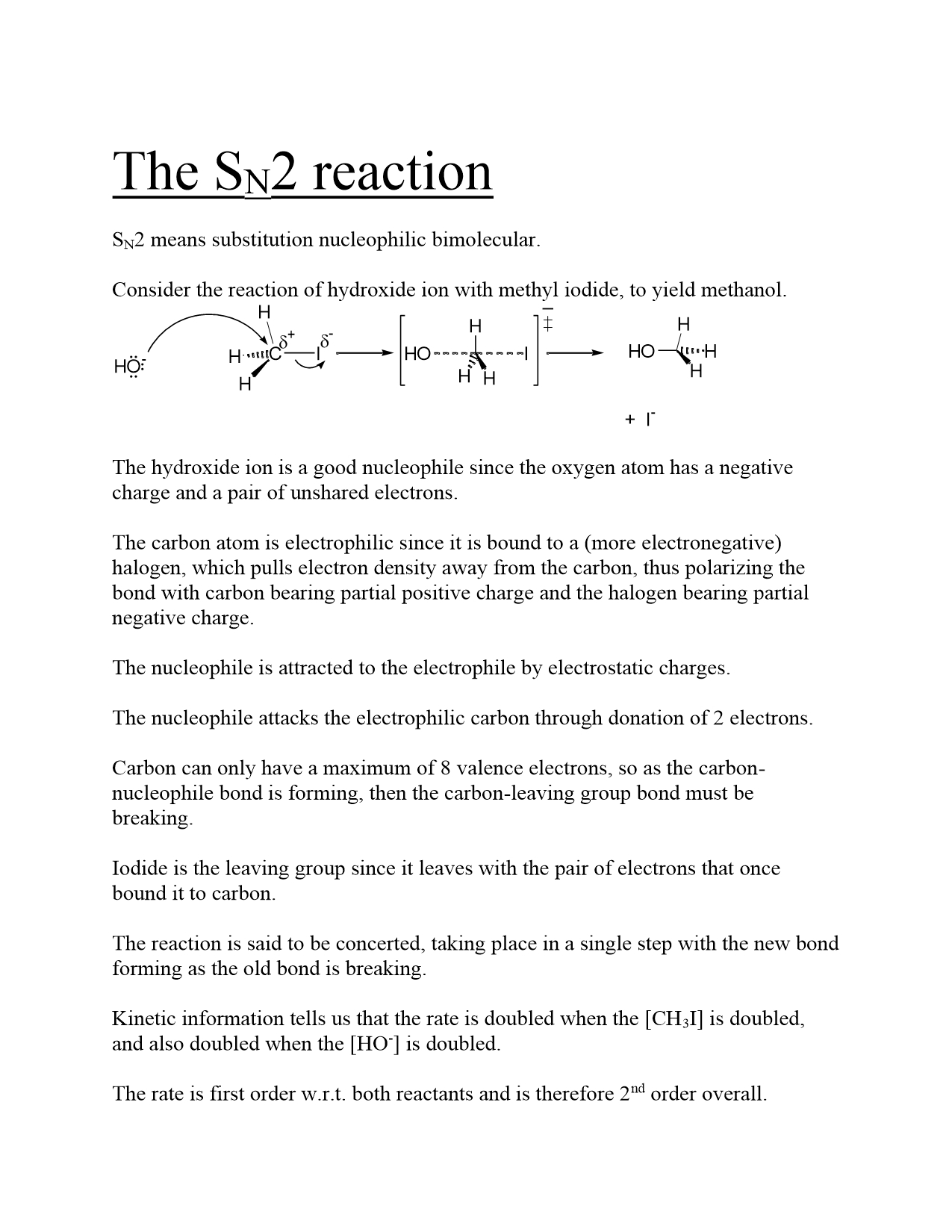
The hydroxide ion is a good nucleophile since the oxygen atom has a negative charge and a pair of unshared electrons.
The carbon atom is electrophilic since it is bound to a (more electronegative)
halogen, which pulls electron density away from the carbon, thus polarizing the
bond with carbon bearing partial positive charge and the halogen bearing partial negative charge.
The nucleophile is attracted to the electrophile by electrostatic charges.
The nucleophile attacks the electrophilic carbon through donation of 2 electrons. Carbon can only have a maximum of 8 valence electrons, so as the carbon nucleophile bond is forming, then the carbon-leaving group bond must be breaking. Iodide is the leaving group since it leaves with the pair of electrons that once bound it to carbon.
Below is the document preview.

HBC 2101: Introduction to Accounting I - Course Outline
Trending!
Introduce students to financial accounting for processing and communicating of financial information to support economic decision making. This particularly focuses on procedures of book keeping and preparation of the financial statements for a simple business.
1 Pages
4085 Views
0 Downloads
51.57 KB
HBC 2101: Introduction to Accounting I - ERRORS ON ACCOUNTS
Trending!
The trial balance produced from the accounts appears to be correct, i.e the debits
are the same as the credits. However, on taking a close check on the balances and
transactions posted, errors may have been made and therefore the balances shown on
the trial balance may be incorrect i.e. under or over stated.
16 Pages
4000 Views
0 Downloads
331.19 KB
HBC 2101: Introduction to Accounting I
Accounting is defined as a process of Recording Classifying Summarizing Interpreting the financial transactions and Communicating the result thereof to the persons interested in such information for decision making purposes
48 Pages
408 Views
0 Downloads
1.25 MB
HBC 2101: Nature, purpose and scope of accounting
Trending!
Accounting may be defined as the process of collecting, recording, summarizing and
communicating financial information. Accounting is nothing but a means of
communicating the results of business operations to varies parties interested in or
connected with the business, viz., the owner, creditors, investors, government, financial institutions and other agencies. Accounting is, therefore, rightly called as the language of business. The basis purpose of a language is to serve as a means of communication. Accounting also serve this purpose. Accounting is not only associated with business but also with every body who is interested in keeping an account for the money received and money spent.
10 Pages
3537 Views
0 Downloads
110.52 KB
HBC 2101: Purchases Ledger Control Account.
Trending!
Purchases Ledger Control Account is a summary account which checks the arithmetical accuracy of the Purchases Ledger. It enables us to see at a glance whether the general ledger balance for the purchase’s ledger agrees with the total of all the individual trade payable accounts held within the purchase’s ledger.
3 Pages
3790 Views
0 Downloads
84.66 KB
HBC 2101: CONTROL ACCOUNTS
Trending!
Control accounts are so called because they control a section of the ledgers. By control
we mean that the total on the control accounts should be the same as the totals on the
ledger accounts. There are two main types of control accounts:
11 Pages
4034 Views
0 Downloads
253.08 KB
HBC 2101: ACCOUNTING FOR TRANSACTIONS
Trending!
HBC 2101 Introduction to Accounting I - ACCOUNTING FOR TRANSACTIONS
50 Pages
4283 Views
0 Downloads
2.11 MB
HBC 2101: BANK RECONCILIATION STATMENTS
Trending!
The cashbook for cash at bank records all the transactions taking place at the bank i.e. the movements of the account held with the bank. The bank will send information
relating to this account using a bank statement for the firm to compare. Ideally, the records as per the bank and the cashbook should be the same and therefore the balance carried down in the cashbook should be the same as the balance carried down by the bank in the bank statement.
11 Pages
4235 Views
0 Downloads
134.71 KB
HBC 2101: Accounting principles and concepts
Trending!
Qualities of Useful Financial Information. The four principal qualities of useful financial information are understandability, relevance, reliability and comparability.
45 Pages
3820 Views
0 Downloads
1.04 MB
HBC 2101: ACCOUNTING FOR MERCHANDISING OPERATIONS
Trending!
Income Statements
Single-step income statement
Multiple-step income statement
Gross Margin = Gross Profit = Net Sales – Cost of Goods Sold
Gross Margin ratio = Gross Margin / Net Sales
25 Pages
5240 Views
0 Downloads
62.17 KB