The SN2 reaction
| Institution | UNIVERSITY |
| Course | BACHELOR OF SCIENCE... |
| Year | 4th Year |
| Semester | Unknown |
| Posted By | stephen oyake rabilo |
| File Type | |
| Pages | 13 Pages |
| File Size | 190.14 KB |
| Views | 5542 |
| Downloads | 0 |
| Price: |
Buy Now
 Buy via
whatsapp Buy via
whatsapp
|


Description
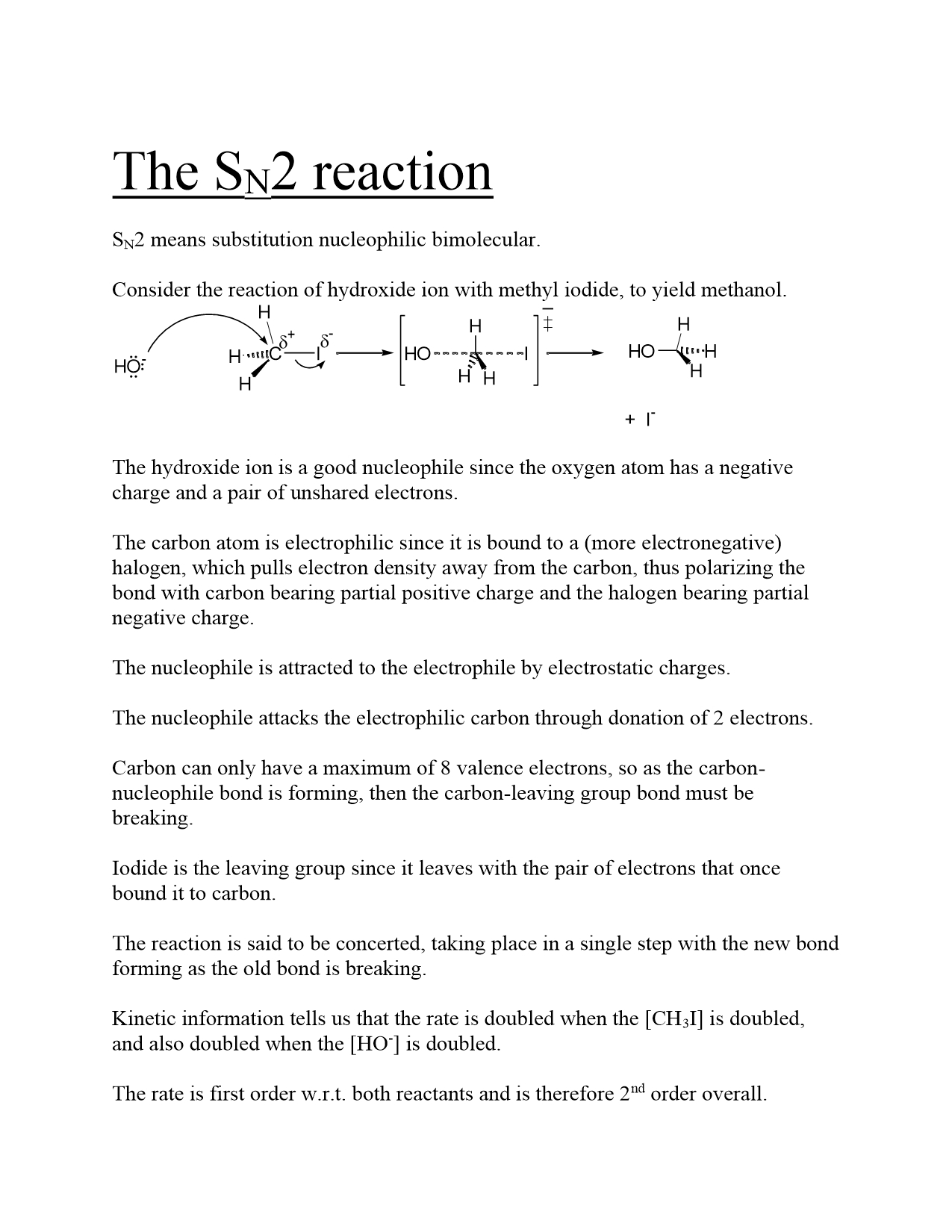
The hydroxide ion is a good nucleophile since the oxygen atom has a negative charge and a pair of unshared electrons.
The carbon atom is electrophilic since it is bound to a (more electronegative)
halogen, which pulls electron density away from the carbon, thus polarizing the
bond with carbon bearing partial positive charge and the halogen bearing partial negative charge.
The nucleophile is attracted to the electrophile by electrostatic charges.
The nucleophile attacks the electrophilic carbon through donation of 2 electrons. Carbon can only have a maximum of 8 valence electrons, so as the carbon nucleophile bond is forming, then the carbon-leaving group bond must be breaking. Iodide is the leaving group since it leaves with the pair of electrons that once bound it to carbon.
Below is the document preview.

EET 200 Microeconomics Theory 2
Trending!
Simple and Direct
109 Pages
6210 Views
0 Downloads
1.97 MB
BAC 413 Marketing Financial Services
Trending!
Simple And Direct
35 Pages
5486 Views
0 Downloads
947.59 KB
EET 100 Introduction to Microeconomics
Trending!
Simple and Clear
139 Pages
5380 Views
2 Downloads
1.97 MB
BMS 404 Econometric Models and Methods
Trending!
Simple and Clear
58 Pages
6170 Views
1 Downloads
1.25 MB