The SN2 reaction
| Institution | UNIVERSITY |
| Course | BACHELOR OF SCIENCE... |
| Year | 4th Year |
| Semester | Unknown |
| Posted By | stephen oyake rabilo |
| File Type | |
| Pages | 13 Pages |
| File Size | 190.14 KB |
| Views | 6406 |
| Downloads | 0 |
| Price: |
Buy Now
 Buy via
whatsapp Buy via
whatsapp
|


Description
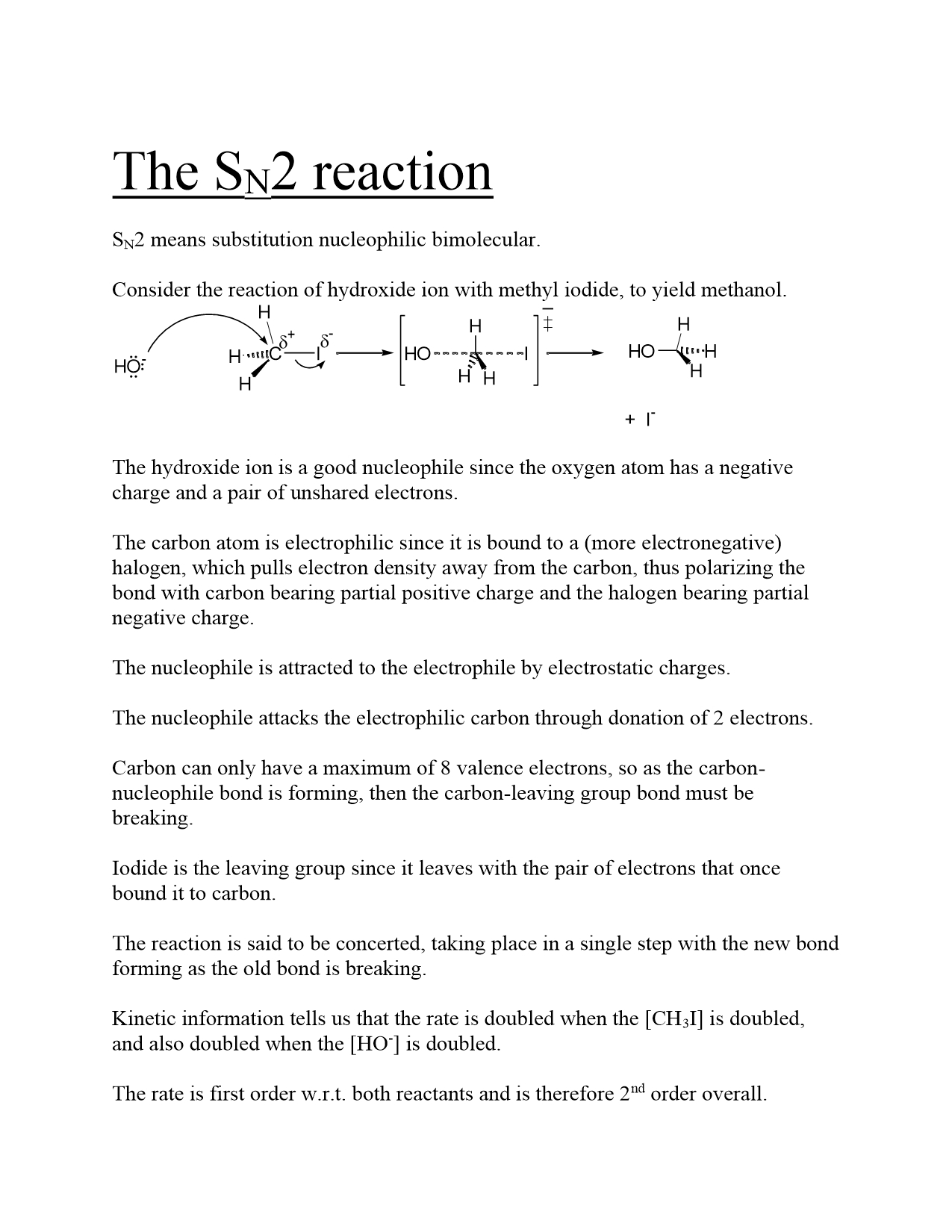
The hydroxide ion is a good nucleophile since the oxygen atom has a negative charge and a pair of unshared electrons.
The carbon atom is electrophilic since it is bound to a (more electronegative)
halogen, which pulls electron density away from the carbon, thus polarizing the
bond with carbon bearing partial positive charge and the halogen bearing partial negative charge.
The nucleophile is attracted to the electrophile by electrostatic charges.
The nucleophile attacks the electrophilic carbon through donation of 2 electrons. Carbon can only have a maximum of 8 valence electrons, so as the carbon nucleophile bond is forming, then the carbon-leaving group bond must be breaking. Iodide is the leaving group since it leaves with the pair of electrons that once bound it to carbon.
Below is the document preview.

AGRICULTURE SYLLABUS
Trending!
UPDATED KNEC AGRICULTURE SYLLABUS
23 Pages
11522 Views
2 Downloads
2.21 MB
HOMESCIENCE FORM 1 NOTES
Trending!
UPDATED HOMESCIENCE FORM 1 NOTES
147 Pages
11263 Views
5 Downloads
1.32 MB
K.C.S.E HRE SYLLABUS
Trending!
This is the comprehensive KNEC HRE SYLLABUS
10 Pages
9893 Views
0 Downloads
515.1 KB
K.C.S.E GERMAN SYLLABUS
Trending!
This is the comprehensive KNEC GERMAN SYLLABUS
No pages found
11651 Views
5 Downloads
60.04 KB
Isimu Jamii
Trending!
Isimujamii - Ni taaluma inayochunguza uhusianouliopo baina ya lugha na jamii.
Hasa hushughulikia jinsi watu wanavyotumia lugha katika jamii.
Isimu- ni uchunguzi wa lugha kisayansi.
Jamii – ni kundi filani la watu wenye uhusiano fulani.
24 Pages
6430 Views
3 Downloads
851.47 KB
FASIHI SIMULIZI NOTES
Trending!
Fasihi ni sanaa inayotumia lugha kuwasilisha ujumbe unaomhusu binadamu. Sanaa ni ufundi wa kuwasilisha fikra na hisia za binadamu kama vile maneno, maandishi,uchoraji, uchongaji, ufinyanzi n.k.
43 Pages
17859 Views
13 Downloads
752.59 KB