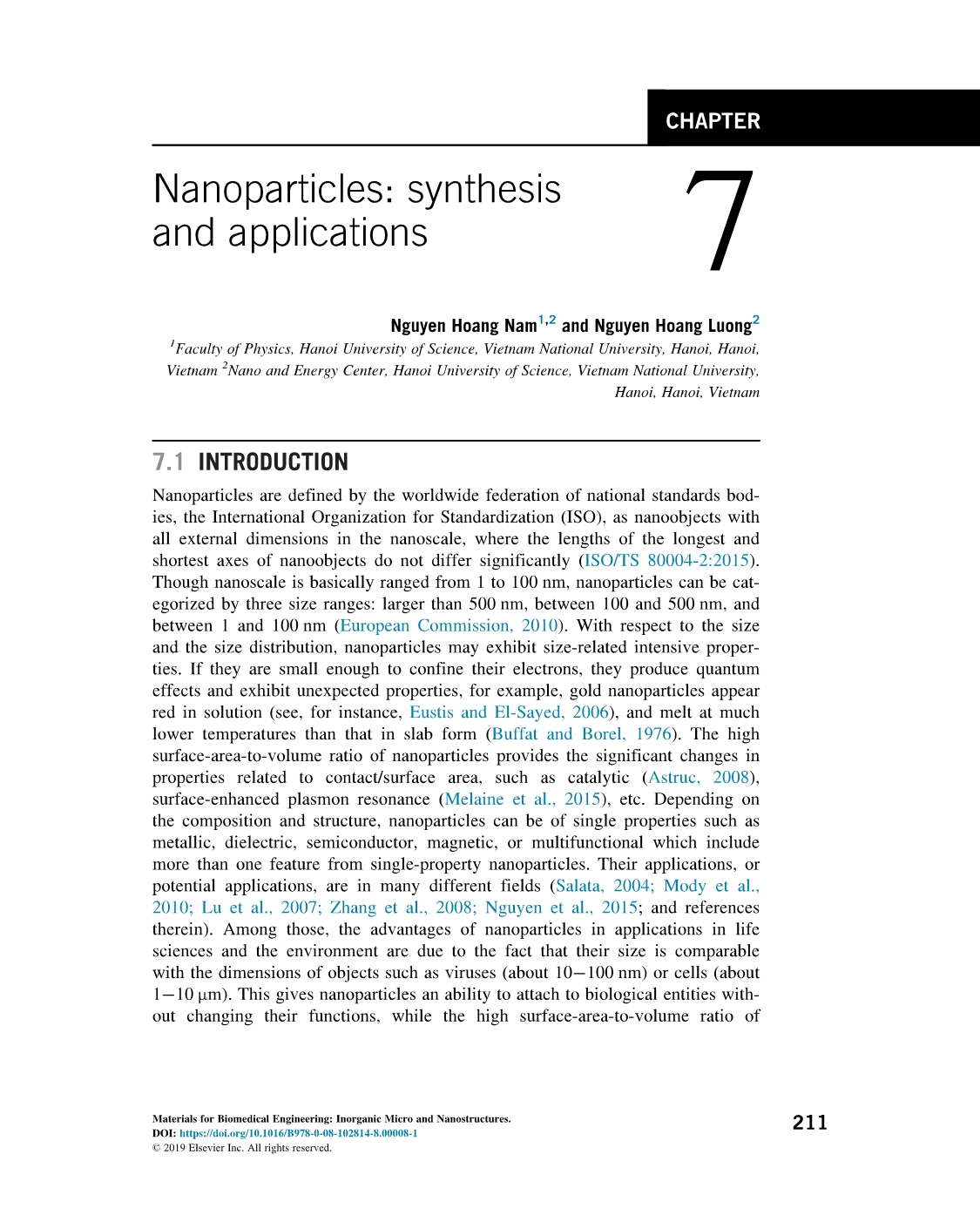
Nanoparticles: synthesis and applications
| Institution | UNIVERSITY |
| Course | BACHELOR OF SCIENCE... |
| Year | 4th Year |
| Semester | Unknown |
| Posted By | stephen oyake rabilo |
| File Type | |
| Pages | 30 Pages |
| File Size | 1.73 MB |
| Views | 6517 |
| Downloads | 0 |
| Price: |
Buy Now
 Buy via
whatsapp Buy via
whatsapp
|


Description
Nanoparticles are defined by the worldwide federation of national standards bodies, the International Organization for Standardization (ISO), as nanoobjects with
all external dimensions in the nanoscale, where the lengths of the longest andshortest axes of nanoobjects do not differ significantly . Though nanoscale is basically ranged from 1 to 100 nm, nanoparticles can be categorized by three size ranges: larger than 500 nm, between 100 and 500 nm, and
between 1 and 100 nm (European Commission, 2010). With respect to the size and the size distribution, nanoparticles may exhibit size-related intensive properties. If they are small enough to confine their electrons, they produce quantum effects and exhibit unexpected properties, for example, gold nanoparticles appear red in solution (see, for instance, Eustis and El-Sayed, 2006), and melt at much lower temperatures than that in slab form (Buffat and Borel, 1976). The high surface-area-to-volume ratio of nanoparticles provides the significant changes in properties related to contact/surface area, such as catalytic (Astruc, 2008),surface-enhanced plasmon resonance (Melaine et al., 2015), etc.
Below is the document preview.

EDF 112: CHARACTER EDUCATION AND INTEGRITY
Course Purpose; To enable the learner appreciate the contributions of education in value development and its place in the moral life of the society.
3 Pages
1155 Views
19 Downloads
160.68 KB
SELECTED FORMAL PHILOSOPHIES OF EDUCATION
Trending!
Behind every school system, educational approach and practice, there is a philosophy based on the views and values of the educators, as well as the society that is sponsoring the education. The philosophy starts with the view of reality and definitions of truth and goodness. From this, the mission and goals of education (and schools) and the emphasis of the instruction (given in schools or classrooms) are defined and established. The various philosophies are based on a view of society and what is important, as well as political beliefs to a degree.
17 Pages
9439 Views
0 Downloads
367.25 KB
INTRODUCTION TO QUANTITATIVE TECHNIQUES IN EDUCATION
Trending!
Quantitative methods in education will serve as a context for the development of Quantitative skills by facilitating the development of your abilities to solve real world problems, make intelligent (more informed) decisions, evaluate quantitative information, and reason more effectively.
81 Pages
8937 Views
0 Downloads
2.26 MB
SNE 100: Special Needs Education Notes
Trending!
Special needs: Is defined as an individual with a mental, emotional, or physical
disability. An individual with special needs may need help in one or more of the
following areas:Communication, Movement, Self-care,Decision-making.
123 Pages
12442 Views
7 Downloads
1.52 MB
EDF 111: PHILOSOPHY OF EDUCATION
Trending!
Philosophy is the rational investigation of the truths and principles of being, knowledge or conduct. It is concerned with making explicit the nature and significance of ordinary and scientific beliefs. It is a system of thought or principles for guidance in practical affairs. It is the art of taking nothing for granted and questioning everything (what is good? Beauty? True? Justice? Courage? Democracy?) So philosophy bring to birth new ideas, new knowledge.
12925 Views
1 Downloads
66.89 KB
EDF 112: CHARACTER EDUCATION AND INTEGRITY NOTES
Trending!
Moral education refers to the general techniques and processes that are aimed at enabling the learner to evaluate scrutinize and make the right judgement and choices regarding values and value systems. The end result of this process is hoped to bring learners to act morally, that is in accordance with set values (goals). Moral education aims at arming the learner with the power of moral reasoning and the desire to act morally. Hence, it exhibits both the cognitive as well as attitudinal components. It involves the ability to make moral judgement based on sound reasoning as well as a process of educating feelings and emotions.
12505 Views
1 Downloads
57.95 KB
The Revised CPA Syllabus
Trending!
Download a copy of the revised syllabus for the Certified Public Accountants Examination.
52 Pages
10097 Views
3 Downloads
3.65 MB
K.C.S.E COMPUTER STUDIES SYLLABUS
Trending!
Get a copy of the the latest K.C.S.E COMPUTER STUDIES SYLLABUS.
23 Pages
11731 Views
5 Downloads
2.41 MB
CBA 101: Business Law 1
Trending!
This unit aims at introducing you to the general principles of law and its application. in particular the unit discusses how this law relates to the business world.
129 Pages
8365 Views
1 Downloads
1.37 MB
ARE 400: Contemporary Trends in Christian Theology
Trending!
What is theology? Theology is the science of God. In its Christian sense it is the
science of the divinely revealed religious truths. Its theme is the being and nature of
God and God’s creatures and the whole complex of the divine dispensation from the
fall of Adam to the redemption through Christ and its mediation of people by His
church including the so-called natural truths of God, the soul, the moral law, which
are accessible to mere reason.
70 Pages
7618 Views
2 Downloads
634.44 KB