 Join Our WhatsApp Channel for Updates!
Nanoparticles: synthesis and applications
| Institution | UNIVERSITY |
| Course | BACHELOR OF SCIENCE... |
| Year | 4th Year |
| Semester | Unknown |
| Posted By | stephen oyake rabilo |
| File Type | |
| Pages | 30 Pages |
| File Size | 1.73 MB |
| Views | 4606 |
| Downloads | 0 |
| Price: |
Buy Now
 Buy via
whatsapp Buy via
whatsapp
|


Description
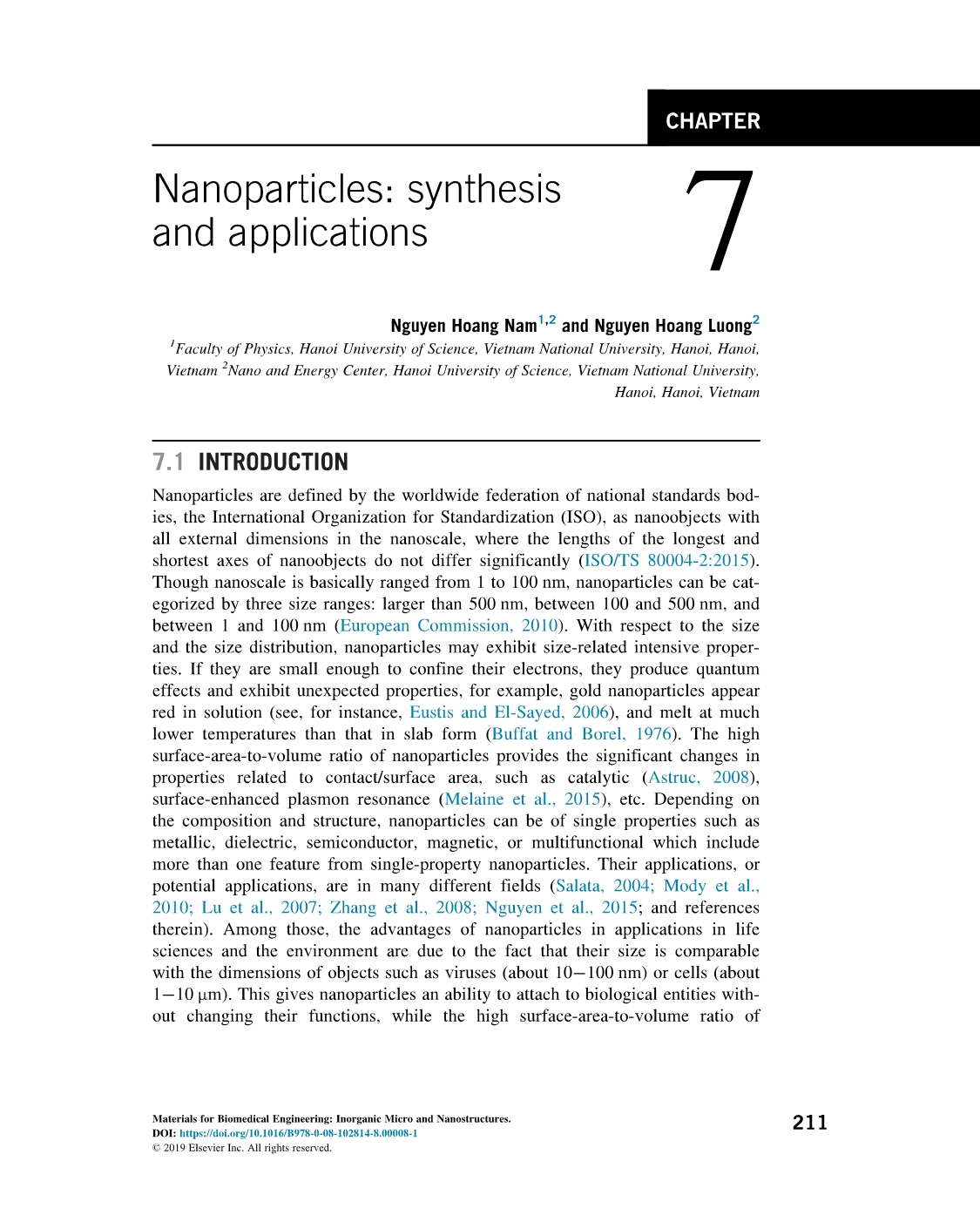
Nanoparticles are defined by the worldwide federation of national standards bodies, the International Organization for Standardization (ISO), as nanoobjects with
all external dimensions in the nanoscale, where the lengths of the longest andshortest axes of nanoobjects do not differ significantly . Though nanoscale is basically ranged from 1 to 100 nm, nanoparticles can be categorized by three size ranges: larger than 500 nm, between 100 and 500 nm, and
between 1 and 100 nm (European Commission, 2010). With respect to the size and the size distribution, nanoparticles may exhibit size-related intensive properties. If they are small enough to confine their electrons, they produce quantum effects and exhibit unexpected properties, for example, gold nanoparticles appear red in solution (see, for instance, Eustis and El-Sayed, 2006), and melt at much lower temperatures than that in slab form (Buffat and Borel, 1976). The high surface-area-to-volume ratio of nanoparticles provides the significant changes in properties related to contact/surface area, such as catalytic (Astruc, 2008),surface-enhanced plasmon resonance (Melaine et al., 2015), etc.
Below is the document preview.

BIT 2108: Access methods.
Trending!
Access methods refer to the techniques and protocols used to retrieve, store, and manipulate data or resources in a computer system or network. These methods determine how users, devices, or applications interact with data or services.
11 Pages
6587 Views
0 Downloads
390.92 KB
BIT 2108: Introduction to Network Protocol Architectures
Trending!
Network protocol architectures refer to the structured frameworks that define the rules, standards, and procedures enabling devices to communicate effectively in a network. These architectures are hierarchical models comprising layers, each assigned specific responsibilities, ensuring seamless communication across diverse systems and technologies.
42 Pages
7353 Views
0 Downloads
1.21 MB
BIT 2108: Networking Media.
Trending!
Networking media refers to the physical materials or communication channels used to transmit data between devices in a network. These media serve as the backbone of computer networks, enabling connectivity, communication, and data exchange. Networking media can be broadly categorized into wired and wireless types, each suited for specific applications based on factors such as speed, distance, cost, and reliability.
71 Pages
6870 Views
0 Downloads
1.81 MB
BIT 2103: Lesson 1 Introduction to Computer Applications and Concept
Trending!
Introduction to Computer Applications is a foundational course or subject designed to familiarize students with the basic concepts and practical uses of computers in various fields. It emphasizes the role of computers in enhancing productivity and efficiency across personal, academic, and professional contexts.
7 Pages
8156 Views
1 Downloads
115.88 KB
BIT 2103: Lesson 5 How to Insert and Position Graphics in Word Documents.
Trending!
Inserting and positioning graphics in a Word document can enhance its visual appeal and make the content more engaging.
3 Pages
6987 Views
0 Downloads
121.04 KB
BIT 2103: Formatting in MS Word
Trending!
Formatting in MS Word involves various tools and techniques to enhance the presentation of text, images, and other elements in a document.
2 Pages
6476 Views
1 Downloads
78.03 KB
BIT 2103: Lesson 1 Ms Excel Basics
Trending!
Microsoft Excel is a powerful spreadsheet application developed by Microsoft, widely used for data analysis, calculations, and data visualization. It allows users to organize, manipulate, and analyze data in a tabular format, consisting of rows and columns that form a grid.
4 Pages
7510 Views
0 Downloads
80.18 KB
SCH 200: ATOMIC STRUCTURE AND CHEMICAL BONDING
Trending!
This course covers an experimental foundation of quantum theory; particles and waves; uncertainty principles; wave and wave equation; properties of a well-behaved
wave functions; Schrödinger equation and its solutions; the physical significance of the wave function; solutions of the Schrödinger equation for hydrogen - like atoms: quantum numbers, radial functions, angular, charge clouds and orbital; energy levels, electron configuration and the periodic table; ionic, covalent, hydrogen and metallic bonds, valence bond theory and molecular orbital theory for simple molecules and ions; complex ions; definition and examples of Lewis acids, Lewis bases, co-ordinate bond, ligands and co-ordination compounds; ionic structures and calculation of lattice energies.
88 Pages
8059 Views
2 Downloads
1.86 MB
BIT 2103:Microsoft PowerPoint
Trending!
Microsoft PowerPoint is a presentation software developed by Microsoft, widely used for creating professional slideshows that combine text, images, graphics, animations, and multimedia. It is part of the Microsoft Office suite and is compatible with Windows, macOS, and mobile platforms.
21 Pages
7256 Views
0 Downloads
1.24 MB
AEN 401: VARIETIES OF ENGLISH
Trending!
This module is organized around thirteen major topics. We will first introduce you to the sources of variation which have precipitated the different varieties of English and explain the three major levels of language variation: phonological, lexical and morpho- syntactic. We will then examine the notion of language standardization and discuss different approaches that have been used in classifying the World Englishes.
86 Pages
6800 Views
2 Downloads
1.2 MB