 Join Our WhatsApp Channel for Updates!
Nanoparticles: synthesis and applications
| Institution | UNIVERSITY |
| Course | BACHELOR OF SCIENCE... |
| Year | 4th Year |
| Semester | Unknown |
| Posted By | stephen oyake rabilo |
| File Type | |
| Pages | 30 Pages |
| File Size | 1.73 MB |
| Views | 2955 |
| Downloads | 0 |
| Price: |
Buy Now
 Buy via
whatsapp Buy via
whatsapp
|


Description
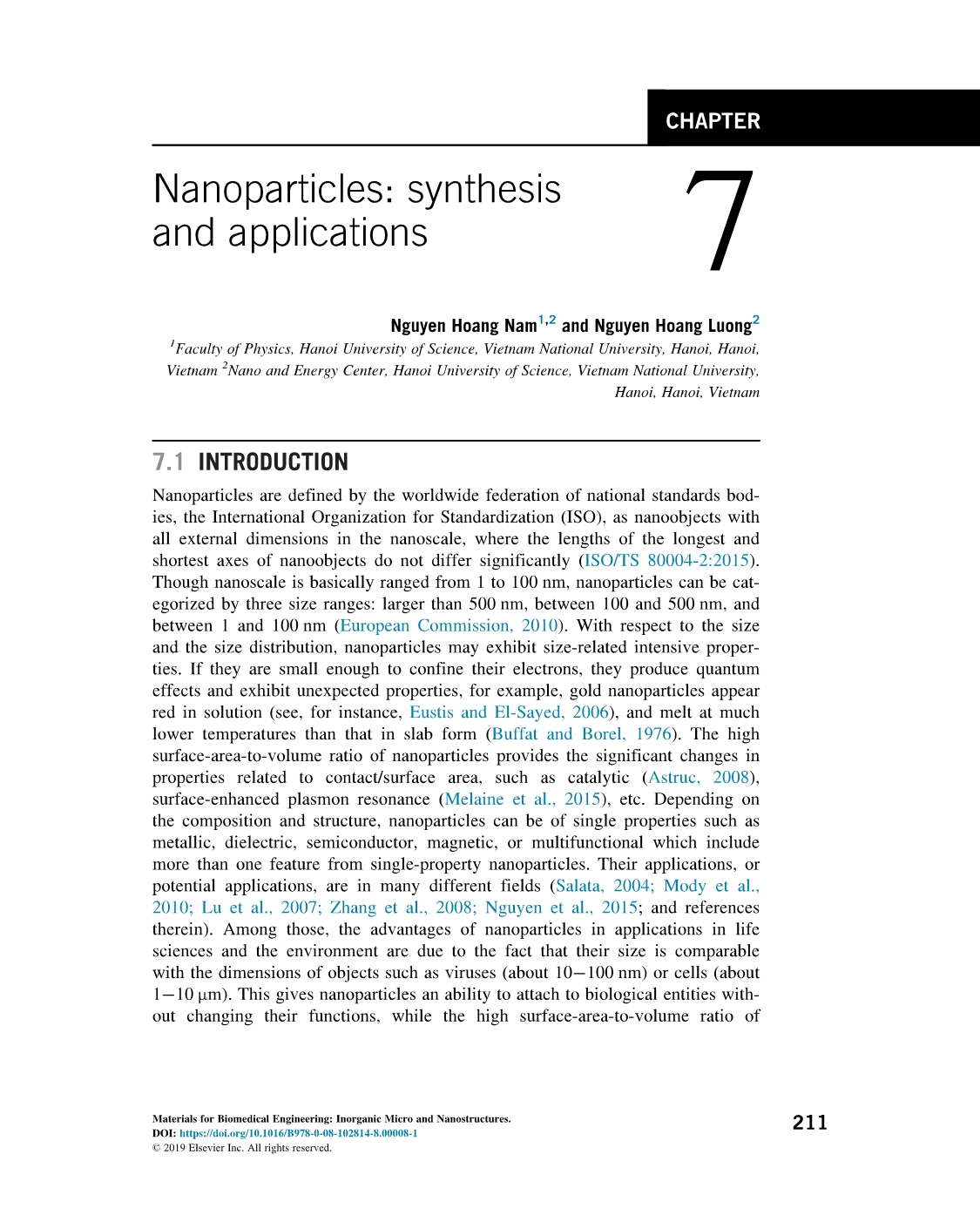
Nanoparticles are defined by the worldwide federation of national standards bodies, the International Organization for Standardization (ISO), as nanoobjects with
all external dimensions in the nanoscale, where the lengths of the longest andshortest axes of nanoobjects do not differ significantly . Though nanoscale is basically ranged from 1 to 100 nm, nanoparticles can be categorized by three size ranges: larger than 500 nm, between 100 and 500 nm, and
between 1 and 100 nm (European Commission, 2010). With respect to the size and the size distribution, nanoparticles may exhibit size-related intensive properties. If they are small enough to confine their electrons, they produce quantum effects and exhibit unexpected properties, for example, gold nanoparticles appear red in solution (see, for instance, Eustis and El-Sayed, 2006), and melt at much lower temperatures than that in slab form (Buffat and Borel, 1976). The high surface-area-to-volume ratio of nanoparticles provides the significant changes in properties related to contact/surface area, such as catalytic (Astruc, 2008),surface-enhanced plasmon resonance (Melaine et al., 2015), etc.
Below is the document preview.

SMA 2104: Mathematics for Sciences - Lesson 5 Permutations and Combination
Trending!
Permutations and Combination
Permutations - This is defined as the number of different ways of arranging different objects in order.
No pages found
4177 Views
0 Downloads
273.38 KB
SMA 2104: Mathematics for Sciences - Lesson 6 Binomial expansion
Trending!
Upon completing this topic you should be able to understand the binomial theorem and it’s application in the expansion of expressions and in approximations.
No pages found
4059 Views
0 Downloads
282.79 KB
SMA 2104: Mathematics for Sciences - Lesson 7 Probability
Trending!
Upon completing this topic,you should be able to;- Apply the principles of probability to solve problems in real-world contexts. Understand and use the language of probability and to compute the probabilities of composite events using the basic rules of probability.
No pages found
4541 Views
0 Downloads
395.57 KB
SBC100: STRUCTURE OF BIOMOLECULES
Trending!
They are well descritive
30 Pages
5808 Views
0 Downloads
2.65 MB
SMA 2104: Mathematics for Sciences - Lesson 8 Statistics
Trending!
Upon completing this topic,you should be able to Collect, organize, and represent data, and be able to recognize and describe relationships. Apply the principles of statistics to solve problems in real world contexts. Demonstrate knowledge of statistical terms. Differentiate between the two branches of statistics. Identify types of data. Understand and use the basic measure of central tendency
No pages found
3902 Views
0 Downloads
282.84 KB
SMA 2104: Mathematics for Sciences - Lesson 9 TRIGONOMETRY
Trending!
Upon completing this topic, you should be able to Define, manipulate and apply trigonometric functions. Define the basic trigonometric ratios, sine, cosine and tangent of an angle and derive the other trigonometric ratios; cosecant, secant and cotangent using the basic trigonometric ratios. Derive identities involving the trigonometric ratios
11 Pages
5267 Views
0 Downloads
635.34 KB
SMA 2104: Quadratic Equations Practice Problems
Trending!
Quadratic Equations Practice Problems, Solving Quadratic Equations When the Product of Two Numbers is Zero
12 Pages
4773 Views
0 Downloads
602.99 KB
SMA 2104: Factorisation Practice Questions
Get a copy Factorisation Practice Questions, this is suitable for your revision
2 Pages
427 Views
0 Downloads
38.59 KB
SMA 2104: Factorisation Practice Questions Answers
Trending!
Factorisation Practice Questions Answers
2 Pages
4815 Views
0 Downloads
38.59 KB
EEE 2202: ANALOGUE ELECTRONICS I
Trending!
Electronics is the study of conduction current in solids, gases, vacuum and liquids.
It is a branch of engineering that comes from the 2 words Electrons - negatively charged particle in an atom, Mechanics - Study of motion of an electron. Electronics is also study of electrons and how they can be used to perform different functions.
The ability to control movement of electrons or electron flow is the basic of electronics it specializes in digital computers, audio systems, communication systems, and automatic control.
99 Pages
4444 Views
0 Downloads
1.43 MB